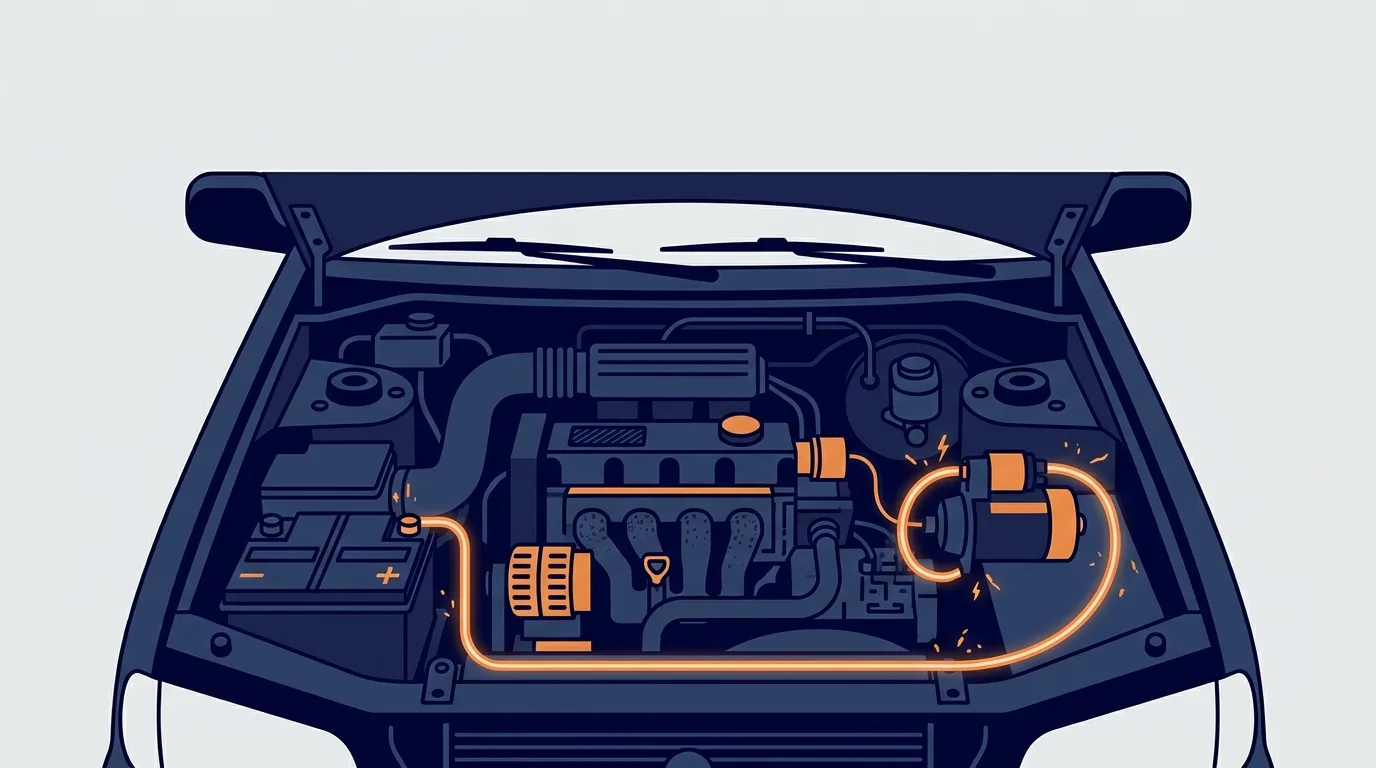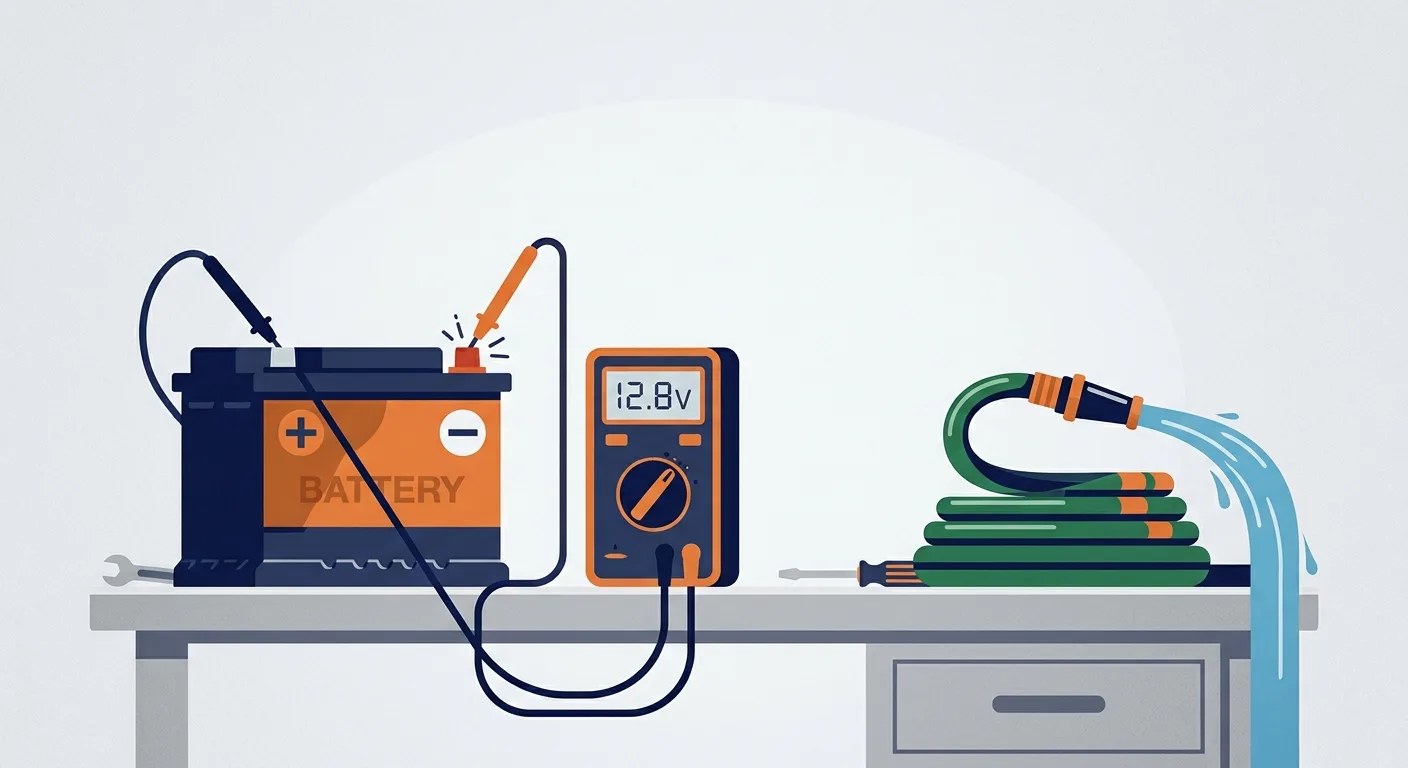
Picture a garden hose. Pressure pushes the water, flow rate tells you how much comes out per second. Voltage is the pressure, current is the flow. That gets you through the first five minutes, then it quietly lies to you: a blocked hose with the tap wide open has full pressure and zero flow, and if you only ever think in "pressure", you will never understand why a battery reads a healthy 12.6 V and still won't crank an engine.
By the end of this you will be able to look at a simple circuit and work out voltage, current, resistance and power with nothing but a calculator and Ohm's law. No magic, no hand waving.
The four quantities that explain every circuit
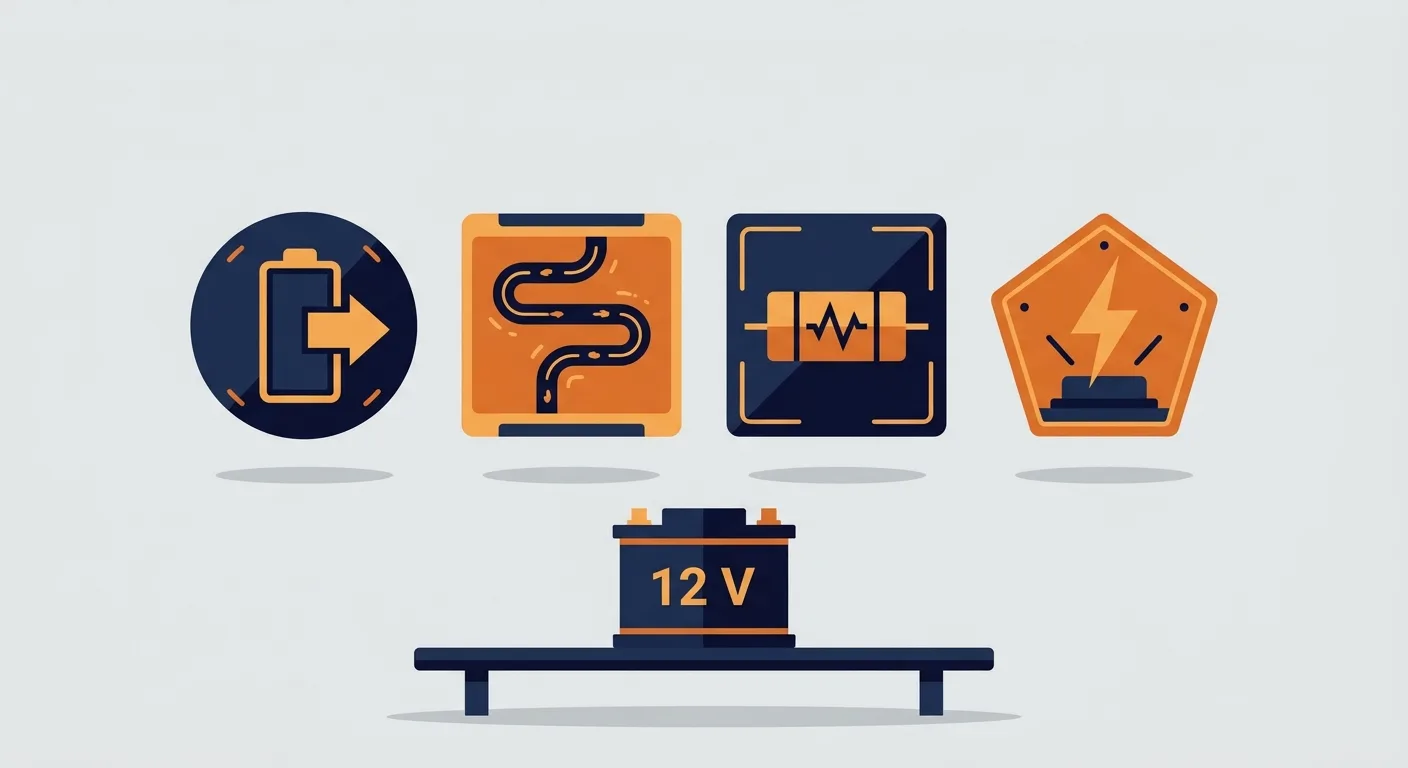
Four things cover almost everything you will ever measure on a car or a bench.
Voltage is potential difference: the push that makes charge move. Symbol V, unit volt (V). One concrete example: a healthy, fully charged 12 V lead-acid battery at rest reads roughly 12.6 V across its terminals (engine off, everything asleep). Voltage is always measured across two points, never "through" anything.
Current is the rate of charge flow. Symbol I, unit ampere (A), with milliamps (mA) for small draws. Example: a 55 W headlamp bulb on a 12 V system pulls about 4.6 A while it is lit. Current flows through a component.
Resistance is opposition to current. Symbol R, unit ohm (Ω). Example: a heated rear window element might be a few ohms. A clean, tight ground connection is well under one ohm.
Power is energy per second. Symbol P, unit watt (W). Example: the 12 V socket charger for your phone might draw 10 to 18 W. Power is what actually does work, heats things and drains your battery.
The single most useful habit here: voltage is measured in parallel (across a component), current is measured in series (in line with the flow). Get that backwards and you will blow a fuse in your meter. The electrical measurement guides walk through this in detail.
Ohm's law and power without the headache

The formulas, all of them:
- V = I × R
- I = V / R
- R = V / I
- P = V × I
- E = P × t (energy in watt-hours, Wh, when t is in hours)
Now the arithmetic. All examples below are illustrative only.
Example 1: 12 V across 3 Ω. I = V / R = 12 / 3 = 4 A. Power: P = 12 × 4 = 48 W.
Example 2: a 60 W load on 12 V. I = P / V = 60 / 12 = 5 A. Resistance it presents: R = V / I = 12 / 5 = 2.4 Ω.
Example 3: how long a battery lasts. A 60 Ah battery (rated capacity, at a specified test rate, not a promise) feeding a 5 A load: t = 60 / 5 = 12 hours in theory. In practice expect less, because capacity falls with load and temperature. Check your own numbers with the battery calculator.
A real example from my own bench, which is the one that made this click for me. I had a 12 V battery and a small 12 V bulb. The battery measured 12.4 V open circuit, no load, and the bulb lit dimly. Bulb out of circuit: about 2.4 Ω cold. In circuit, I measured 1.2 A and about 10 V across the bulb. Two things to notice. The bulb's resistance rises once the filament is hot, so the cold reading was never the whole story. And the missing volts were not lost, they were dropped across the wiring and the battery's own internal resistance under load. Same battery, same bulb, different story depending on whether current was flowing. That is the whole reason voltage and current are separate ideas.
Series and parallel: why cars use parallel
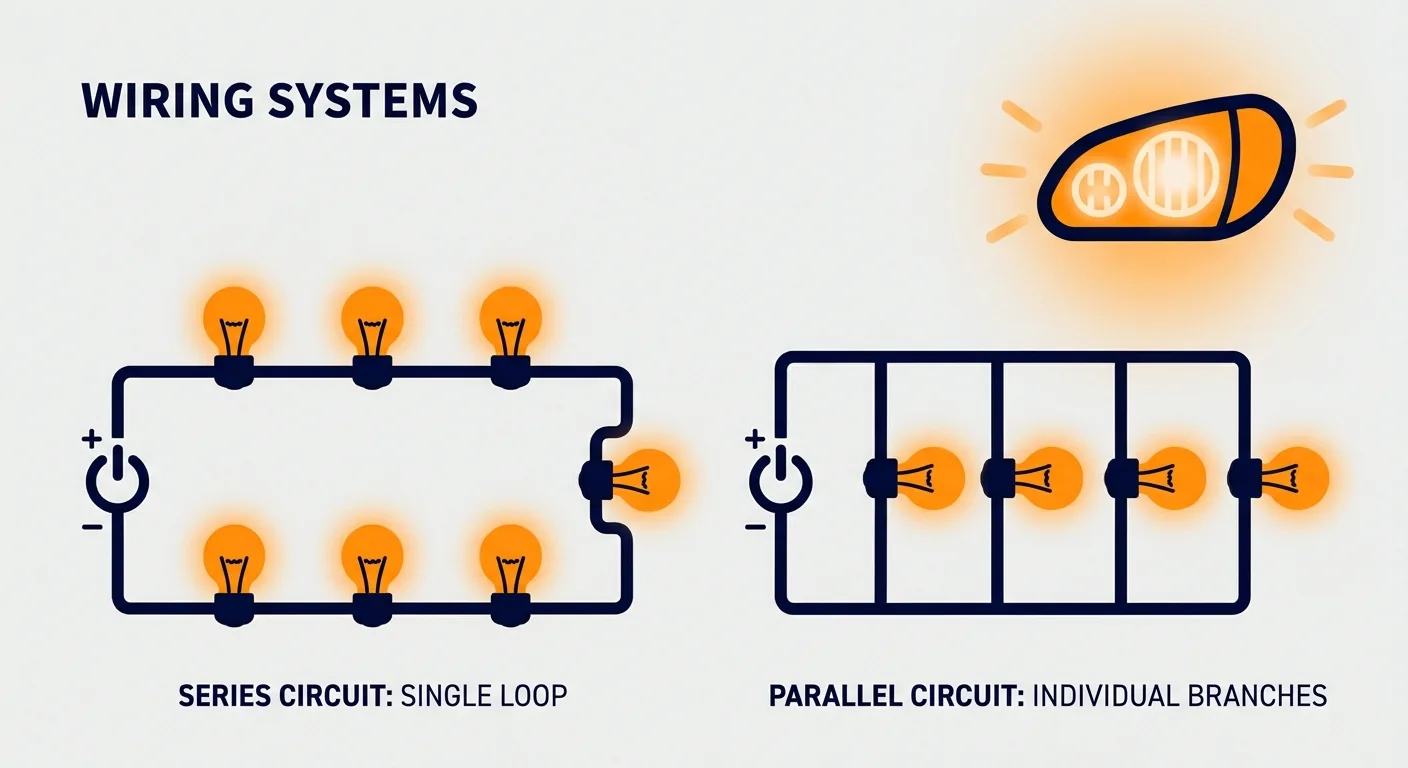
Series: one path. Current is the same through every component, voltage divides between them, resistances add: R_total = R1 + R2 + R3.
Parallel: multiple paths. Voltage is the same across every branch, current divides between them, and resistances combine as 1/R_total = 1/R1 + 1/R2 + 1/R3.
Worked example (illustrative): two 6 Ω resistors in parallel. 1/6 + 1/6 = 2/6, so R_total = 3 Ω. Feed that with 12 V and total current is 12 / 3 = 4 A, split as 2 A per branch, each branch seeing the full 12 V.
This is why vehicle and household loads are wired in parallel. Every device gets the full supply voltage, and switching one off does not kill the rest. The cost is that total current adds up fast, which is why wire gauge and fuse ratings matter and why the wire gauge and voltage drop calculator is worth bookmarking.
DC and AC, and why it matters on a car
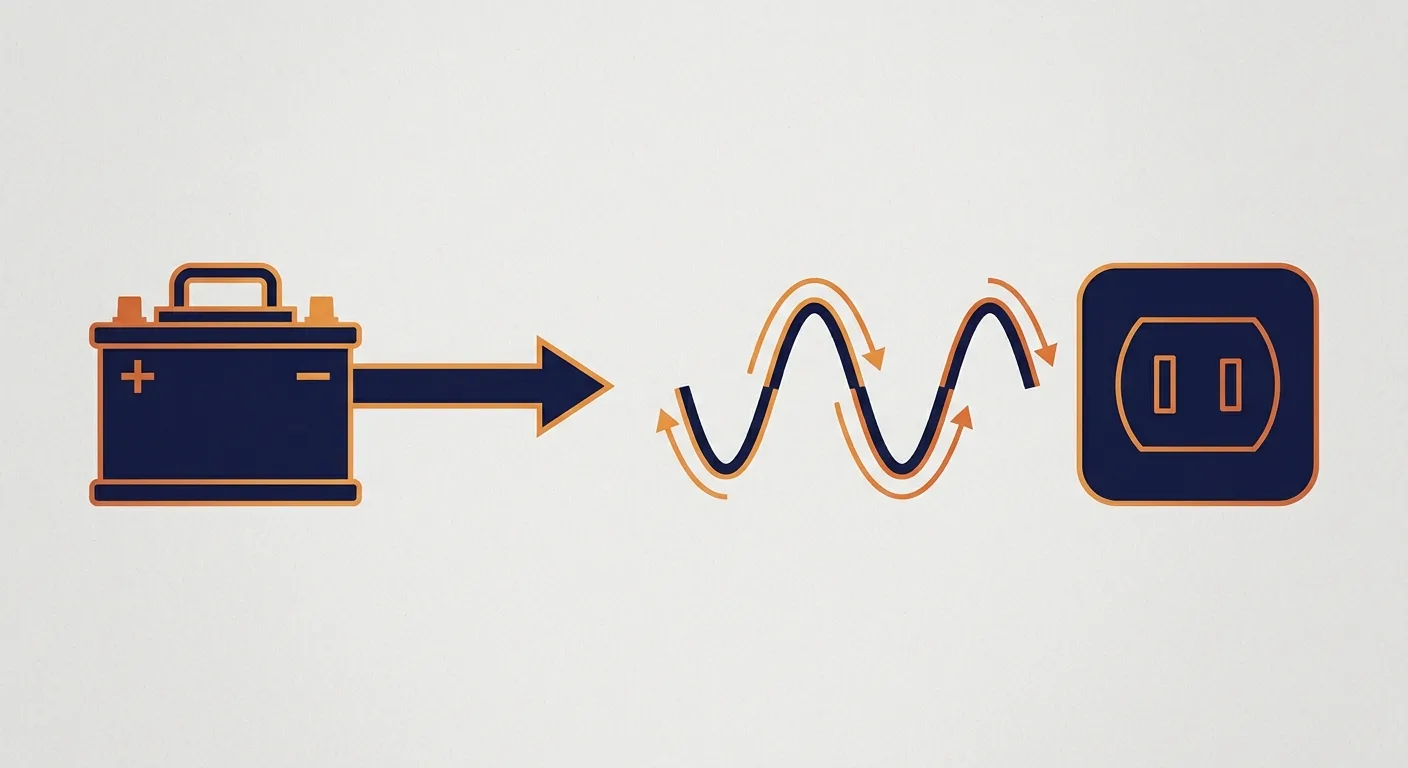
Direct current (DC) flows one way. Your 12 V system is DC. Alternating current (AC) reverses direction, and the frequency (Hz) is how many times per second it does so. Mains AC is used because it is easy to transform to high voltage for transmission, which keeps losses down.
Two safety points, no instructions. First, the 12 V system is low voltage and generally safe to probe, but a short circuit can still cause burns, fire and a battery explosion, so disconnect the battery negative before repair where appropriate and never short a live circuit. Second, a hybrid or EV also carries a high-voltage traction system, often several hundred volts DC. That is a different world. Do not probe it, do not touch it, and leave it to qualified technicians. Before any HV work, confirm the system state in the service information for that exact model.
Measuring without damaging anything

Your multimeter has modes: voltage (V, AC or DC), current (A or mA), resistance (Ω) and continuity (usually a beep). Voltage goes in parallel, probes across the component. Current goes in series, meter in line with the circuit, because you are making the current flow through the meter.
That is why current ranges need a suitable fuse, and why a meter with a blown current fuse reads 0 A on a circuit that is clearly working. Check the fuse before you trust the reading. For mains work, which is not your job unless you are a qualified electrician, category ratings (CAT II, III, IV) and one-hand practice exist for a reason. Test before touch: prove the meter on a known live source, test the circuit, then prove the meter again.
For car diagnosis, work in a logical order: visual inspection, battery state of charge, cranking voltage, charging voltage, voltage drop, current draw (with modules asleep), then continuity. Each reading rules something in or out. The electrical diagnostics guides and the charging system check cover the sequence properly.
Common misconceptions worth killing
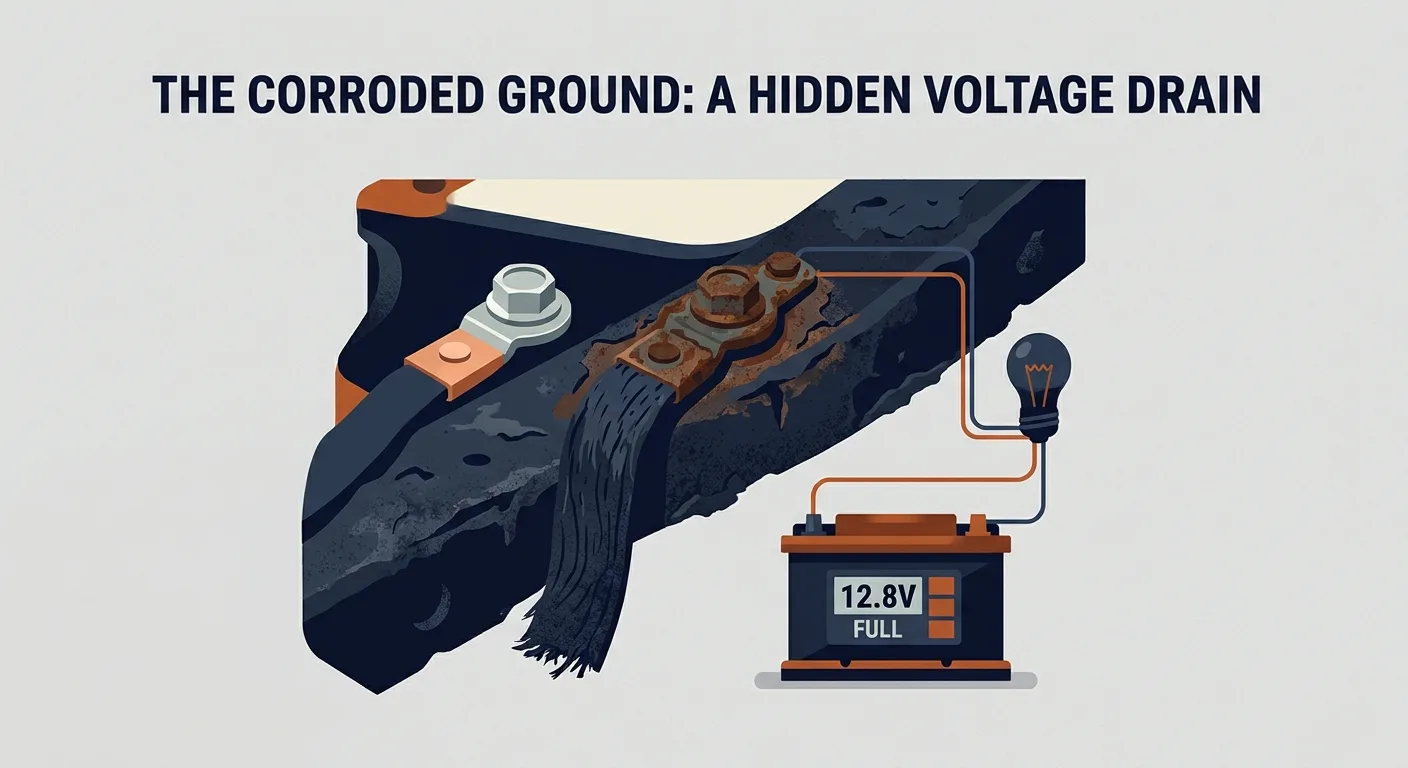
Voltage is not current. A 12.6 V battery with a bad ground can show full voltage and deliver almost nothing.
A good ground is not optional. Most "mystery" electrical faults are bad grounds or corroded connections, not failed modules.
Resistance is not always a fault. A bulb, a heater and a relay coil all have resistance by design. What matters is whether it is in the expected range for that circuit.
A bigger fuse is not a fix. If a fuse blows, find out why. Upsizing it moves the failure to the wiring, which is worse.
A charged capacitor can still bite after the power is removed. Some circuits hold charge, so treat them as live until you have verified otherwise.
If a fault sets a code, look it up before replacing parts: the OBD code lookup is free. And the electrical concepts library is a good next read.
Practice check

- 12 V across 4 Ω. What current? 3 A (I = 12 / 4).
- 12 V, 2 A load. What power and resistance? 24 W, 6 Ω.
- Two 4 Ω resistors in parallel. Total resistance? 2 Ω (1/4 + 1/4 = 1/2).
- A 50 Ah battery feeding 5 A. Rough runtime? About 10 hours, less in practice.
Illustrative figures only. Verify real values against service information.
FAQ
What kills you, voltage or current? Current through the body, but voltage is what drives it. That is why high voltage is treated with far more respect than a 12 V battery.
Why do I read 0 V but the device still works? Usually a bad probe contact or the wrong reference point, sometimes a floating ground. Re-probe at the battery terminals and at the component ground.
Can I measure current by putting the meter across a battery? No. That is a short circuit. Current is measured in series, with a fused range.
What does CCA mean on a battery? Cold cranking amps: a cranking performance figure at a specified cold temperature. It is not the same as Ah.
Do I need to disconnect the battery to test resistance? Yes, power off and the component isolated, or you will read the rest of the circuit instead.
One takeaway

Voltage pushes, current flows, and the two are only related through resistance. Learn to measure each in the right place, and half of automotive electrical diagnosis stops being mysterious.