The Fundamental Principle: Compression Ignition
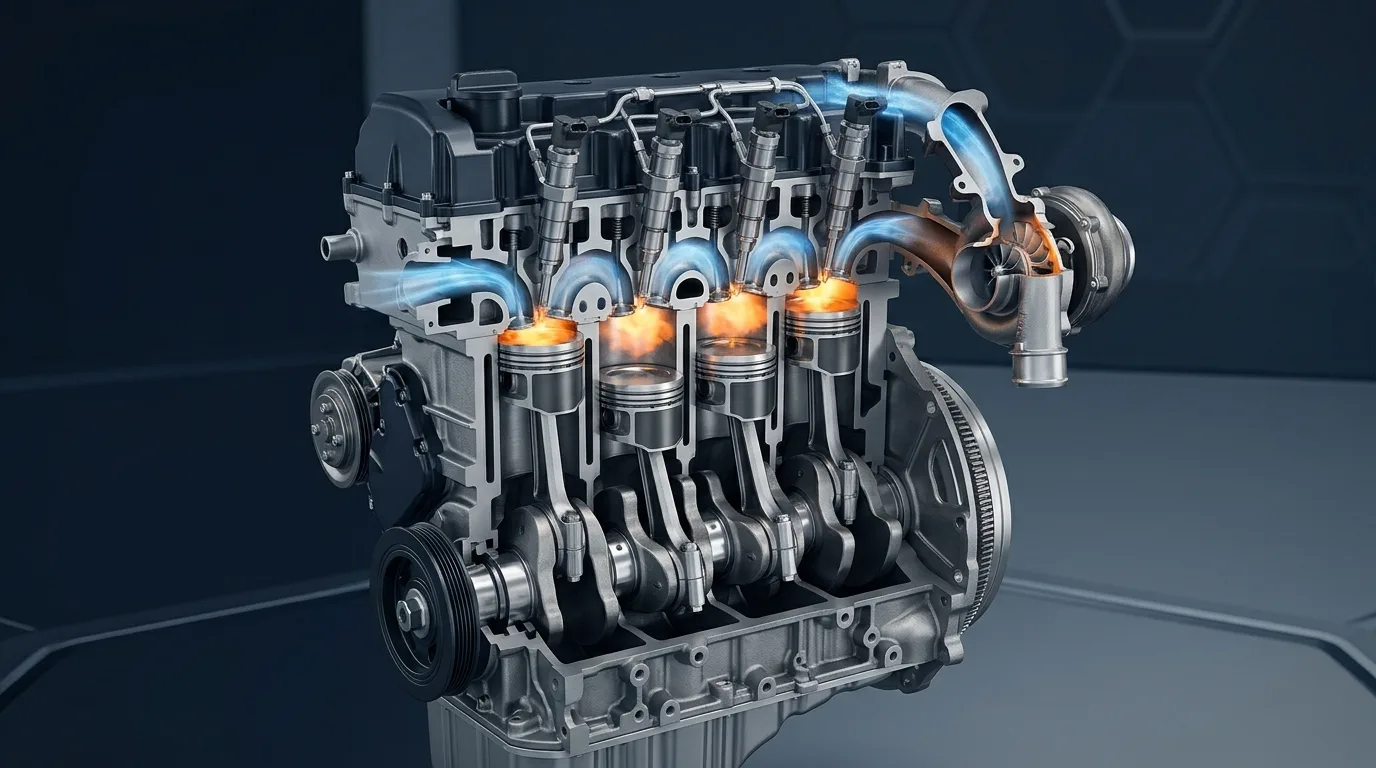
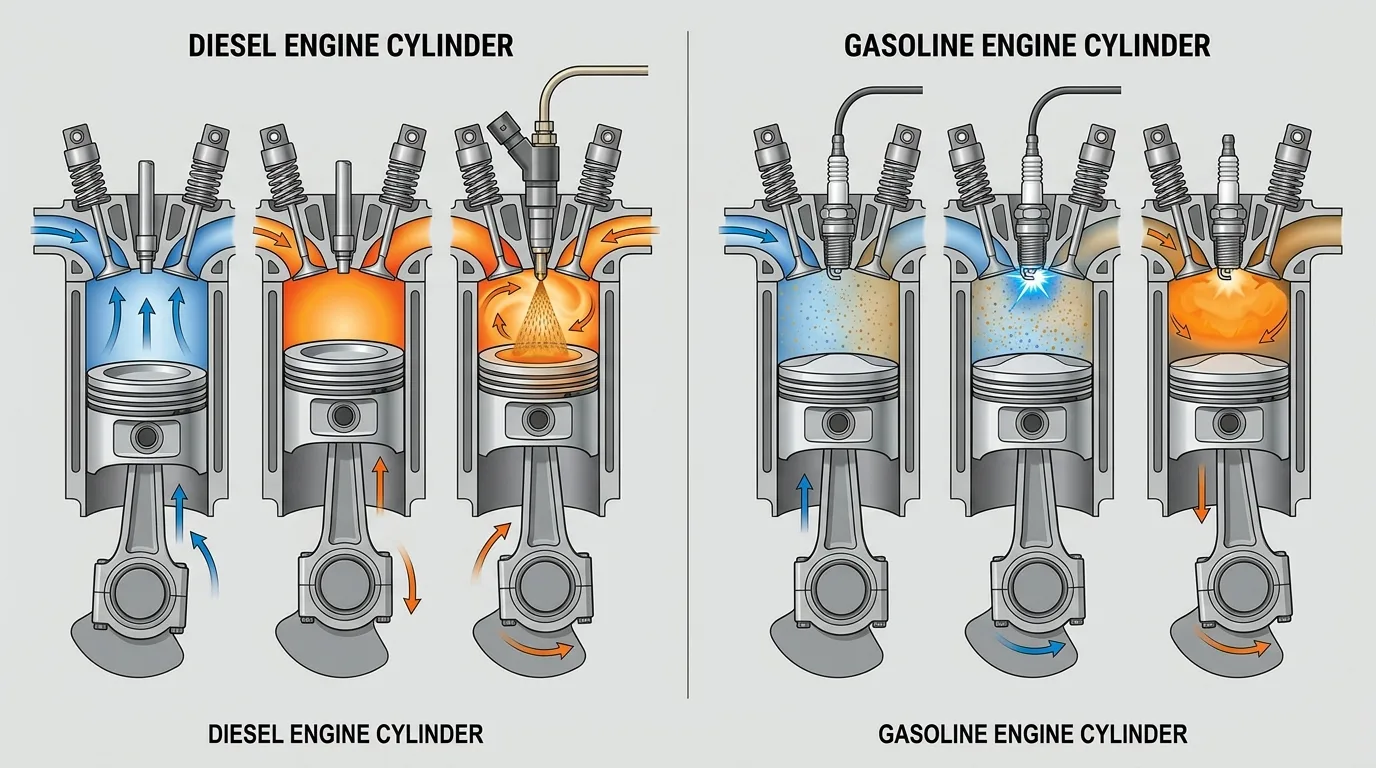
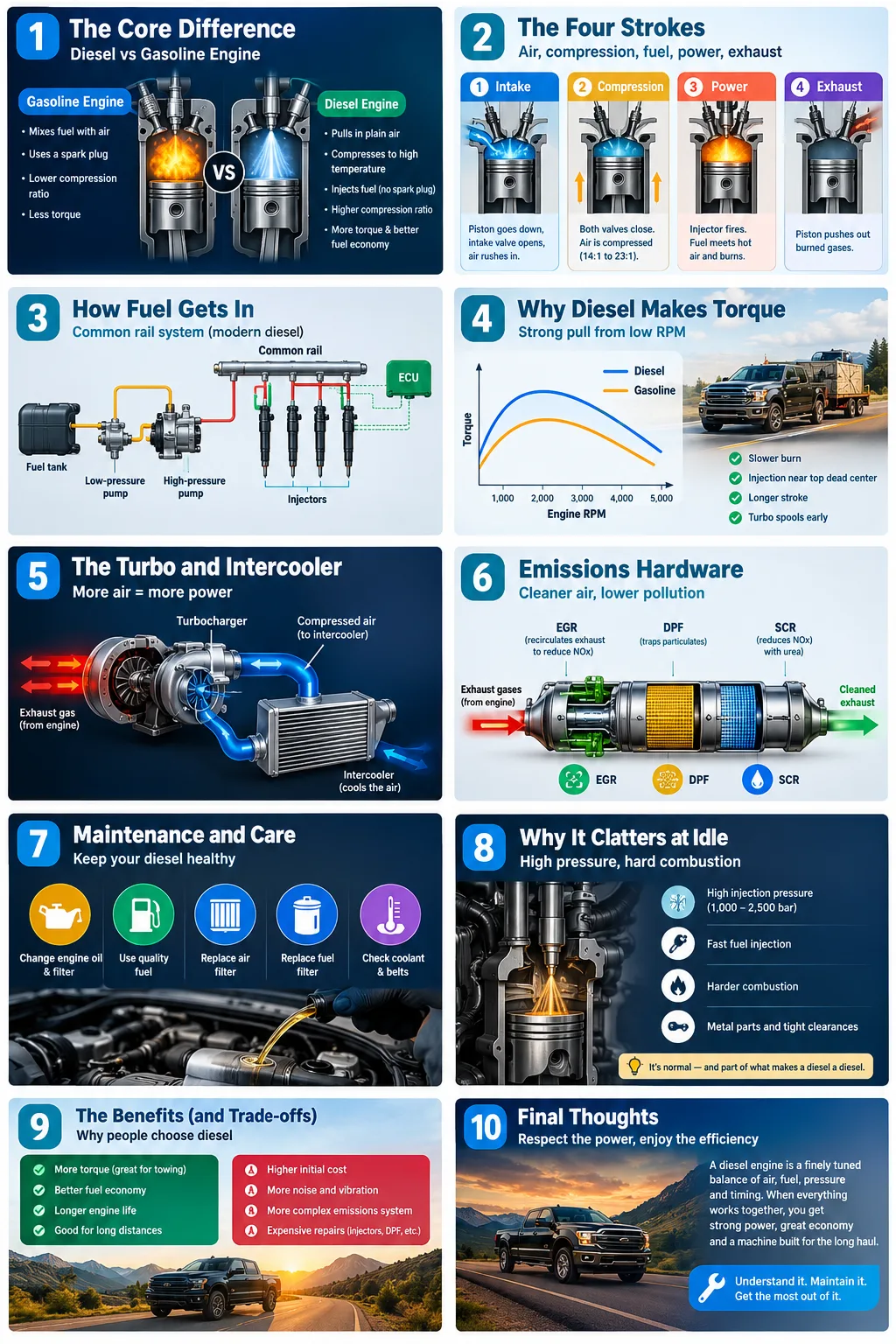
A diesel engine is an internal combustion engine that relies on compression ignition rather than spark ignition. In a gasoline engine, a spark plug ignites a pre-mixed air-fuel mixture. In a diesel engine, air is drawn into the cylinder and compressed to a high pressure and temperature. Fuel is then injected directly into the hot compressed air, where it ignites spontaneously.
This process is possible because compressing a gas raises its temperature. In a diesel engine, the compression ratio is typically between 14:1 and 25:1, significantly higher than the 8:1 to 12:1 of a typical gasoline engine. This high compression ratio is the key to the diesel cycle's efficiency.
- Compression ratio: typically 14:1 to 25:1
- Ignition: by heat of compression, not a spark plug
- Fuel: diesel (a distillate fuel oil)
- Air: unthrottled in most designs, drawn in freely
The Four-Stroke Diesel Cycle
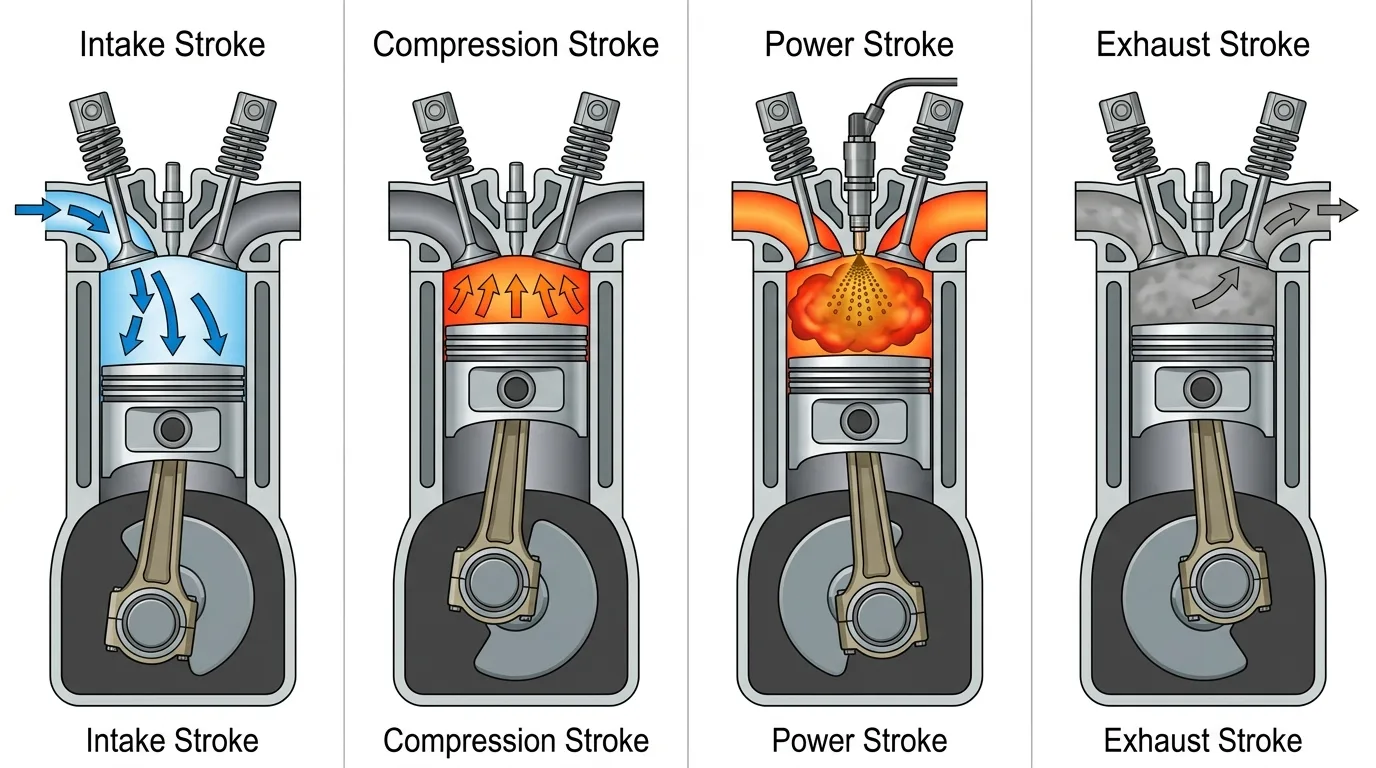
Most diesel engines operate on a four-stroke cycle, completing one power stroke every two crankshaft revolutions. The cycle consists of intake, compression, power, and exhaust strokes. Each stroke is described below.
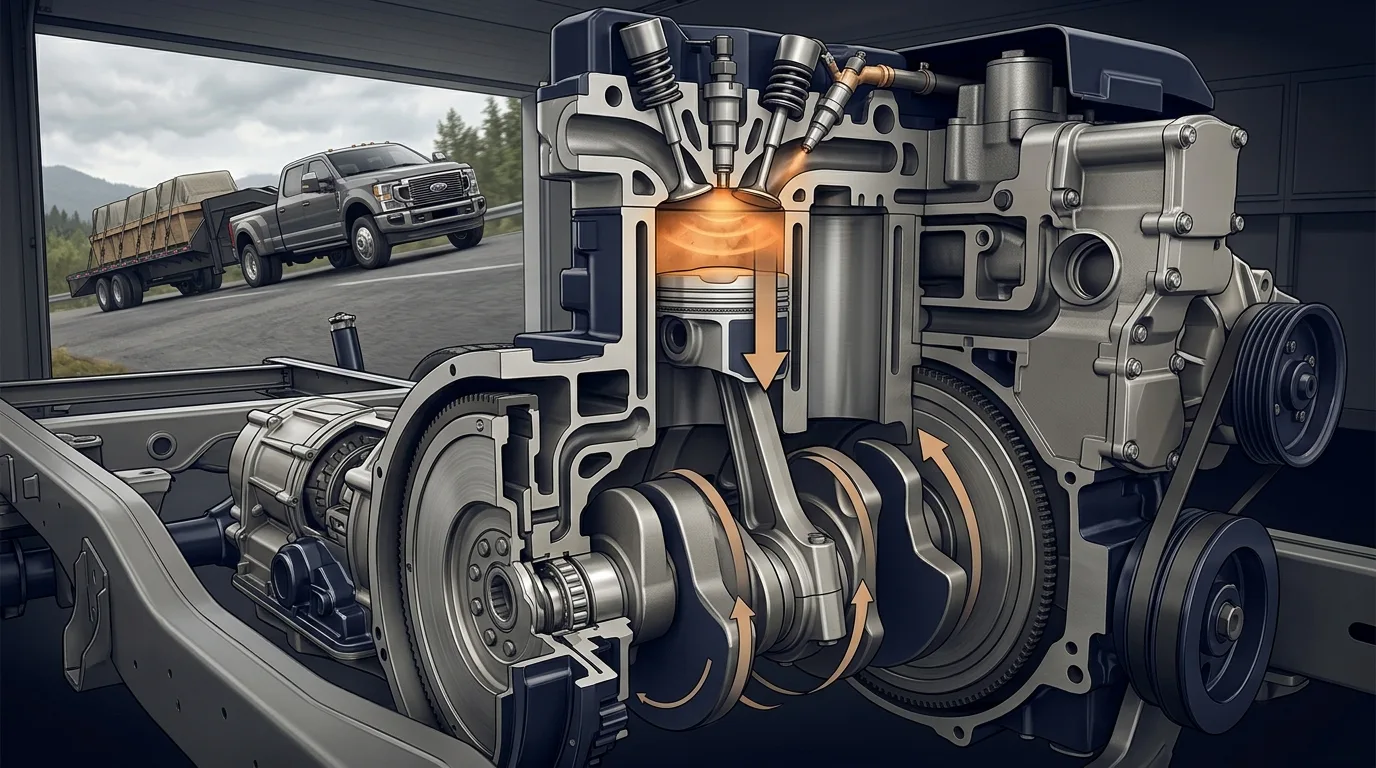
Intake stroke: The piston moves down from top dead center (TDC) to bottom dead center (BDC). The intake valve is open, and air is drawn into the cylinder. Unlike a gasoline engine, there is no throttle plate to restrict airflow in a conventional diesel, so the engine ingests a full charge of air.
Compression stroke: Both valves are closed. The piston moves up from BDC to TDC, compressing the air to a high pressure and temperature. At the end of this stroke, the air temperature can reach 700 to 900 degrees Celsius (approximately 1300 to 1650 degrees Fahrenheit), well above the autoignition temperature of diesel fuel.
Power stroke: Near TDC, the injector sprays a fine mist of diesel fuel into the hot air. The fuel vaporizes and ignites, and the expanding gases force the piston down. This is the only stroke that produces work.
Exhaust stroke: The exhaust valve opens, and the piston moves up from BDC to TDC, pushing the burned gases out of the cylinder.
- Intake: air in, piston down
- Compression: air compressed, piston up
- Power: fuel injected, ignition, piston down
- Exhaust: gases out, piston up
Key Components of a Diesel Engine
While a diesel engine shares many components with a gasoline engine, such as the crankshaft, connecting rods, and pistons, it has several unique or strengthened parts to handle higher pressures.
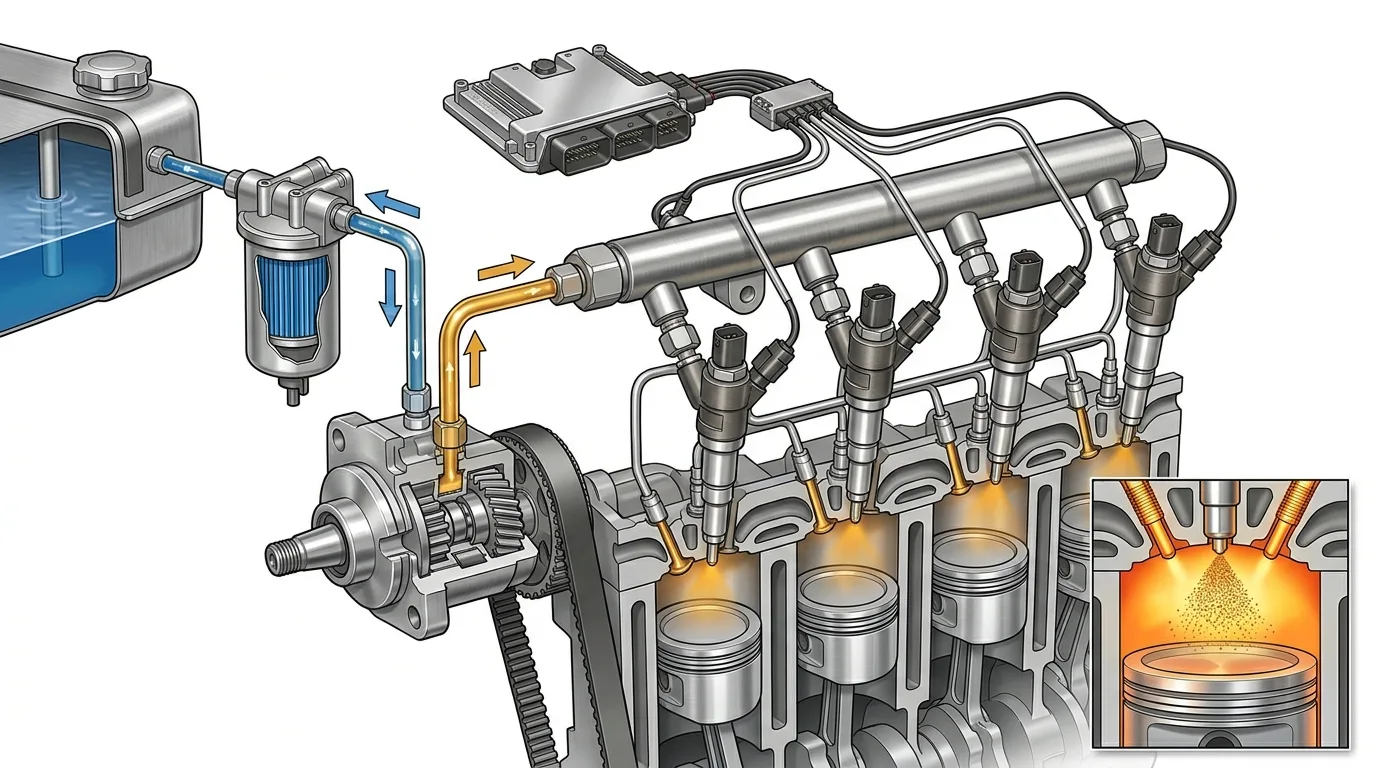
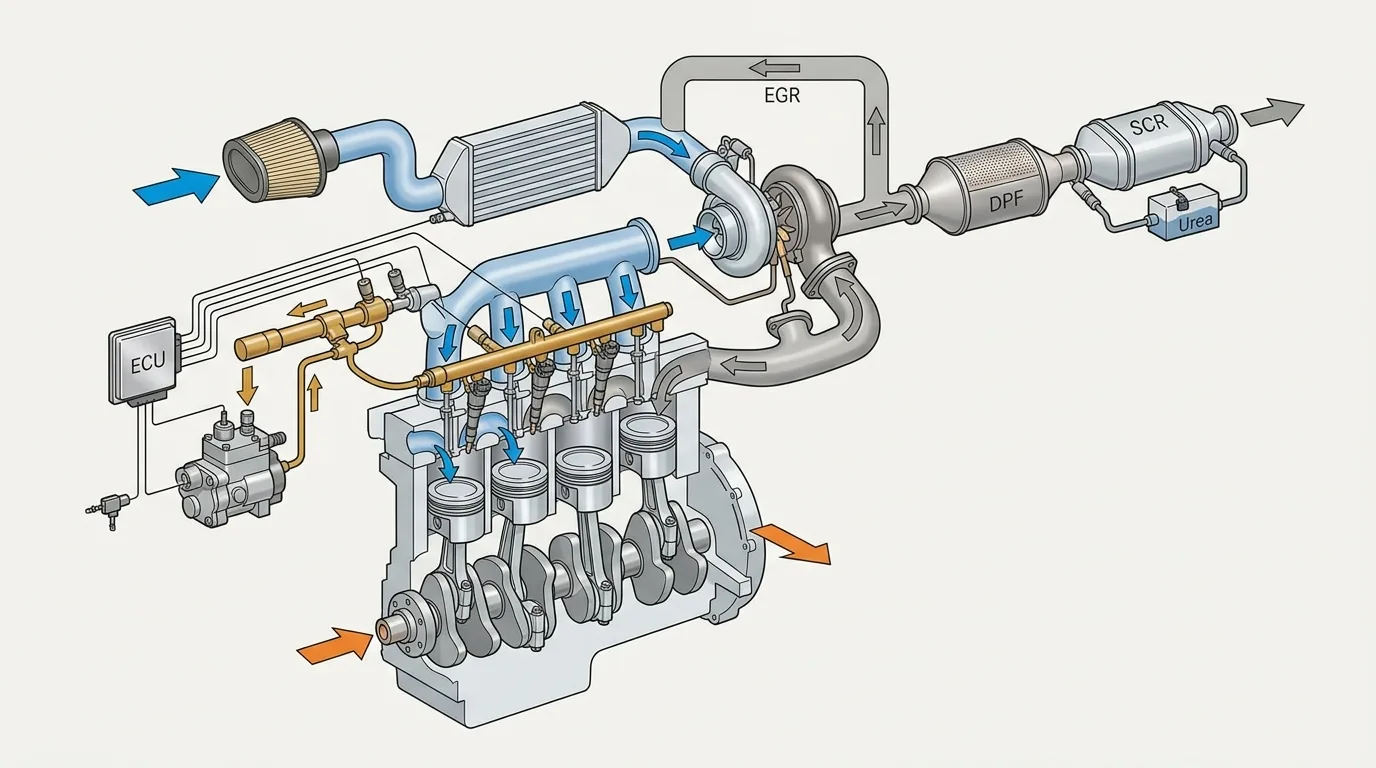
Fuel injectors: Diesel injectors are precision devices that atomize fuel at pressures ranging from around 300 bar in older systems to over 2,500 bar in modern common-rail systems. The injector must deliver fuel at the correct time and in the correct quantity.
High-pressure fuel pump: This pump pressurizes the diesel fuel and delivers it to the injectors. In common-rail systems, a single high-pressure pump supplies a rail that feeds all injectors.
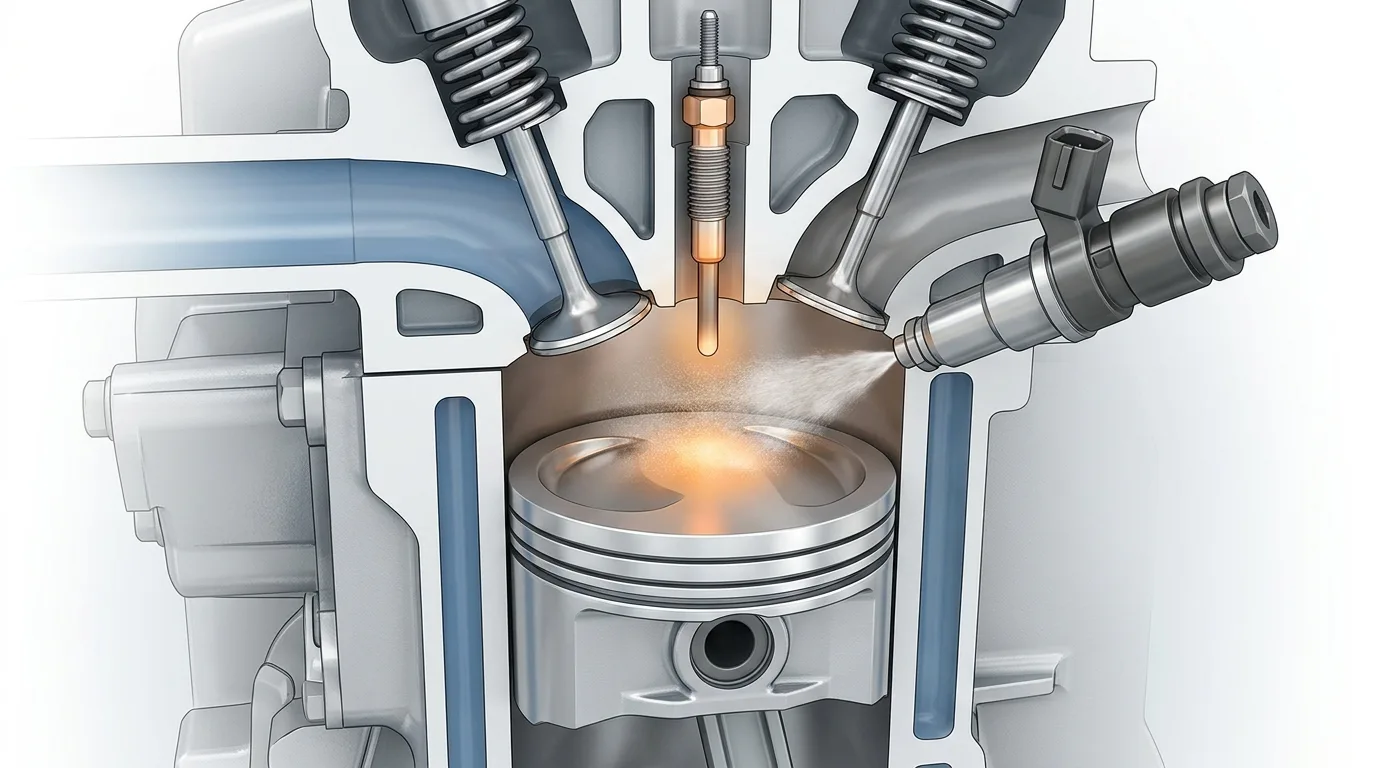
Glow plugs: Unlike spark plugs, glow plugs are used only for cold starting. They preheat the combustion chamber to help the engine start when cold. Once the engine is running, they are no longer needed.
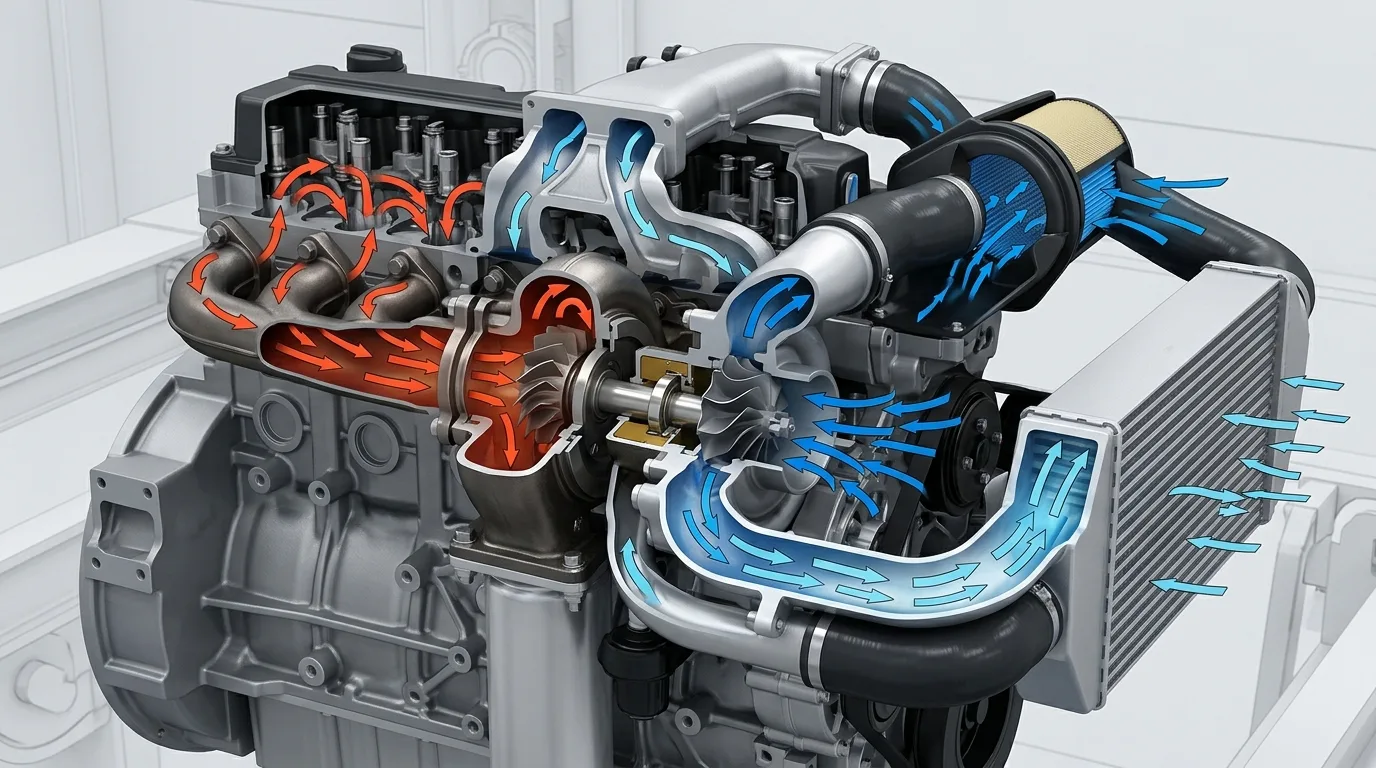
Turbocharger: Many diesel engines use a turbocharger to force more air into the cylinders, increasing power and efficiency. The turbocharger is driven by the exhaust gas stream.
- Fuel injectors (high pressure, precise timing)
- High-pressure fuel pump (common rail or unit injector)
- Glow plugs (cold start aid)
- Turbocharger (forced induction, common on modern diesels)
Fuel Injection Systems: From Mechanical to Common Rail
Early diesel engines used mechanical injection systems, such as inline pumps or distributor pumps, where a camshaft and plunger controlled fuel delivery. These systems were robust but limited in timing and pressure control.
Modern diesel engines predominantly use common-rail injection. In a common-rail system, a high-pressure pump pressurizes fuel and stores it in a rail. Solenoid or piezoelectric injectors, controlled by the engine control unit (ECU), inject fuel at precisely timed intervals. This allows multiple injections per cycle, reducing noise and emissions.
Another system is the unit injector, where each cylinder has its own injector that is actuated by the camshaft and generates pressure locally. This was common in some passenger cars and heavy-duty engines.
- Mechanical injection: inline or distributor pump
- Common rail: high-pressure rail, electronically controlled injectors
- Unit injector: camshaft-actuated, high pressure per cylinder
Diesel vs Gasoline Engines: Key Differences
Diesel and gasoline engines differ in several fundamental ways. Understanding these differences helps explain why diesel engines are preferred for heavy-duty applications.
Ignition: Diesel uses compression ignition; gasoline uses spark ignition.
Air intake: Diesel engines are unthrottled (air intake is unrestricted), while gasoline engines use a throttle plate to control airflow.
Compression ratio: Diesel engines have higher compression ratios, leading to greater thermal efficiency.
Fuel: Diesel fuel is heavier and oilier than gasoline, and it has a higher energy density by volume.
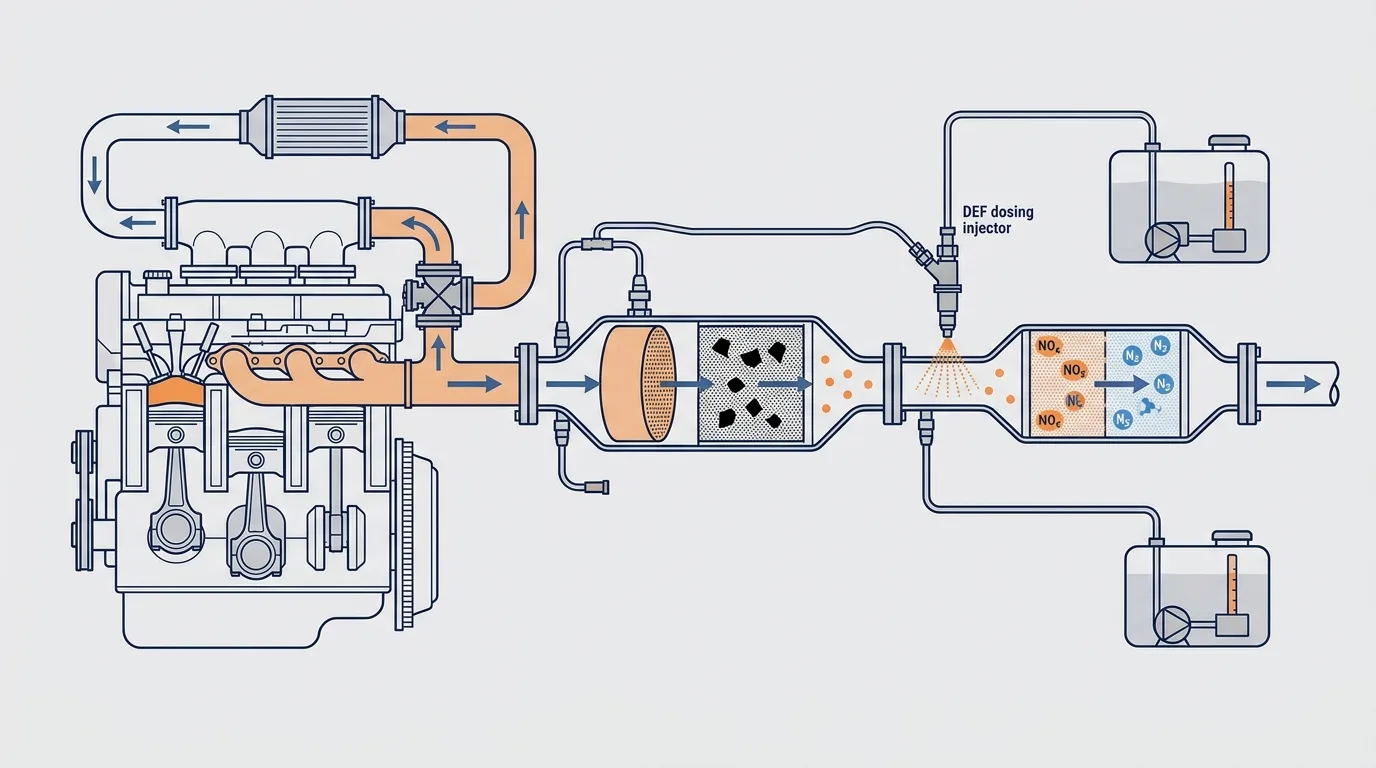
Emissions: Diesel engines tend to produce more nitrogen oxides (NOx) and particulate matter (PM), while gasoline engines produce more carbon monoxide (CO) and hydrocarbons (HC). Aftertreatment systems like selective catalytic reduction (SCR) and diesel particulate filters (DPF) are used to reduce diesel emissions.
- Ignition: compression vs spark
- Air control: unthrottled vs throttled
- Compression ratio: higher for diesel
- Emissions: NOx and PM vs CO and HC
Practical Examples of Diesel Engine Operation
To illustrate how a diesel engine works, consider these examples.
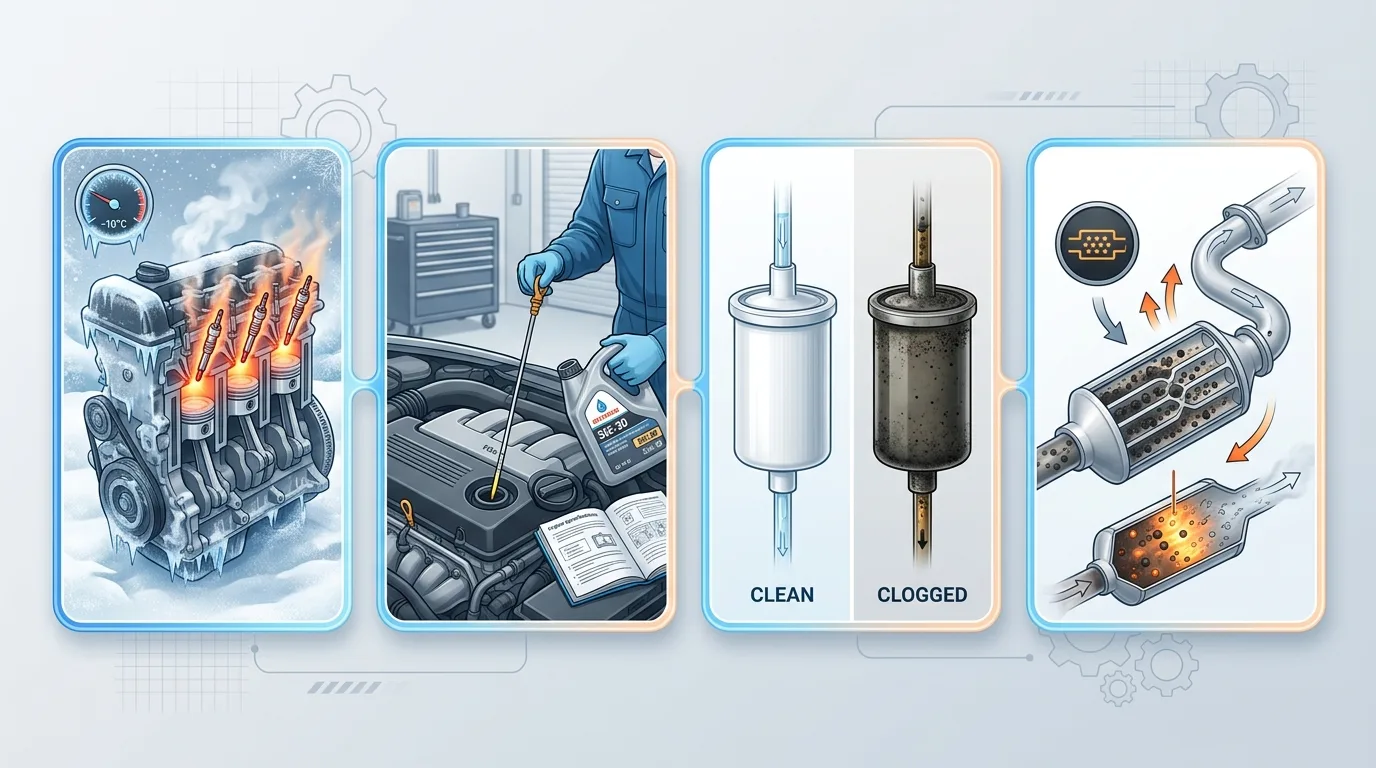
Example 1: Cold start. When you start a diesel engine on a cold morning, you may need to wait for the glow plugs to warm up. The glow plugs heat the combustion chamber, allowing the air to reach a high enough temperature for the fuel to ignite. Once the engine starts, the glow plugs turn off.
Example 2: Turbo boost. Under acceleration, the turbocharger spins faster, forcing more air into the cylinders. The ECU increases fuel injection quantity to match the increased air, producing more power. This is why diesel engines often feel strong at low RPM.
Example 3: Regeneration. The diesel particulate filter (DPF) traps soot. Periodically, the engine performs a regeneration cycle, injecting extra fuel to raise exhaust temperatures and burn off the soot. This is a normal part of modern diesel operation.
- Cold start: glow plugs preheat chamber
- Turbo boost: more air, more fuel, more power
- DPF regeneration: burns off trapped soot
Efficiency and Applications
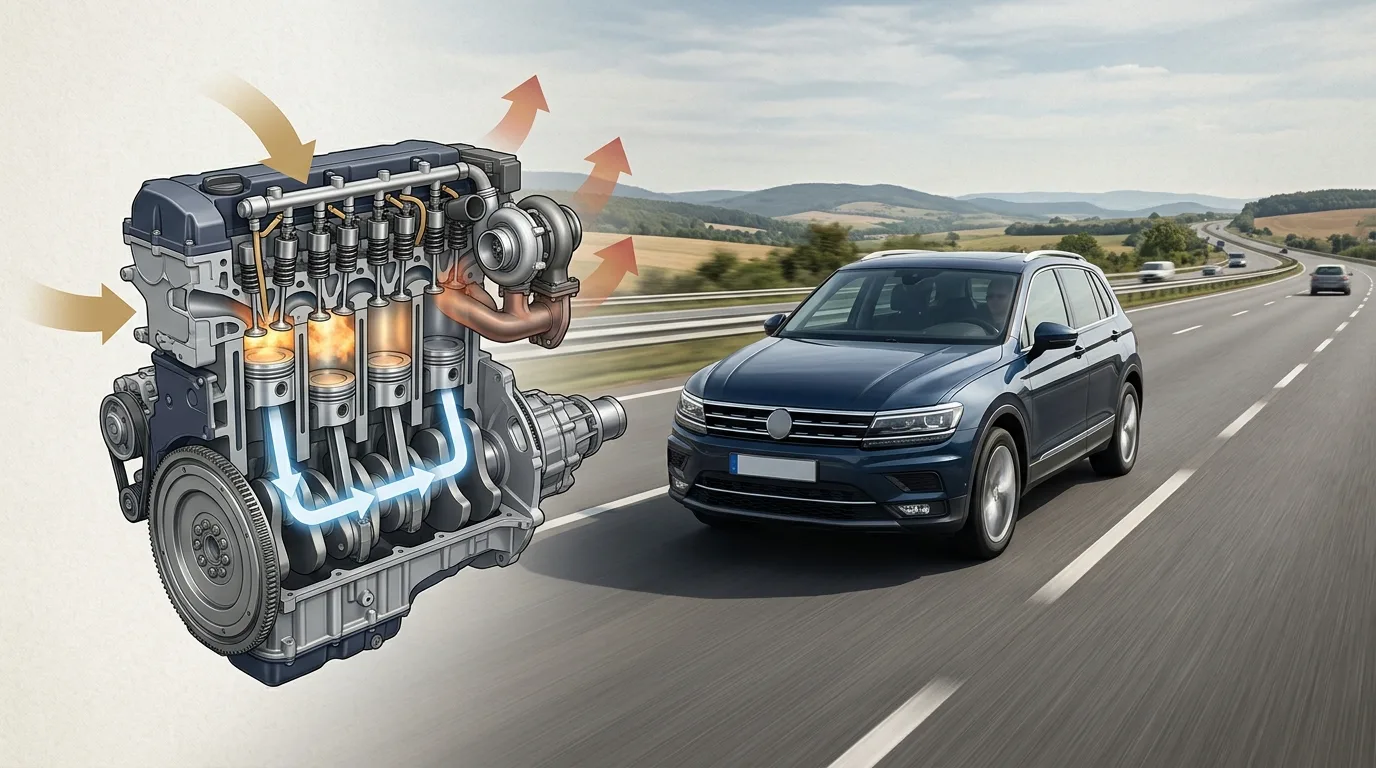
Diesel engines are more thermally efficient than gasoline engines, often achieving 30 to 40 percent efficiency in passenger cars and up to 50 percent in large marine or stationary engines. This efficiency comes from the high compression ratio and the lack of throttling losses.
Due to their efficiency and torque characteristics, diesel engines are used in a wide range of applications: passenger cars, trucks, buses, trains, ships, and generators. They are also common in agricultural and construction machinery.
- Thermal efficiency: 30-40% typical, up to 50% in large engines
- Applications: cars, trucks, ships, generators, machinery