Turbochargers explained: how boost works
How a turbo makes power from exhaust gas, what boost, wastegate and intercooler mean, and how to keep one alive.
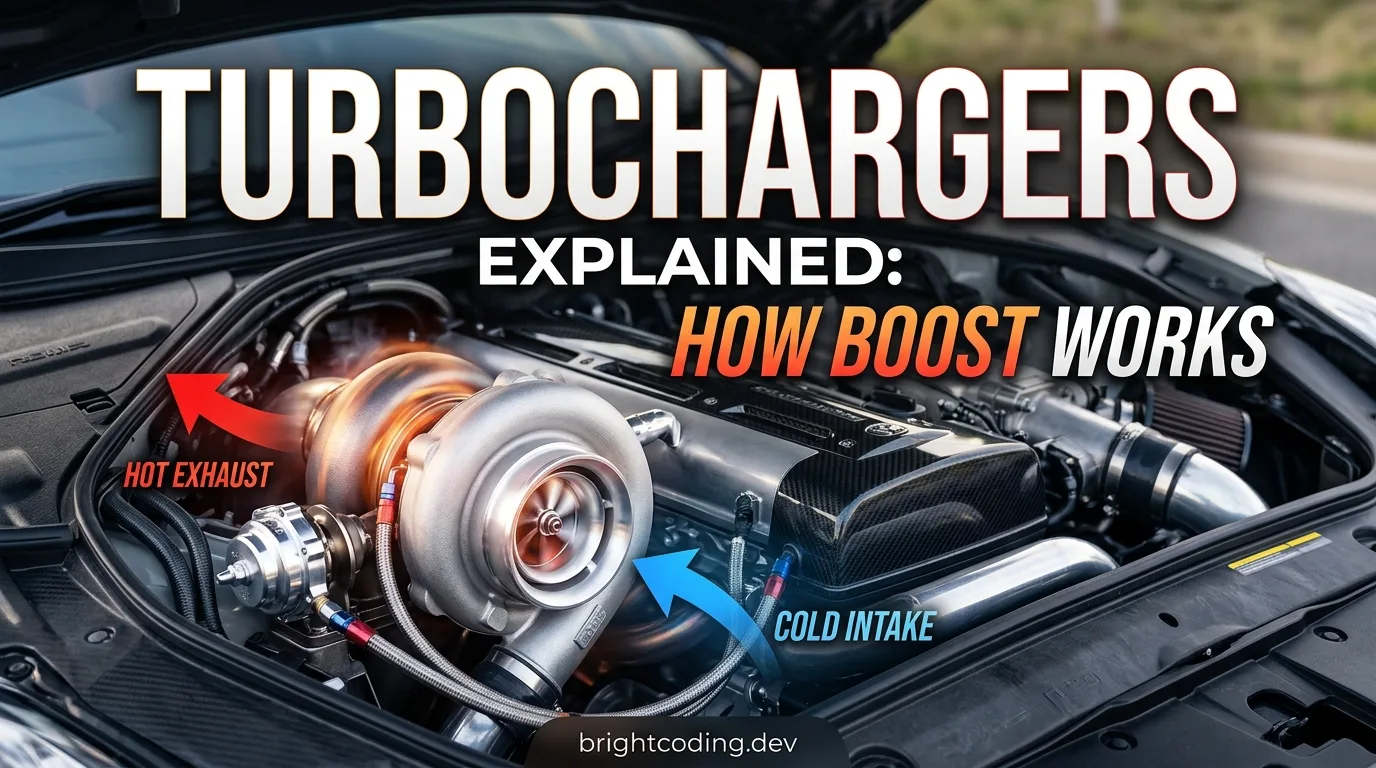
Turbochargers are one of the great free lunches of engine design — except the lunch isn't free, it's paid for in exhaust heat and plumbing complexity. By the end of this guide you'll understand exactly how a turbo turns waste exhaust gas into usable power, why turbo lag happens, what that whooshing noise actually is, and how to tell whether the turbo on your car is healthy or on its way out. Budget about 15 minutes to read this properly. If you're actually working on a turbo car, keep your owner's manual open next to you.
What you need before you start
You don't need a lift for most of this. Here's what's genuinely useful:
- Your owner's manual (boost specs, service intervals, and oil requirements vary wildly between engines)
- A basic OBD2 scanner or a phone app with a Bluetooth dongle — codes tell you a lot before you touch a wrench
- A mechanic's stethoscope or a long screwdriver (for listening to bearings)
- A flashlight and a mirror on a stick
- Nitrile gloves and safety glasses
- A notebook or phone for logging what you find
If you're planning to actually remove a turbo, add: penetrating oil, a torque wrench, new gaskets and crush washers, fresh oil and filter, and a coolant catch pan. Never reuse turbo oil feed or drain gaskets.
Safety first, always: Never work under a car supported only by a jack. Use stands on flat, solid ground. Turbo housings stay hot for a long time after shutdown — sometimes 20+ minutes. Burns from a downpipe are a rite of passage you can skip.
Step 1: Understand what a turbo actually does
A turbocharger is two fans on a shared shaft. One fan (the turbine) sits in the exhaust stream. The other (the compressor) sits in the intake stream. Hot exhaust gas spins the turbine, the turbine spins the compressor, and the compressor crams more air into the engine than it could pull in on its own.
More air means you can burn more fuel, and more fuel burned per cycle means more power from the same displacement. That's the whole trick. A 2.0L turbo engine can make the power of a much larger naturally aspirated engine while weighing less and sipping less fuel when you're cruising off boost.
Why it matters: Everything else in this guide — lag, heat, oil quality, intercoolers — flows from this one idea. If you get this, the rest is detail.
Tip: Think of the turbine as a water wheel in a stream. The stream is your exhaust. The wheel doesn't care why the stream is flowing, it just spins.
Step 2: Learn the boost control loop
The turbo doesn't just spin freely. A wastegate (internal or external) bleeds exhaust gas around the turbine when boost hits the target. On modern cars, an electronic boost control solenoid or the ECU itself manages this in milliseconds. Older cars used a simple spring-and-diaphragm actuator.
The target boost is set by the ECU based on throttle, rpm, air temp, and a dozen other inputs. When you see boost "fall off" near redline, that's usually the wastegate opening to protect the engine, not a fault.
Why it matters: Half of all "my turbo is broken" complaints are actually boost control problems, not turbo problems.
Tip: If you have a boost gauge or a live-data app, log boost vs. rpm on a safe, legal pull. A turbo that spools late but hits target is usually fine. One that never reaches target has a leak, a stuck wastegate, or a dying turbo.
Step 3: Diagnose the classic symptoms
Before you buy anything, match the symptom to the likely cause:
- No boost, no whistle, no power: often a boost leak (split charge pipe, loose clamp) or a seized turbo.
- Whistle that's suddenly much louder: usually a boost leak — the turbo is working harder to make up for lost pressure.
- Blue smoke from the exhaust: oil is getting past the turbo seals or the engine's valve guides. Not always the turbo.
- Whine that rises and falls with rpm, even at idle: bearing noise. Bad sign.
- Shaft play when you wiggle the compressor wheel: if it touches the housing, stop driving it.
Pull codes first. A P0299 (underboost) or P0234 (overboost) points you at the boost system, not necessarily the turbo itself. Run the code through a free OBD code lookup before you start ordering parts — the description often tells you exactly which circuit or sensor to check. If you want to shortcut the diagnosis, the car symptom finder is a good second opinion.
Step 4: Check the oil feed and return
Turbo bearings live on a thin film of engine oil. That oil also carries heat away from the bearing housing, which is why turbos are so sensitive to oil quality and oil level.
Check your oil level cold, on level ground. Then check the feed line for weeping or cracks — a small leak here becomes a big problem at 100,000 rpm. The return line (usually a fat pipe going down to the sump) must be clear and not kinked. A partially blocked return pressurizes the housing and pushes oil past the seals.
Cost note (approximate): A replacement feed line kit typically runs $40–$120 depending on the car. Gaskets and crush washers are usually under $20. Verify fitment against your specific engine before ordering.
Tip: If your car has a turbo timer in the manual (many older turbo cars recommend idling 30–60 seconds before shutdown), follow it. It lets the oil carry heat away before flow stops.
Step 5: Inspect the intercooler and charge pipes
The intercooler cools the compressed air before it enters the engine. Cooler air is denser, which means more oxygen per cylinder, which means more power and less risk of detonation.
Look for oil residue at the intercooler inlet and outlet — a light film is normal on a healthy engine, but a puddle means something upstream is leaking. Check every clamp and coupler on the charge pipe. A clamp that's merely loose can feel like a blown turbo.
Tip: Spray soapy water on suspect joints and have a helper blip the throttle. Bubbles show you the leak instantly. Don't do this on a hot engine.
Step 6: Understand lag, spool, and why it feels different
Turbo lag is the gap between pressing the throttle and feeling boost. It exists because exhaust gas has to build up enough energy to spin the turbine, and the compressor has to move enough air to pressurize the intake tract.
Small turbos spool fast but run out of breath up top. Big turbos are the opposite. Twin-scroll housings, variable geometry (VGT), and electric-assist turbos all exist to shrink that gap. Twin-scroll is common on modern four-cylinders; VGT is common on diesels.
Why it matters: If you think your car feels "laggy," it may just be how it was tuned. That's not a fault. If it feels more laggy than it did six months ago, that's worth investigating.
Step 7: Look after the things that kill turbos
Turbos rarely die of old age. They die of:
- Dirty oil — change it on schedule, use the viscosity your manual specifies, and don't stretch intervals.
- Oil starvation — low level, blocked feed, or a failing oil pump.
- Heat soak — long hard runs followed by immediate shutdown.
- Foreign object damage — a failed air filter letting grit into the compressor.
- Overboost — a stuck wastegate or bad tune pushing the turbo past its design limit.
Tip: If you drive hard, give the engine a gentle cooldown minute before shutting it off. It's the cheapest insurance a turbo owner can buy.
Step 8: Know when to hand it over
If you've confirmed shaft play, found metal in the intake, or heard bearing noise that follows rpm, stop driving. A grenaded turbo can send debris into the engine and turn a $1,200 job into a $6,000 one.
Rebuilding a turbo is possible and can save money, but it requires balancing equipment most DIYers don't have. A reputable specialist can rebuild or replace the cartridge and balance it correctly. Replacing a turbo with a quality remanufactured unit is usually the safer bet for a daily driver.
If you're not sure what you're looking at, the mechanical encyclopedia has diagrams of the internal parts worth a look before you commit to a plan. And if you'd rather follow a specific job from start to finish, the step-by-step car guides are laid out for exactly that.
Pro tips
- Log before you guess. A $30 Bluetooth dongle and a free app will tell you more in five minutes than an hour of staring at the engine bay.
- Change your oil on the short side of the interval. Turbo bearings are oil-hungry; clean oil is cheap, bearings are not.
- Check the air filter housing for cracks. A cracked box lets unmetered air in and confuses the ECU.
- Keep the intake tract clean. A tiny bit of grit at 100,000 rpm is like a shotgun blast to the compressor wheel.
- Never use an impact gun on turbo oil feed lines. You'll crack the fitting and turn a small job into a weekend one.
- Save your receipts. If you ever sell, a documented turbo service history is worth real money.
Common pitfalls
- Assuming any whistle means a bad turbo. Nine times out of ten it's a boost leak. Check clamps and couplers first.
- Reusing gaskets and crush washers. They're a few dollars. A leak at 30 psi of oil pressure is not worth the savings.
- Driving with a known boost leak. The turbo overworks, oil gets hot, and bearings die faster. Fix it now.
- Skipping the oil change after a turbo replacement. Debris from the failed unit is still in the system. Flush it.
- Buying the cheapest reman turbo on the internet. Rebuild quality varies enormously. Ask who balanced it and how.
Useful resources
- Your owner's manual — the single best source for your specific engine's oil spec and service intervals
- A reputable OBD2 scanner app with live data — the free car tools page has a rundown of what to look for
- The expert car tips section for maintenance habits that keep turbos alive
- A local independent shop that specializes in your brand — worth finding before you need one
FAQ
How long does a turbo usually last? With clean oil and sensible driving, many turbos last well past 150,000 miles. With neglect, some don't see 60,000. The variable is maintenance, not the turbo itself.
Can I drive with a blown turbo? No. If the compressor or turbine wheel has contacted the housing, debris can enter the engine. Park it and get it towed.
Do I need premium fuel with a turbo? Many modern turbo engines specify premium for full performance and to avoid knock under boost. Check your manual — some are designed for regular, but most turbocharged engines prefer higher octane.
Why does my turbo whistle more than it used to? Usually a boost leak, sometimes a failing bearing. Check the charge pipes first, then listen carefully. A whistle that rises and falls with rpm even at idle is a bad sign.
Is a turbo timer necessary? Most modern cars don't need one. The advice to idle before shutdown still helps, especially after hard driving, but you don't need to buy a gadget for it.
Final word
Turbos are simpler than they look once you separate the turbo itself from the boost system around it. Learn the oil path, respect the heat, and diagnose before you replace. Do that, and your turbo will outlive plenty of other parts on the car.
Questions about this article
Related articles

10 Gasoline Engine Maintenance Tips to Make Your Car Last Longer
Your engine doesn't die suddenly. It dies by a thousand small neglects, most of them cheap to fix and easy to postpone. This is the short list of habits that quietly add years to a gasoline engine, and the mistakes that quietly take them away.
Read the article →
Petrol vs Diesel: Which Engine Is Cheaper to Maintain?
You are standing in a dealer lot or scrolling through listings, and the same question keeps surfacing: petrol or diesel? The sticker price is only half the story. What you actually pay over five or seven years depends on servicing, parts, fuel, and how the car is driven. That is where the petrol vs…
Read the article →
Petrol vs Diesel Engine: Which One Is Really Better in 2026?
Buying a car in 2026 means you cannot dodge the petrol versus diesel question, especially if you are shopping used or looking at a nearly-new car that still has a combustion engine under the hood. Read this and you will know how to match the engine to your actual driving, work out what the fuel and…
Read the article →
12 Common Gasoline Engine Problems and How to Diagnose Them
Your check engine light comes on. The engine starts shaking at a red light. You hear a noise that wasn't there last week. Most people do one of two things: panic and hand the car to a shop with a blank check, or ignore it until the problem gets expensive.
Read the article →
Carburetor vs. Fuel Injection: Which System Is Better?
You already know the short answer: fuel injection wins on paper. It has won in showrooms for decades, and there is no serious argument left about which system meters fuel more precisely. So why does the question still come up in the bay every week?
Read the article →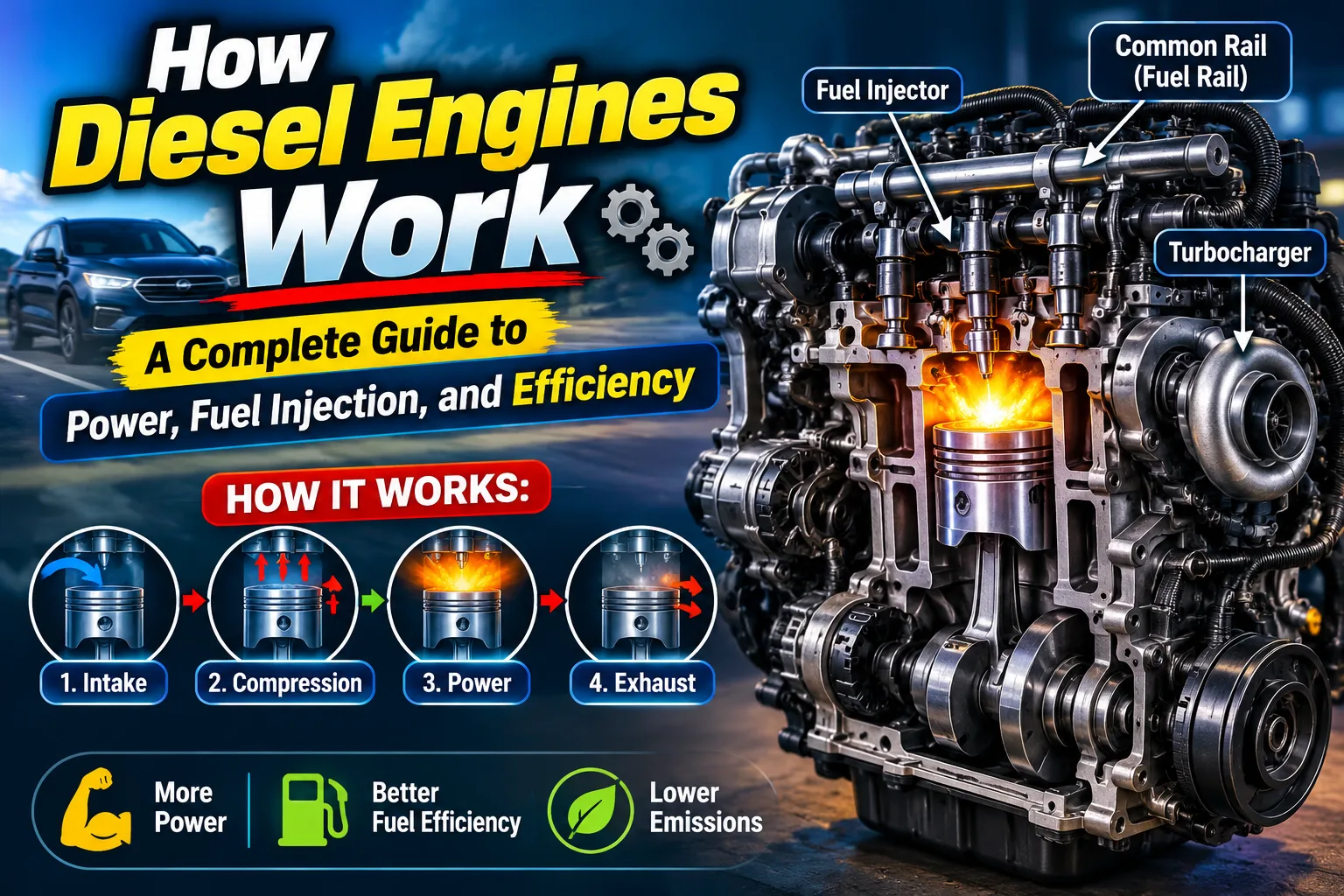
How Diesel Engines Work: A Complete Guide to Power, Fuel Injection, and Efficiency
By the end of this guide you will understand what actually happens inside a diesel engine, why it clatters at idle, why it makes so much torque, and why it sips fuel compared to a gasoline engine of similar size. You will also be able to follow a mechanic's explanation of injection timing and compr…
Read the article →