How Diesel Engines Work: A Complete Guide to Power, Fuel Injection, and Efficiency
By the end of this guide you will understand what actually happens inside a diesel engine, why it clatters at idle, why it makes so much torque, and why it sips fuel compared to a gasoline engine of similar size. You will also be able to follow a mechanic's explanation of injection timing and compr…
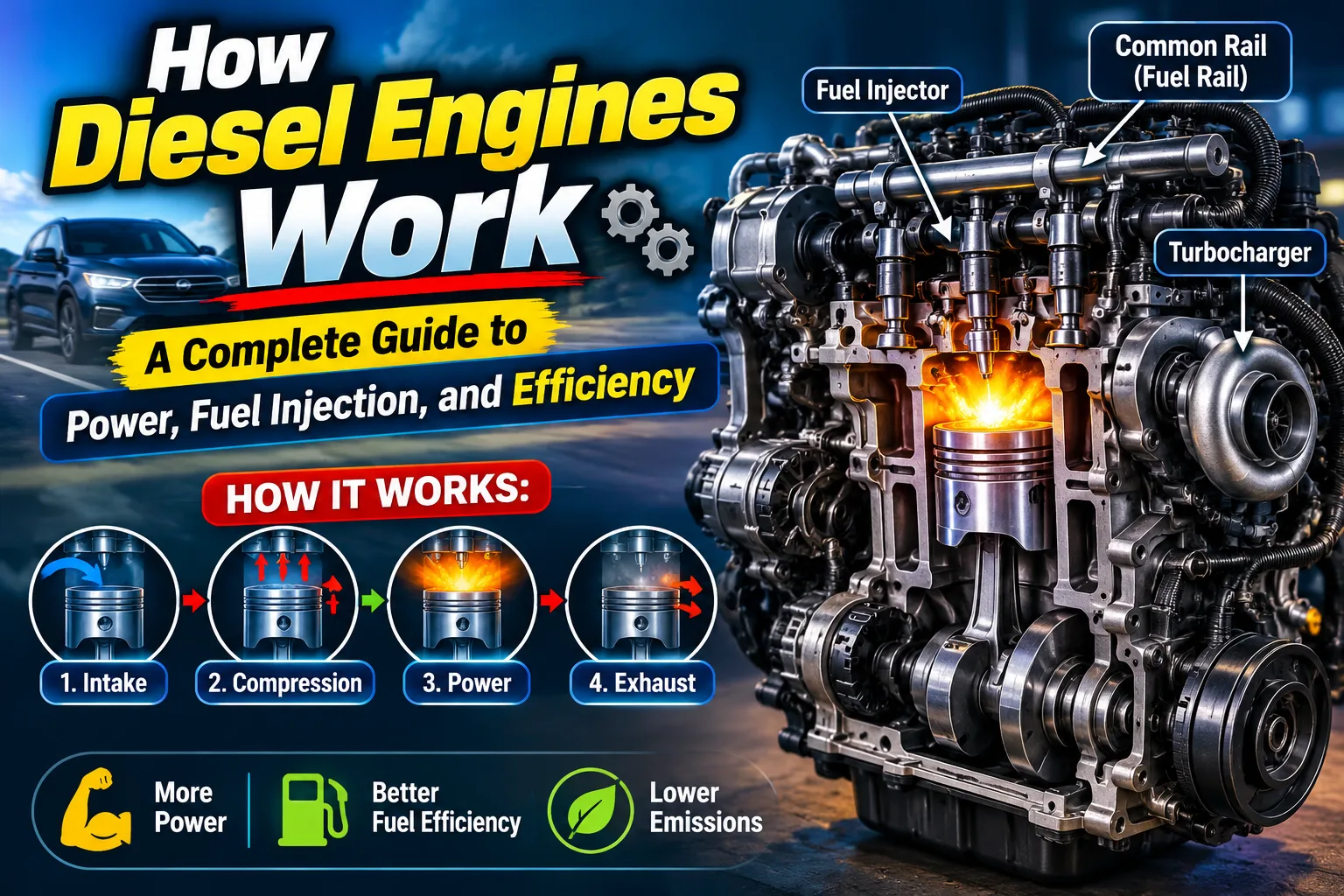
By the end of this guide you will understand what actually happens inside a diesel engine, why it clatters at idle, why it makes so much torque, and why it sips fuel compared to a gasoline engine of similar size. You will also be able to follow a mechanic's explanation of injection timing and compression without nodding politely and hoping nobody asks you a question.
It takes about 15 minutes to read properly. If you have a diesel in the driveway and a Haynes manual on the shelf, keep both nearby.
What you need before you start
You do not need to pull an engine apart to learn this. But a few things help:
- Your owner's manual, for fuel type, oil spec, and service intervals
- A basic understanding of the four-stroke cycle (intake, compression, power, exhaust)
- A notebook, because diesel has a lot of moving parts and you will want to sketch the fuel path
- Optional: a cheap OBD2 scanner, if your diesel is 1996 or newer and you want to see live data
- Safety glasses if you plan to open anything under the hood
Safety first: diesel fuel is an irritant and a slipping hazard. Diesel exhaust contains particulates and nitrogen oxides. Never work on a fuel system with the engine hot or running, and never crack open a high-pressure injector line with your bare hands nearby. Common rail systems can hold thousands of psi even after shutdown, and a pinhole leak can inject fuel straight through skin. That is a medical emergency, not a bad day.
Step 1: Understand the core difference from a gasoline engine
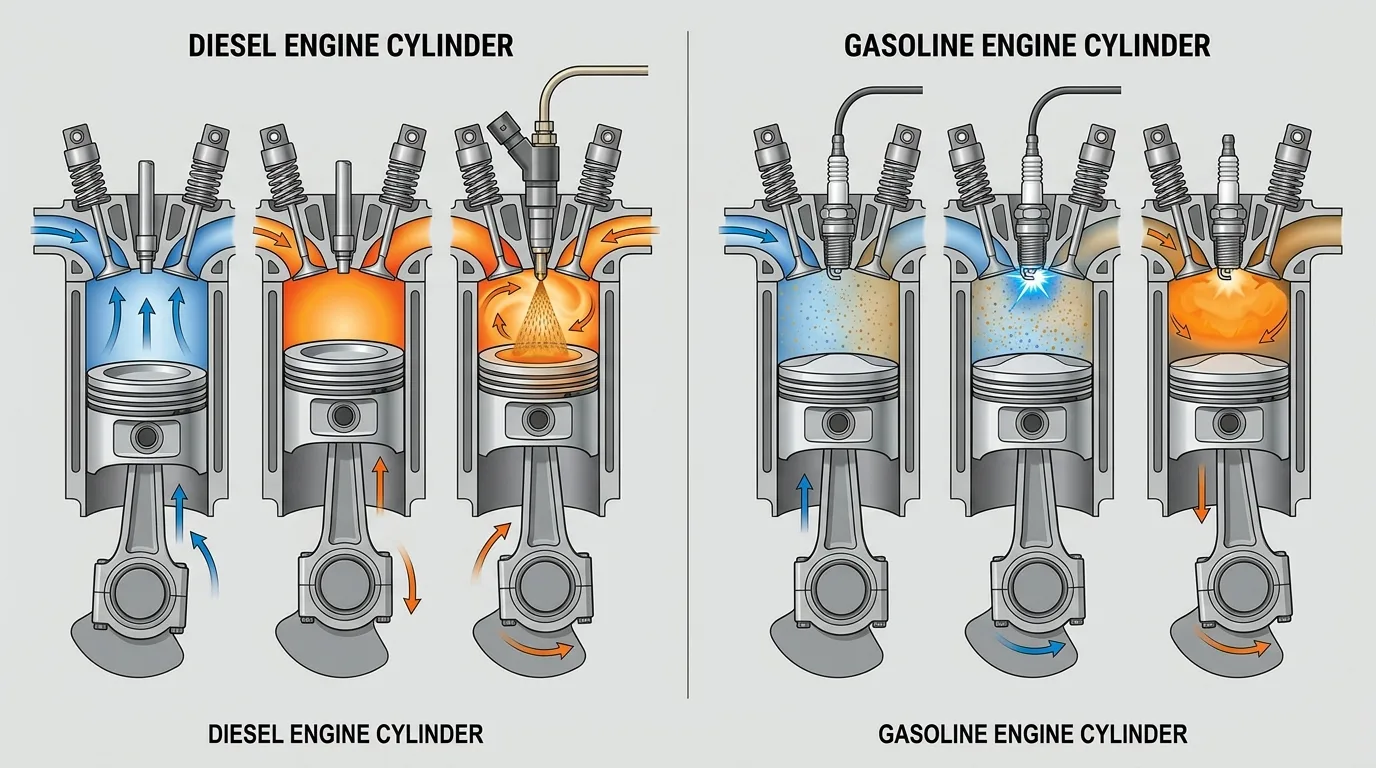
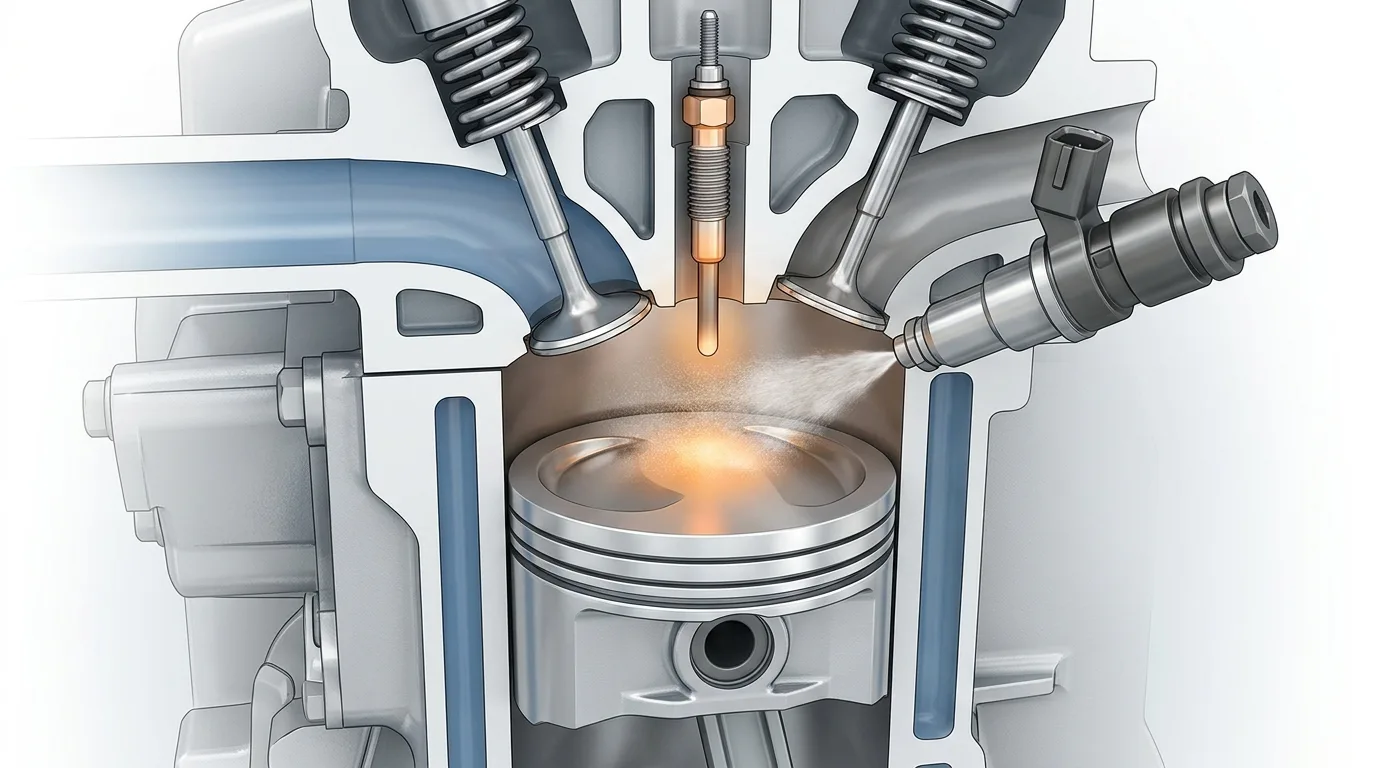
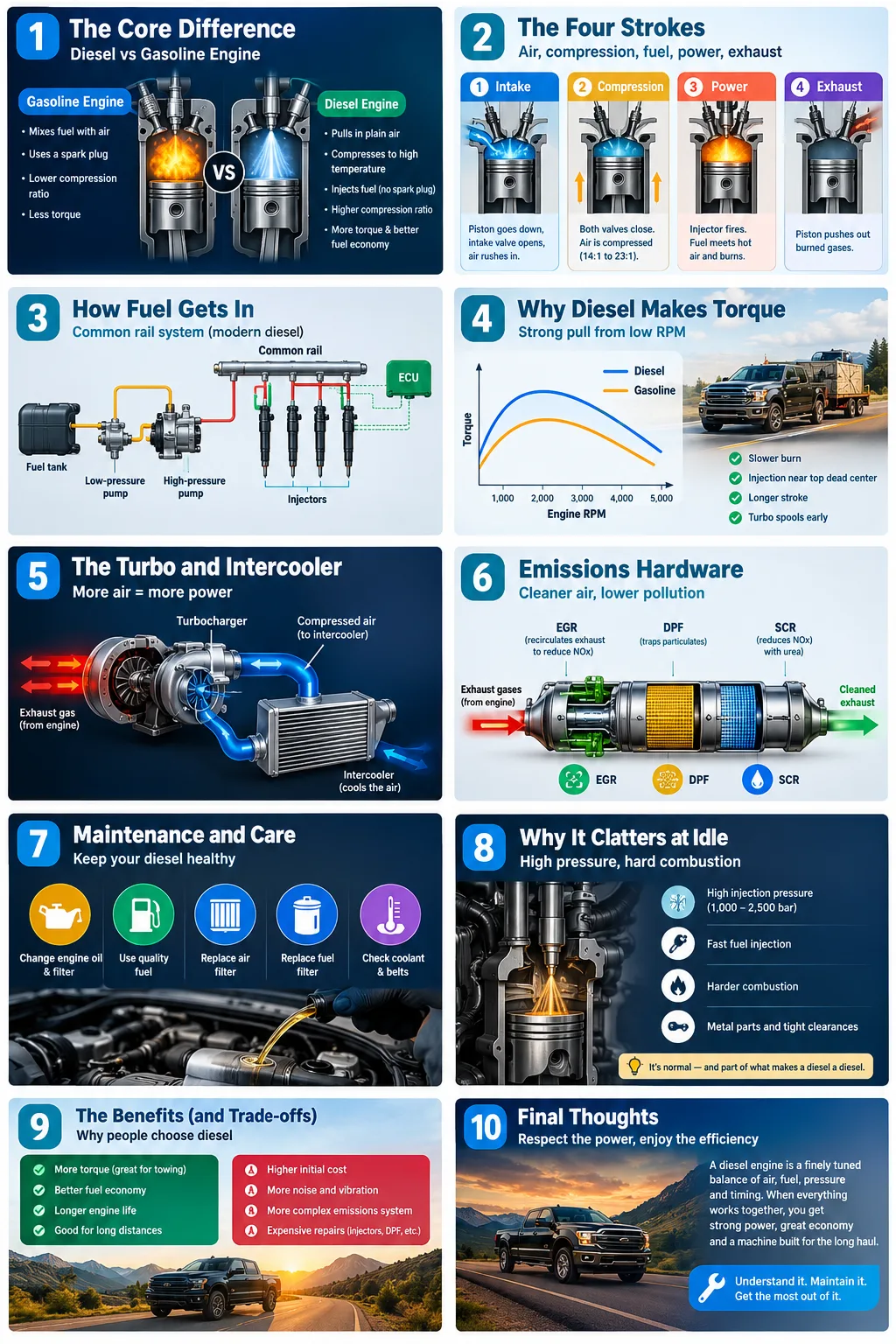
A gasoline engine mixes fuel with air, then ignites it with a spark plug. A diesel engine does none of that. It pulls in plain air, squeezes it until it gets hot enough to light a candle, then sprays fuel directly into that hot air. The heat does the igniting. No spark plugs, no throttle plate on most modern designs, no pre-mixed charge.
That single difference explains almost everything else: the higher compression ratio, the heavier block, the clatter, the torque curve, the fuel economy. Higher compression means the piston has to work harder on the way up, but it extracts more energy on the way down. That is the trade diesel makes, and it wins on efficiency.
Step 2: Follow the air through the four strokes
Here is the sequence, one piston at a time.
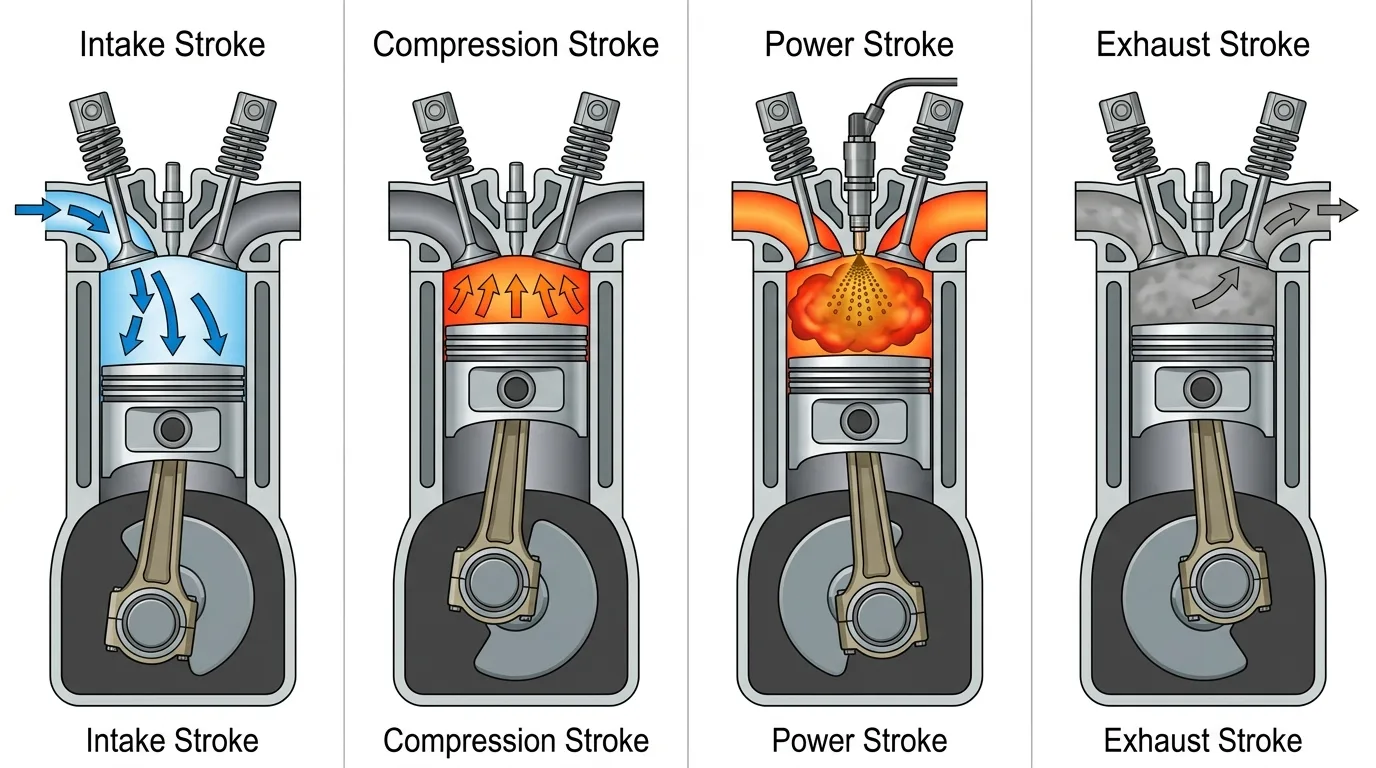
- Intake stroke. The piston drops, the intake valve opens, and air rushes in. On a turbocharged diesel, that air is already compressed and often cooled by an intercooler, so more oxygen fits in the cylinder.
- Compression stroke. Both valves close. The piston rises and squeezes that air into a tiny space. Compression ratios on diesels typically run somewhere around 14:1 to 23:1, versus roughly 9:1 to 12:1 on gasoline engines. Verify your specific engine's figure in the manual; do not guess.
- Power stroke. Near the top of the stroke, the injector fires. The fuel meets air that is hot enough (often well over 700°F, though exact numbers vary by design) and burns. Expanding gases shove the piston down.
- Exhaust stroke. The exhaust valve opens and the piston pushes burned gases out toward the turbo, then the exhaust aftertreatment.
Practical tip: the compression stroke is why diesels need stout rods, pistons, and head bolts. It is also why a diesel with a blown head gasket tends to fail loudly rather than quietly.
Step 3: Learn how the fuel actually gets in
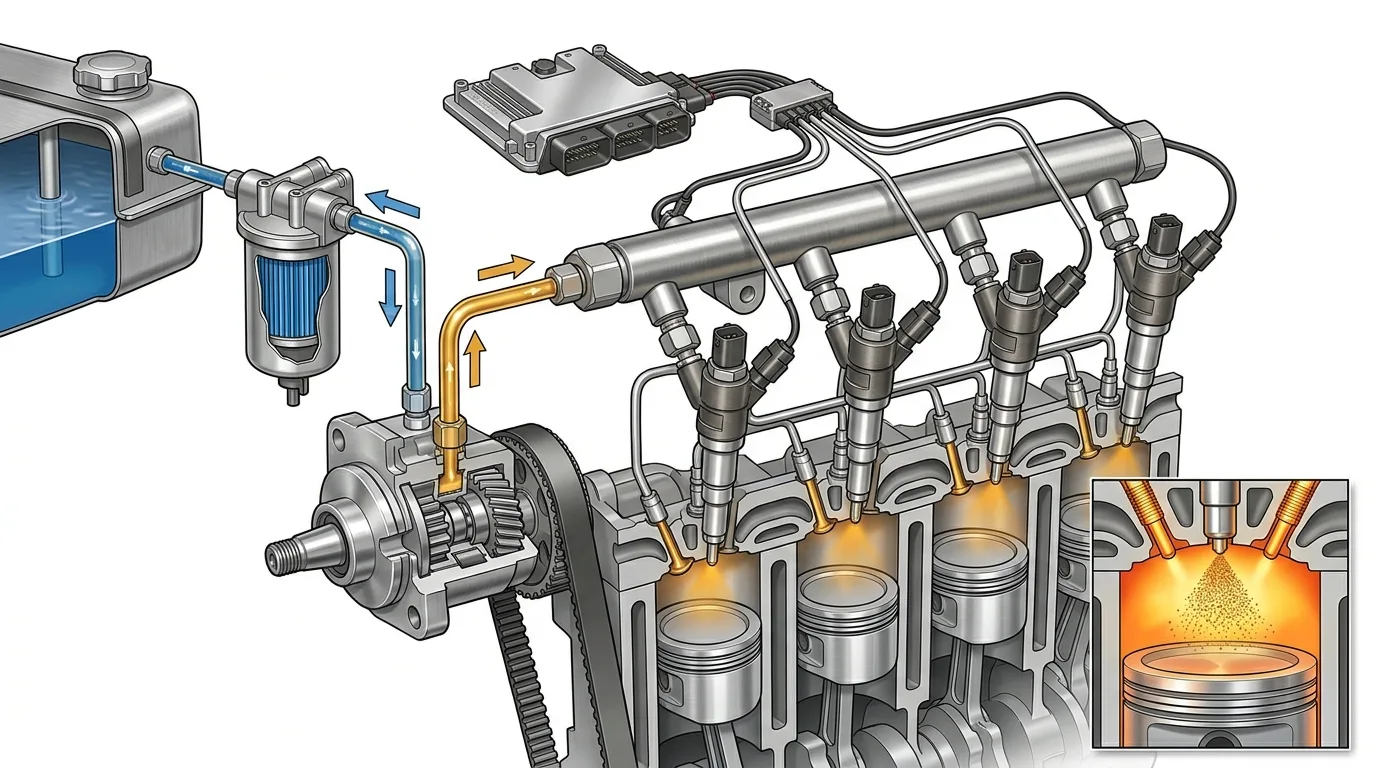
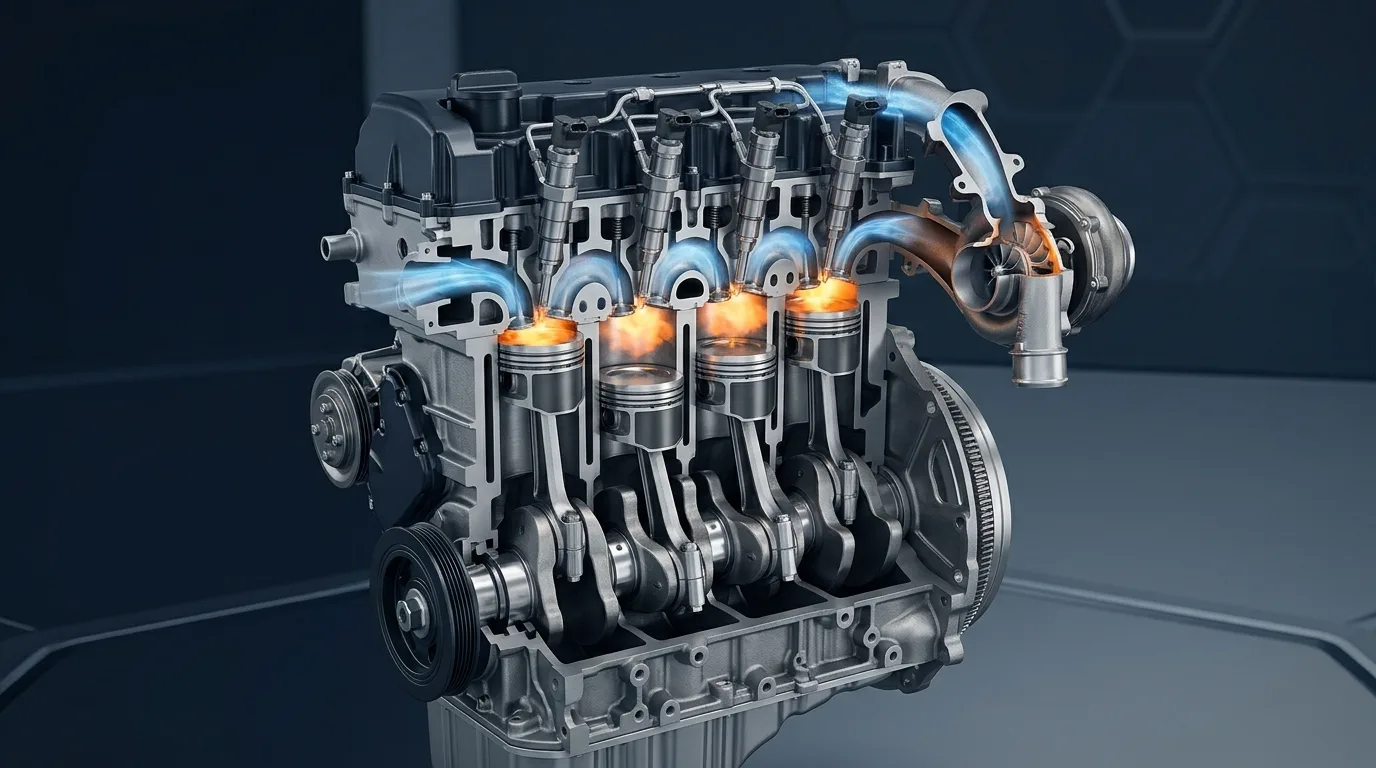
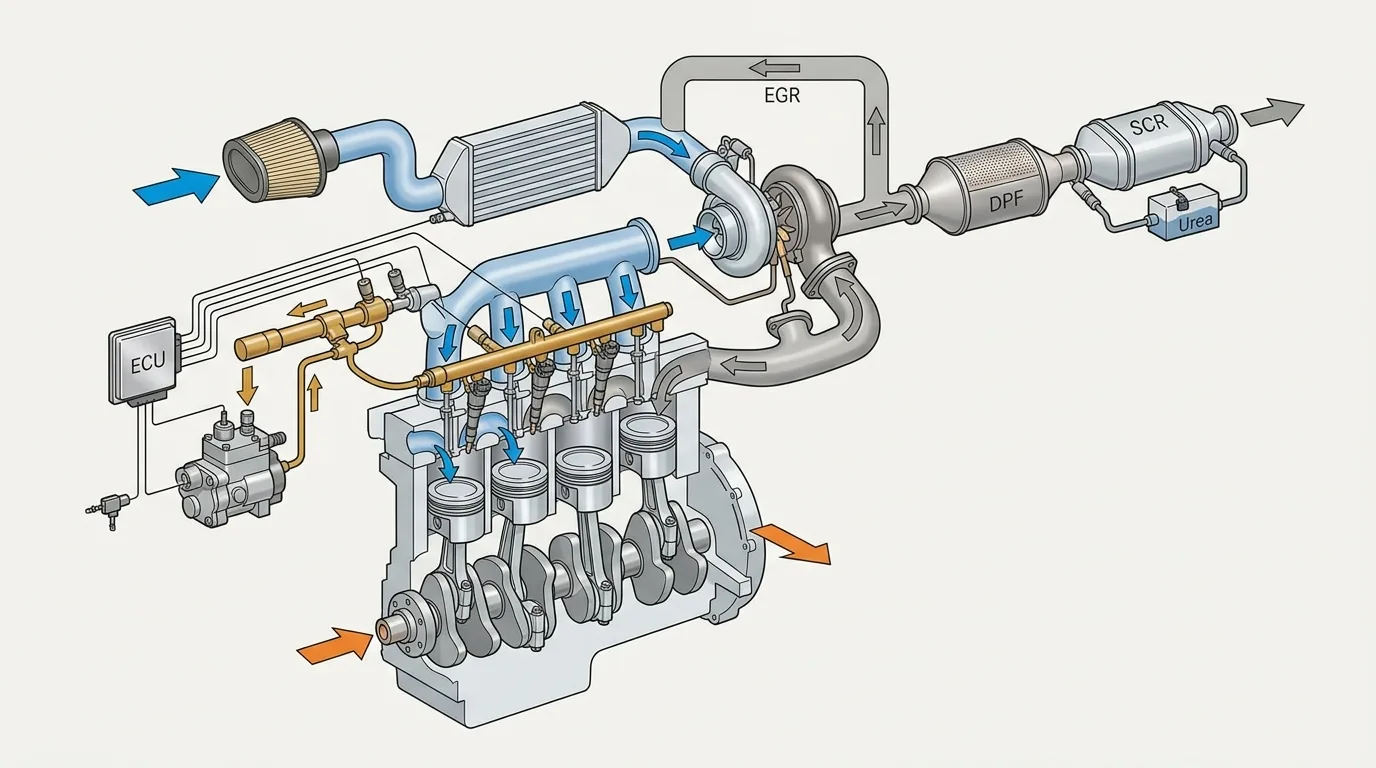
Older diesels used a mechanical injection pump and lines running to each injector. Modern diesels almost all use common rail: one high-pressure pump feeds a rail, and the rail feeds all injectors, which are controlled electronically. The ECU decides exactly when and how much to spray, sometimes splitting one injection event into several small pulses to control noise and emissions.
Why this matters: injection timing and pressure are the two biggest levers on power, smoke, and fuel economy. A worn injector or a failing pressure sensor can throw off both. If a warning light comes on, a free OBD code lookup is a fast way to see whether the fault points at the fuel system, the EGR, or the aftertreatment before you start guessing.
Approximate cost note: a single replacement injector on a common rail diesel often runs several hundred dollars in parts alone, and labor can add a few hundred more depending on access. Prices vary widely by make, so treat that as a rough range and get a quote.
Step 4: See why diesel makes torque low in the rev range
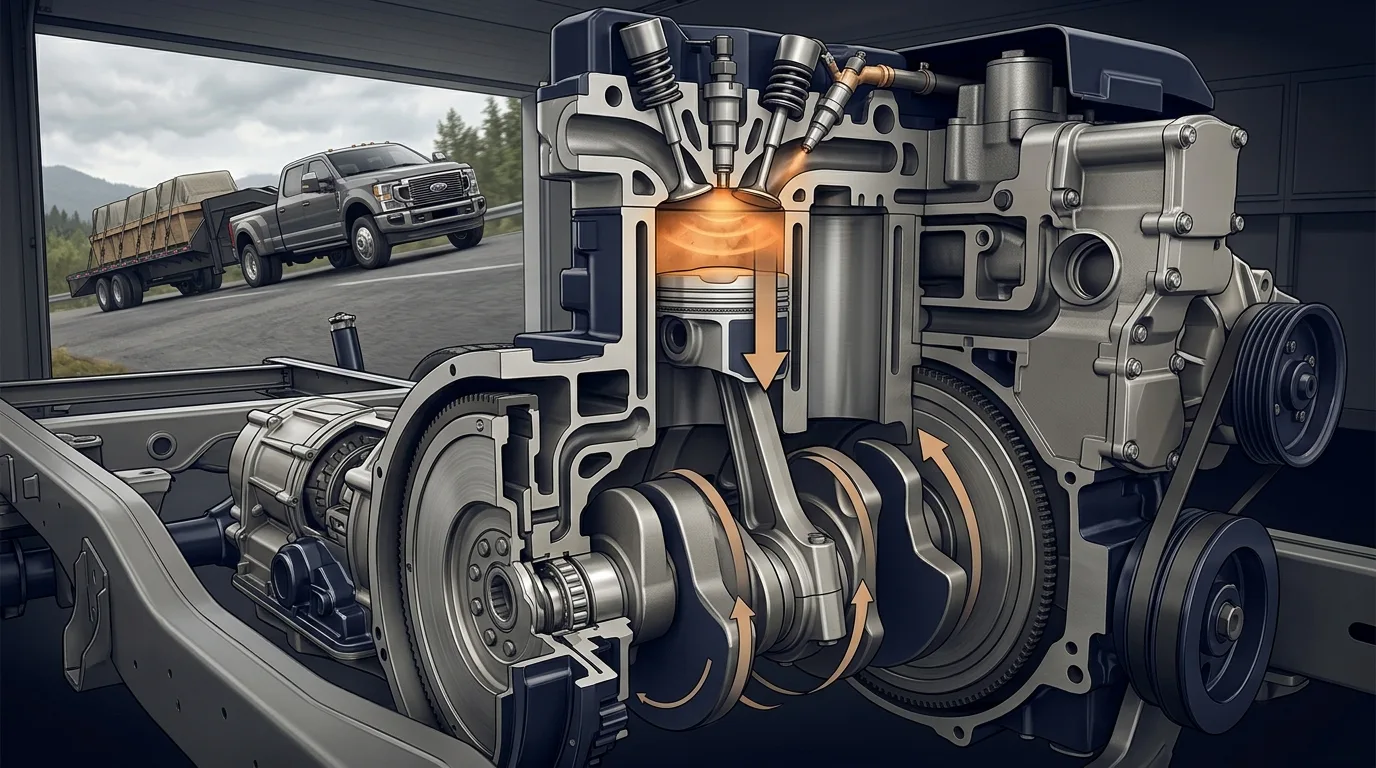
Diesel burns slower and the fuel is injected right as the piston is near the top, so peak cylinder pressure arrives at a point where it can push the crank hardest. Combine that with a long stroke on many designs and a turbo that spools early, and you get strong pull from just off idle. That is why a diesel truck can tow a trailer without screaming to 5,000 rpm.
Practical tip: do not lug a diesel at very low rpm under heavy load. It feels like it can handle it, but you are loading the bearings and the turbo. Downshift.
Step 5: Understand the turbo and intercooler role
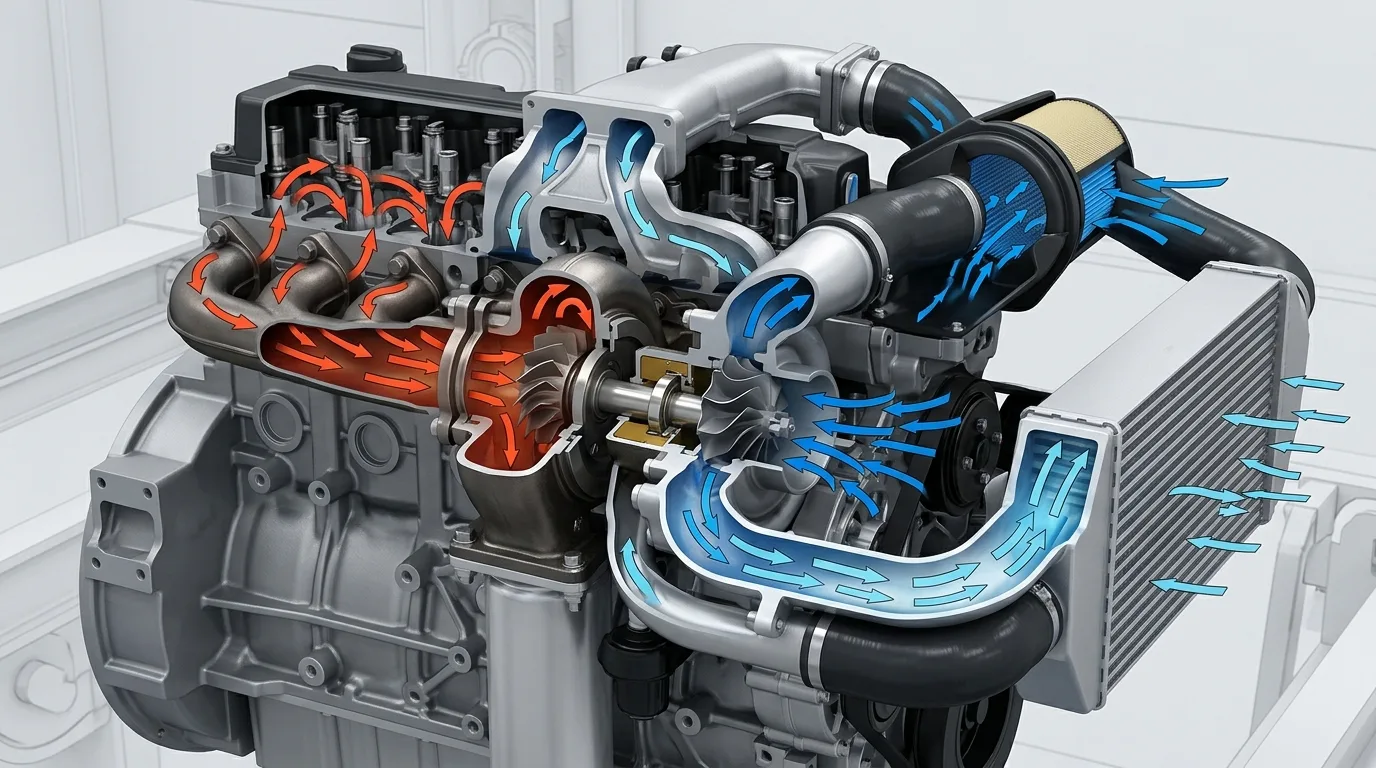
A turbo uses exhaust gas to spin a compressor that packs more air into the intake. More air means you can burn more fuel, which means more power. The intercooler then cools that compressed air, because cooler air is denser and because hot intake air raises combustion temperatures and NOx.
Safety warning: turbochargers get extremely hot. After a hard pull, let the engine idle for a minute before shutting down. That lets oil carry heat away from the turbo bearings and reduces the chance of cooking the oil in the center housing.
Step 6: Look at emissions hardware
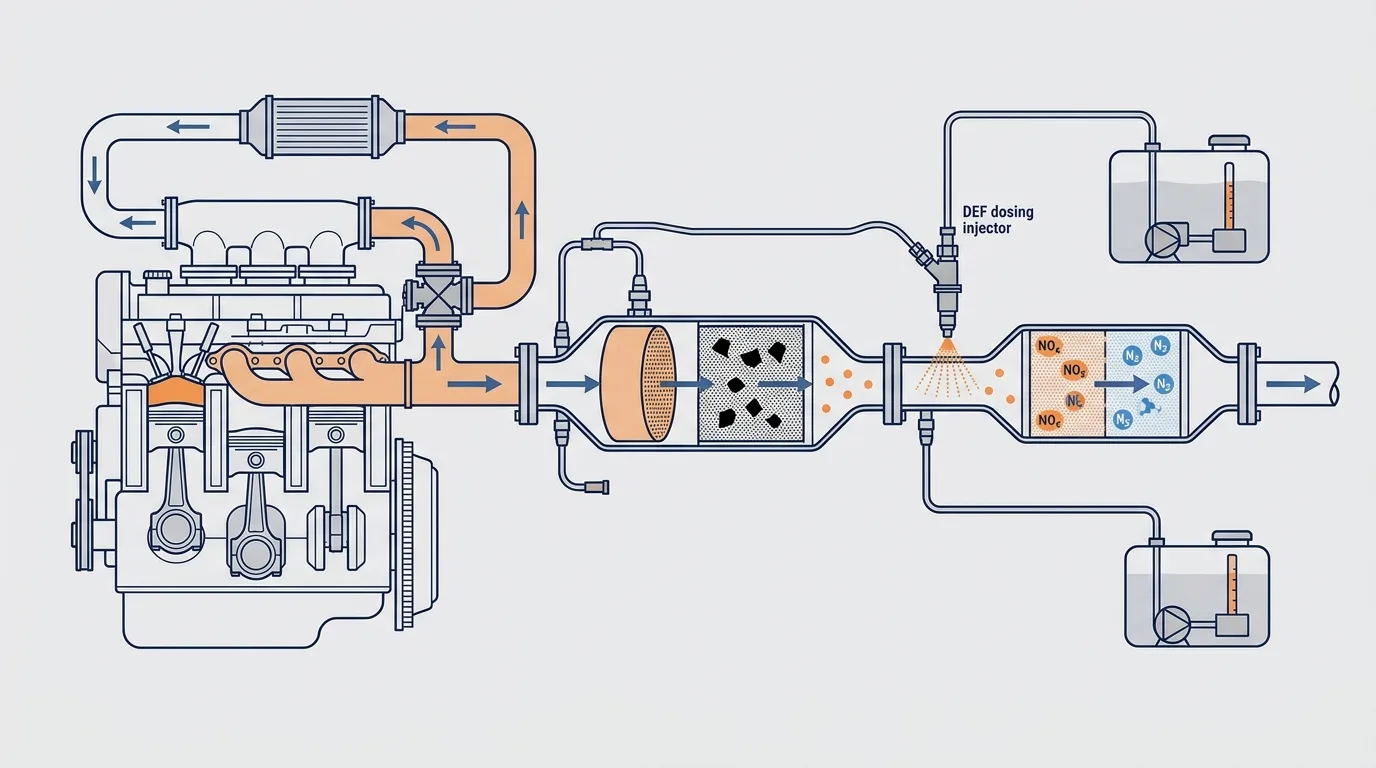
Modern diesels use several pieces to clean up the exhaust:
- EGR recirculates some exhaust gas back into the intake to lower combustion temperature.
- DPF (diesel particulate filter) traps soot and burns it off during regeneration.
- SCR uses diesel exhaust fluid (DEF) to convert NOx into nitrogen and water.
If any of these misbehave, you will usually get a check engine light and possibly a derate (reduced power). Do not ignore a derate. Scan it, then check the mechanical encyclopedia for how each system interacts before you start replacing parts.
Step 7: Compare efficiency honestly

Diesel wins on thermal efficiency because of the high compression ratio and because there is no throttle plate creating pumping losses at part load. That is why a diesel often returns 20 to 30 percent better fuel economy than a comparable gasoline engine in the same vehicle.
The catch: diesel fuel usually costs more per gallon, the engine costs more up front, and the emissions hardware adds maintenance. If you drive mostly short trips in cold weather, a modern diesel can actually be a poor choice because the DPF needs heat to regenerate. Match the engine to your actual driving, not to the brochure.
Step 8: Diagnose common symptoms logically
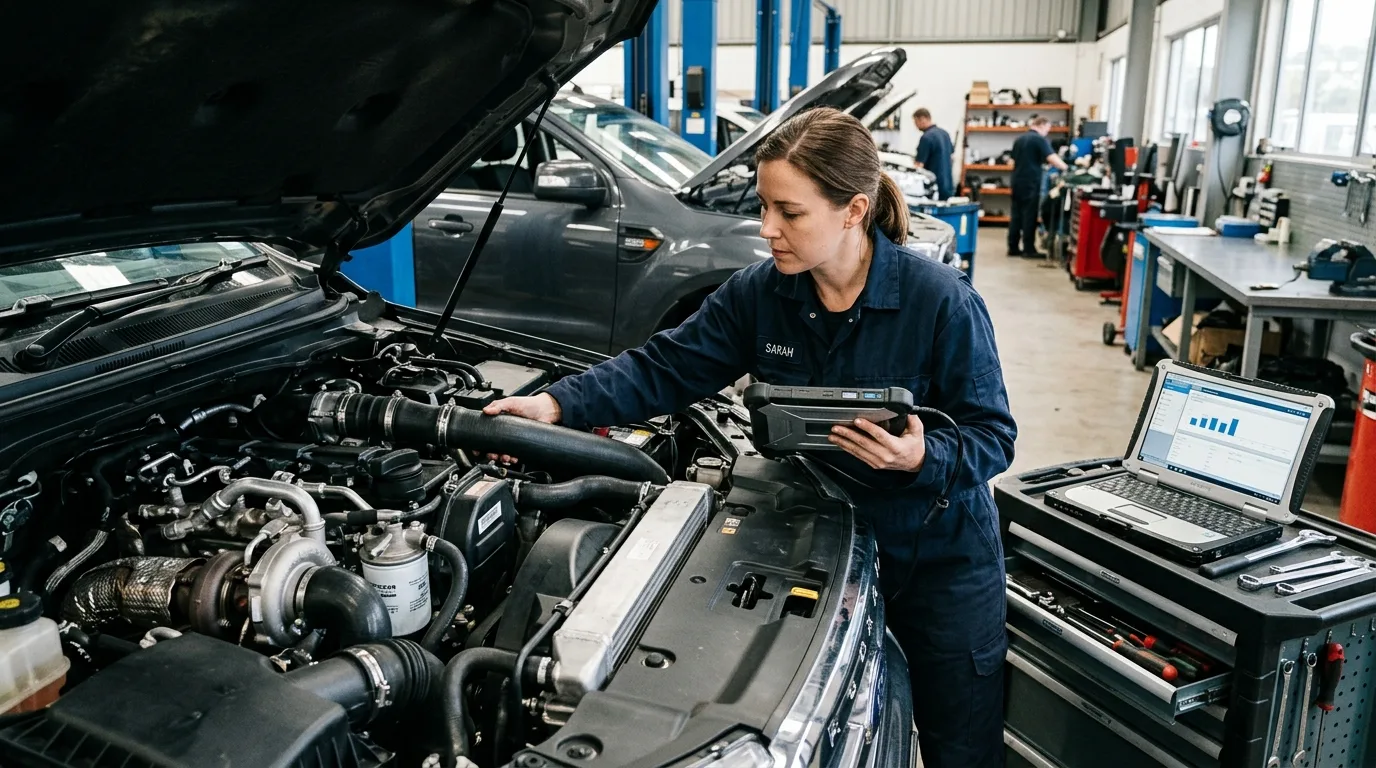
When a diesel runs rough, smokes, or loses power, work from cheap to expensive:
- Check the air filter and intake for restrictions.
- Scan for codes and live data. Fuel rail pressure and injector balance rates tell you a lot.
- Check for boost leaks at intercooler boots and clamps.
- Look at fuel quality and water in the separator.
- Only then suspect injectors or the high-pressure pump.
If you are stuck, the AI mechanic assistant can help you interpret a scan and narrow down the next test. For a symptom-first approach, the car symptom finder is a good starting point when you do not have a code yet.
Step 9: Service it like a diesel, not a gas car
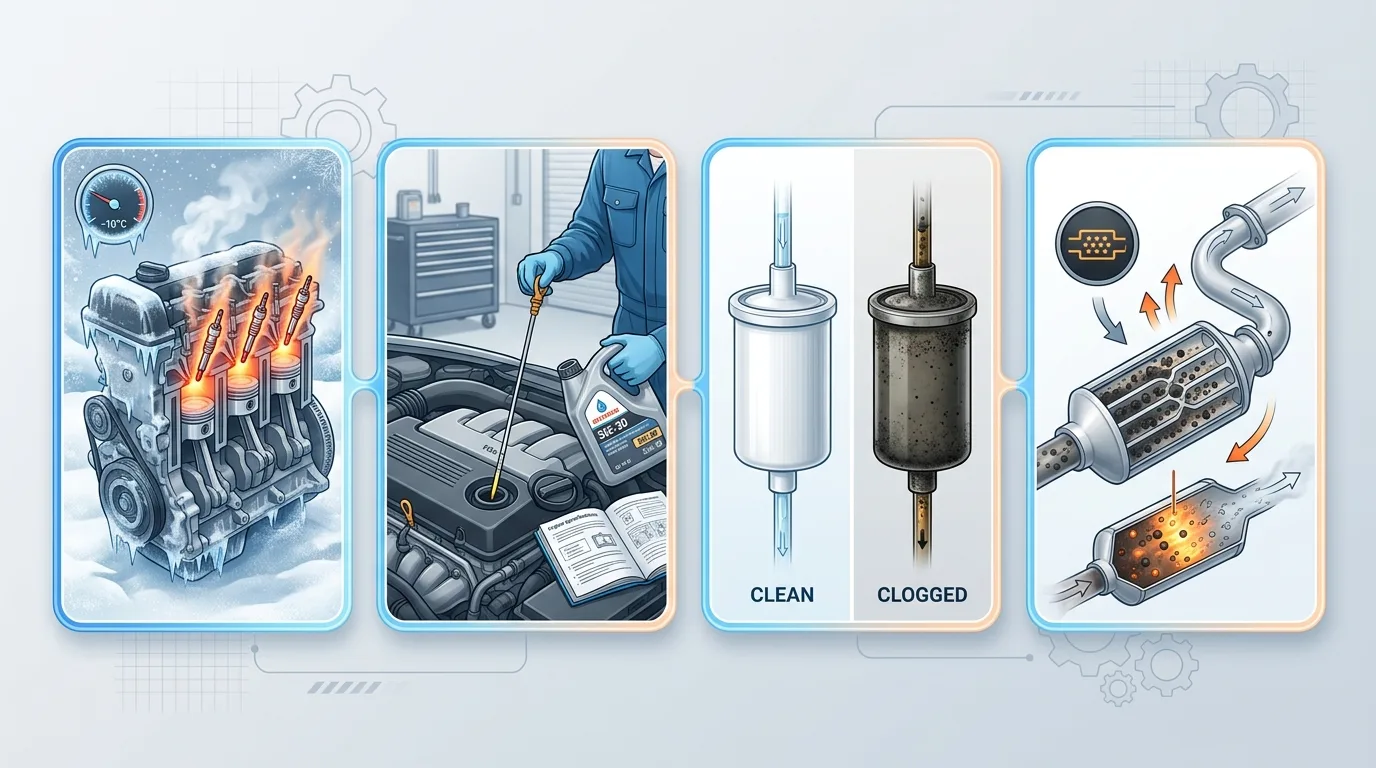
Diesel oil does more work: it lubricates, cools the turbo, and handles soot. Use the exact oil specification in your manual. Do not stretch intervals because "it still looks clean." Fuel filters matter more than on a gasoline car because a clogged filter starves the high-pressure pump, and that repair is expensive.
Approximate cost note: a fuel filter service is usually a modest DIY job on older trucks and a fiddly one on newer engines with priming procedures. Budget an hour the first time.
Step 10: Know when to stop and hand it over
You can handle filters, fluid checks, and basic diagnosis. You should not open a common rail fuel system, remove injectors, or touch the high-pressure pump unless you have the right tools and training. The pressures involved can kill you. There is no shame in that boundary. The step-by-step car guides cover the jobs that are genuinely DIY-friendly.
Pro tips
- Cold starts: let the glow plugs do their job, and do not rev a cold diesel. Let oil pressure build first.
- Keep a fuel log. A sudden drop in economy is often the first sign of an injector or EGR issue.
- Use a quality diesel additive only if the manufacturer recommends it. Otherwise, skip it.
- On a regen-equipped truck, occasional highway driving keeps the DPF happy. Short trips are its enemy.
- When buying used, ask for service records on the fuel filter and oil. Missing those is a red flag.
- Learn your engine's specific torque specs from the manual, never from a forum post.
Common pitfalls
Treating it like a gasoline engine. Diesels need different oil, different filters, and different driving habits. Using the wrong oil can damage the turbo and the emissions system.
Ignoring a check engine light because "it still runs fine." A derate can strand you, and a small fault can become a pump or injector failure.
Cracking injector lines to "bleed" a modern system. On common rail, that can spray high-pressure fuel. Follow the manufacturer's priming procedure instead.
Short-tripping a DPF-equipped diesel. The filter never gets hot enough to clean itself, and you end up paying for a forced regen or a replacement.
Buying the cheapest fuel filter. It is the cheapest insurance you will ever buy for a very expensive pump.
Useful resources
- Your owner's manual and the factory service manual for your specific engine
- The free car tools section for calculators and checklists
- The expert car tips archive for maintenance habits that apply across vehicles
- A reputable OBD2 scanner with live data, not just a code reader
FAQ
Do diesel engines have spark plugs? No. They use glow plugs to help cold starts, but combustion is triggered by compression heat, not a spark.
Why do diesels sound like they are knocking? That rattle is the rapid pressure rise when fuel ignites. Modern common rail engines fire multiple small injections to soften it, but some clatter at idle is normal.
Is diesel better than gasoline? It depends on your driving. Diesel wins on efficiency and torque, and loses on upfront cost, fuel price, and cold-weather short-trip behavior.
Can I run biodiesel in any diesel? Not necessarily. Check your manual and the fuel's blend rating. Some newer emissions systems have limits on biodiesel percentage.
How long do diesel engines last? With proper maintenance, many diesels outlast comparable gasoline engines. The emissions hardware often needs attention before the long block does.
Final word
Diesel is not complicated once you see the logic: squeeze air hard, spray fuel late, let heat do the rest. Learn that, respect the pressures and the heat, and you will understand your engine better than most people who own one. Keep the filters clean, the oil correct, and the codes read early, and a diesel will reward you for a long time.
Related articles

12 Common Gasoline Engine Problems and How to Diagnose Them
Your check engine light comes on. The engine starts shaking at a red light. You hear a noise that wasn't there last week. Most people do one of two things: panic and hand the car to a shop with a blank check, or ignore it until the problem gets expensive.
Read the article →
Carburetor vs. Fuel Injection: Which System Is Better?
You already know the short answer: fuel injection wins on paper. It has won in showrooms for decades, and there is no serious argument left about which system meters fuel more precisely. So why does the question still come up in the bay every week?
Read the article →
How to Parallel Park Like a Pro: Simple Tricks That Work
Parallel parking is the one driving skill most people never really learn. They pass the test, then spend the next twenty years circling the block for a spot they can just pull into. That ends today.
Read the article →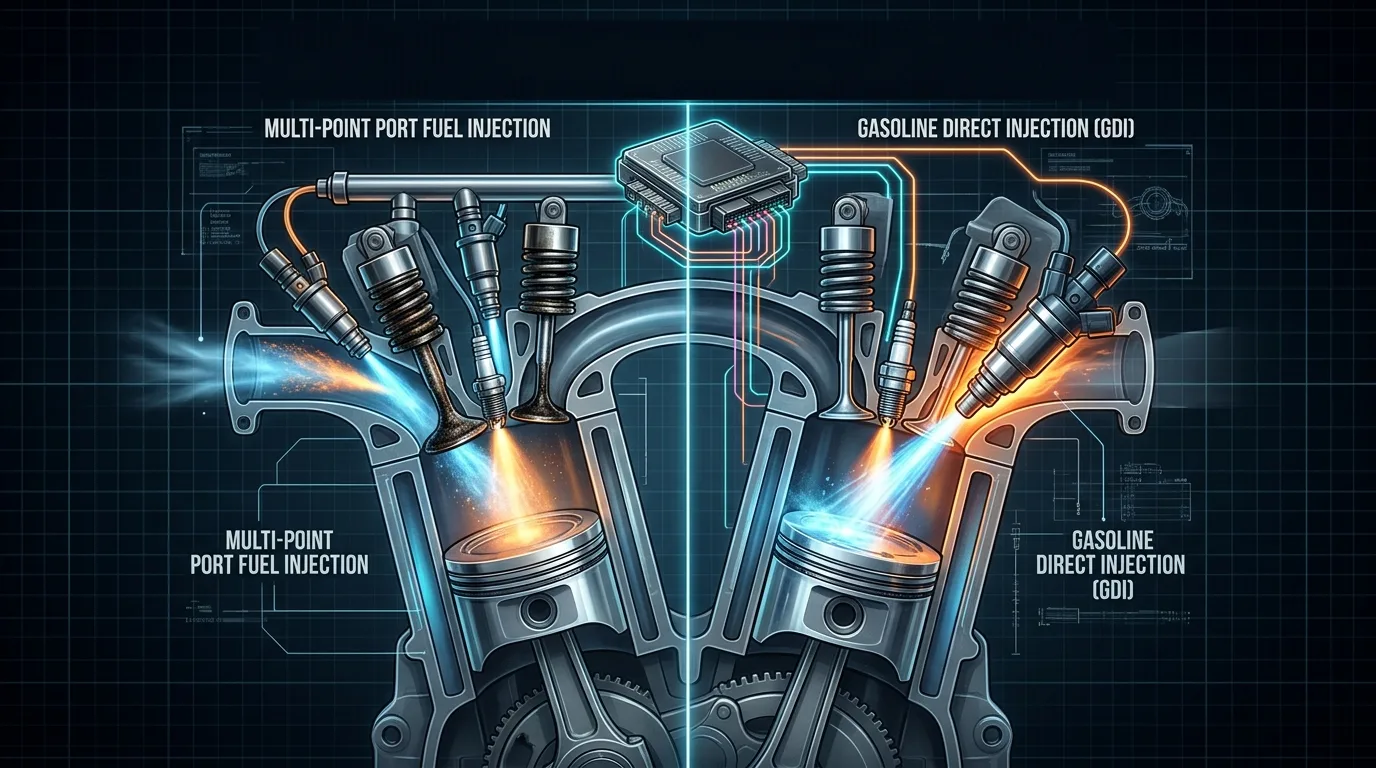
Gasoline Fuel Injection Systems Explained: The No-BS Guide to MPI, GDI, PFI, and Everything In Between
Confused by MPI, GDI, PFI, and dual injection? You’re not alone. no-BS guide breaks down every gasoline fuel injection system in plain English how they work, where they spray, and which one is best for your car. Learn real differences, common symptoms, and maintenance tips without textbook jargon.
Read the article →
How to Keep Your Car Safe When Parking Overnight
Most cars are stolen at night, and most of those thefts are crimes of opportunity, not master criminals outsmarting an alarm. A door left unlocked, a key fob hanging by the front door, a bag visible on the passenger seat: that is what gets a car taken.
Read the article →
What Thieves Look for Before Breaking Into a Car
Most car thefts are not spontaneous. A thief walks or drives past your car first, checks a short list of easy signals, and decides in seconds whether it is worth the risk. This article breaks down what that list looks like, why certain cars get picked over others, and the practical steps that actua…
Read the article →