Think of electricity like water in a pipe: voltage is the pressure pushing it, current is how much water flows per second. It is a good picture and it gets you a long way, but it stops being accurate the moment you try to explain why a car battery and a wall outlet can both light a bulb yet behave nothing alike. Water in a pipe does not have a frequency, and it does not care whether the pump pushes steadily or reverses direction sixty times a second. Electricity does.
By the end of this piece you should be able to look at a simple circuit and work out voltage, current, resistance and power with a pencil, and you will know why the two supplies in your life, the 12 V socket in the car and the 230 V (or 120 V, depending where you live) outlet in the wall, are built the way they are. Check the exact mains voltage for your country yourself; I am not going to guess it for you.
The four quantities
Before AC and DC make sense, you need the four words that get thrown around in every electrical conversation. Each has a symbol, a unit, and a plain meaning.
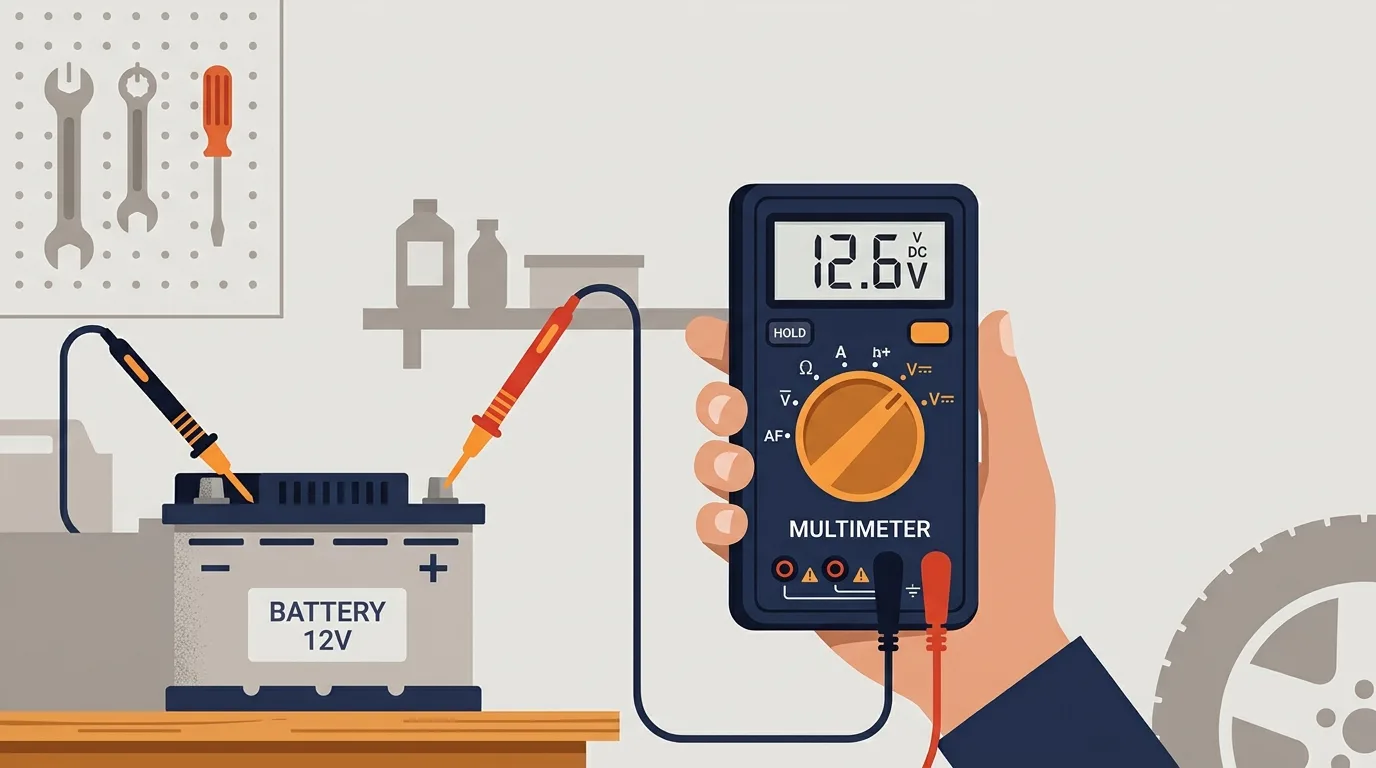
Voltage (symbol V, unit the volt, V) is potential difference: the push that makes charge move. A fresh car battery sits around 12.6 V at rest. That number is the pressure available, not the amount of charge moving.
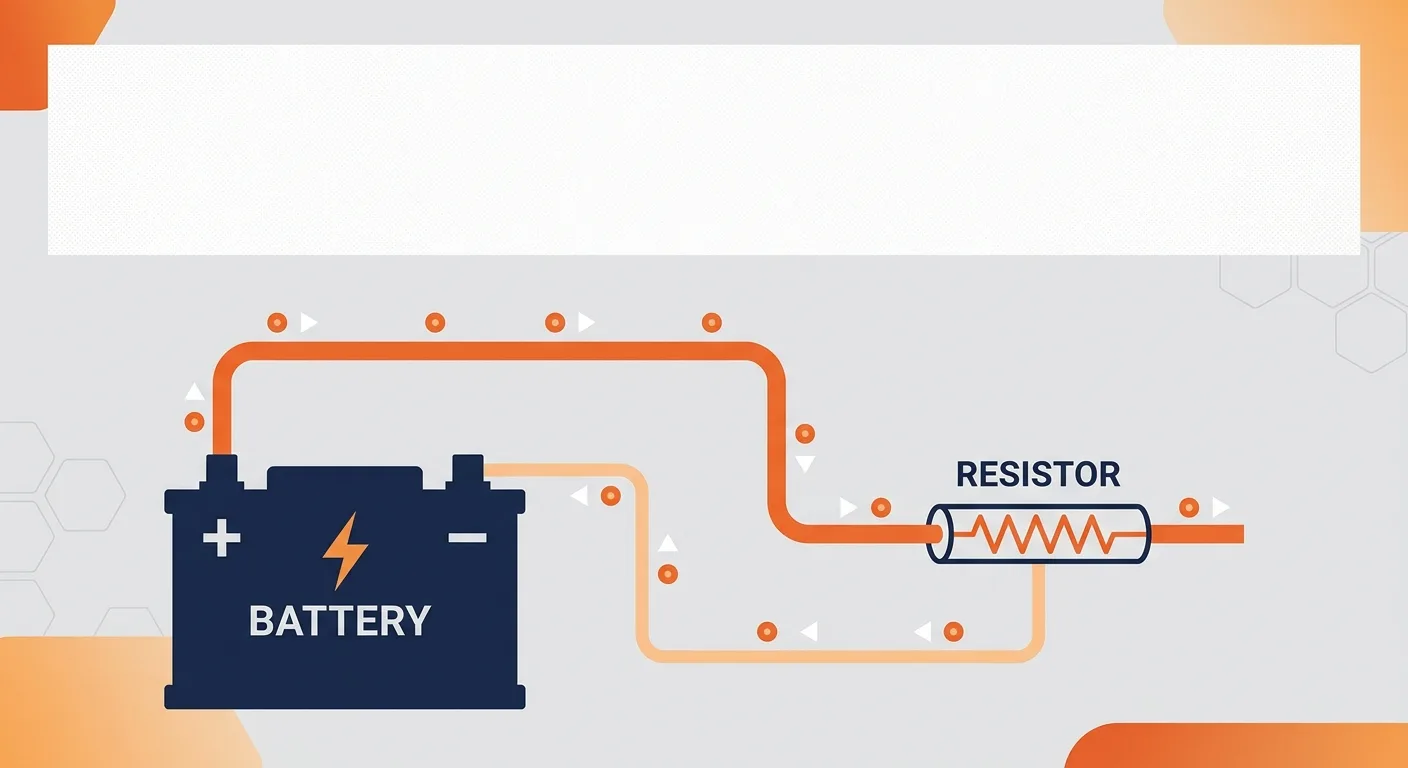
Current (symbol I, unit the ampere, A) is the rate at which charge flows. A small dashboard bulb might draw 0.2 A. A starter motor can pull hundreds of amps for a second or two. Same 12 V supply, wildly different currents.
Resistance (symbol R, unit the ohm, Ω) is how much a component opposes that flow. A relay coil might be a few hundred ohms; a thick battery cable is a fraction of an ohm.
Power (symbol P, unit the watt, W) is energy per second. A 55 W headlight converts 55 joules of electrical energy into light and heat every second.
Here is the detail beginners trip over: voltage is measured across a component, with the meter in parallel, one probe on each side. Current flows through the component, so to measure it the meter has to become part of the circuit, in series. Get those two the wrong way round and you will blow a fuse in the meter at best.
Ohm's law and power
Three formulas cover most of what you will ever need on a low-voltage circuit:
- V = I × R
- P = V × I
- E = P × t (energy equals power times time, in joules if P is in watts and t in seconds)
And the rearrangements: I = V / R, and R = V / I.
Example 1 (illustrative). A 12 V supply across a 3 Ω resistor. I = V / R = 12 / 3 = 4 A. Power dissipated: P = V × I = 12 × 4 = 48 W. That resistor is getting hot; 48 W in a small part is a lot.
Example 2 (illustrative). A 60 W load on 12 V. I = P / V = 60 / 12 = 5 A. If you want to know the resistance the load presents, R = V / I = 12 / 5 = 2.4 Ω.
Example 3 (illustrative). A 5 W bulb left on for 2 hours. Energy E = P × t = 5 × 7200 = 36,000 J, or 0.01 kWh. Small number, but that is exactly how your household bill adds up.
If you want the full set of rearrangements in one place, the electrical formulas reference at /electrical/formulas is worth bookmarking.
Series and parallel
In series, components sit on one path. The same current flows through every one, and the voltages add up to the supply. Resistances simply add: R_total = R1 + R2 + R3.
In parallel, each component gets its own branch across the same supply. The voltage is the same across every branch, and the currents add. Resistances combine as 1/R_total = 1/R1 + 1/R2 + …
Worked example (illustrative). Two 6 Ω resistors in parallel. 1/R = 1/6 + 1/6 = 2/6, so R = 3 Ω. On a 12 V supply each branch carries 2 A and the total is 4 A.
This is why almost every load in a car and in a house is wired in parallel. If your headlights were in series, one bulb failing would kill both, and each would only get half the voltage, so both would be dim. Parallel wiring means one dead bulb leaves the other working and each sees the full supply.
DC and AC
Direct current (DC) flows one way. A battery, a solar panel, and the output of your car's alternator after rectification are all DC. Alternating current (AC) reverses direction periodically. Frequency is how many complete cycles happen per second, in hertz (Hz). Mains in most of the world is 50 Hz or 60 Hz; check your local supply rather than trusting a number from a forum.
Vehicles use low-voltage DC because batteries store chemical energy as DC, and because 12 V is far less likely to drive a dangerous current through a person under normal dry conditions. Mains is AC for reasons that go back to transformers: AC can be stepped up to high voltage for efficient long-distance transmission and stepped back down near your home, which DC does not do with a simple transformer.
The safety side matters. Low-voltage DC can still burn you, start a fire through a short, or throw a nasty spark, and a car battery can deliver enormous current into a wrench dropped across its terminals. Mains AC is a different league entirely. Anything involving mains wiring, a consumer unit, or opening an appliance that plugs into the wall belongs to a qualified electrician. I will not give you live-mains steps here, and you should not take them from a website.
Measuring safely
A multimeter is your best diagnostic tool, provided you respect what each mode does.
Voltage mode goes across the component, in parallel. Current mode goes in series, with the circuit broken so the current flows through the meter. Resistance and continuity modes are used with the circuit dead and, ideally, the component isolated, because a parallel path will give you a false reading.
A current range needs a fuse because a meter on amps is nearly a short circuit by design. If you leave it on amps and touch the probes across a battery, the fuse is doing you a favour. Treat a blown meter fuse as a warning, not an inconvenience. If your meter has separate current jacks, keep the red lead in the voltage jack by default and move it only when you actually need to measure current.
The rule that keeps people alive is test before touch: prove the meter works on a known live source, test the circuit you care about, then prove the meter still works. Category ratings (CAT II, CAT III and so on) tell you what kind of installation a meter is built to survive; a cheap meter with no rating is not a mains instrument. For mains work, a qualified electrician uses one-hand practice, keeping the other hand away, and appropriate PPE. Your job, as a beginner, is low-voltage measurement only. The electrical measurement guides at /electrical/measurements walk through meter modes properly, and if you want to test yourself, there is a short electrical quiz at /electrical/quiz.
Common misconceptions
Voltage is not current. A static shock can be thousands of volts and harmless; a 12 V car battery can weld a ring to a terminal. What hurts you is current through your body, and that depends on voltage, resistance and path.
A good ground is not optional. A poor ground causes dim lights, weird sensor readings and intermittent faults that send people chasing the wrong part. If a circuit reads oddly, check the ground before you replace anything expensive. The electrical diagnostics guides at /electrical/diagnostics are a good next stop.
Resistance is not always a fault. Every real component has resistance. A reading that is "too high" might just mean you measured through a parallel path.
A bigger fuse is not a fix. The fuse is sized to protect the wiring. Fit a larger one and the wire becomes the fuse, which means melted insulation and possibly a fire. Find the fault instead.
A charged capacitor can still bite after the power is off. Capacitors hold charge. Respect them.
Practice check
- 12 V across 4 Ω. What current? Answer: I = V / R = 12 / 4 = 3 A.
- A 24 W load on 12 V. What current, and what resistance does it present? Answer: I = P / V = 24 / 12 = 2 A; R = V / I = 12 / 2 = 6 Ω.
- Two 4 Ω resistors in parallel. Total resistance? Answer: 1/R = 1/4 + 1/4 = 1/2, so R = 2 Ω.
- A 10 W lamp runs for 30 minutes. Energy used? Answer: E = P × t = 10 × 1800 = 18,000 J, or 0.005 kWh.
FAQ
What kills you, voltage or current? Current through your body, along a path that crosses your heart or vital organs, over a long enough time. Voltage is what drives that current, so higher voltage is more dangerous, but the current is the mechanism.
Why do I read 0 V but the device still works? Usually a meter setup problem: wrong mode, a blown meter fuse on the current range, a bad probe, or you measured across the wrong points. Do not assume the circuit is dead until your meter has been proved on a known source.
Why does my meter show 12 V but the bulb is dim? A high-resistance connection somewhere in the path can show full voltage with no load attached but collapse under load. That is why load testing matters.
Is AC always more dangerous than DC? Not automatically. A high-voltage DC supply is lethal too. What matters is the voltage, the available current and the path through your body.
Can I do my own car electrical work? Low-voltage 12 V work like bulbs, fuses, and meter checks is a reasonable place to learn. Anything involving mains, high-voltage EV systems, or airbags is not. If you are diagnosing a fault, a free OBD code lookup at /tools and the step-by-step car guides at /guides can point you in the right direction.
The one takeaway
Learn the four quantities and the three formulas, keep your meter in the right mode, and respect the difference between a 12 V car system and the mains. Everything else is detail on top of that foundation, and the Electrical Hub at /electrical is where to keep building it.
Put this to work on the car: check the numbers with the free battery calculator, follow the step-by-step electrical measurement guides, or start from the Electrical Hub for concepts, formulas and more diagnostics.