Gasoline Fuel Injection Systems Explained: The No-BS Guide to MPI, GDI, PFI, and Everything In Between
Confused by MPI, GDI, PFI, and dual injection? You’re not alone. no-BS guide breaks down every gasoline fuel injection system in plain English how they work, where they spray, and which one is best for your car. Learn real differences, common symptoms, and maintenance tips without textbook jargon.
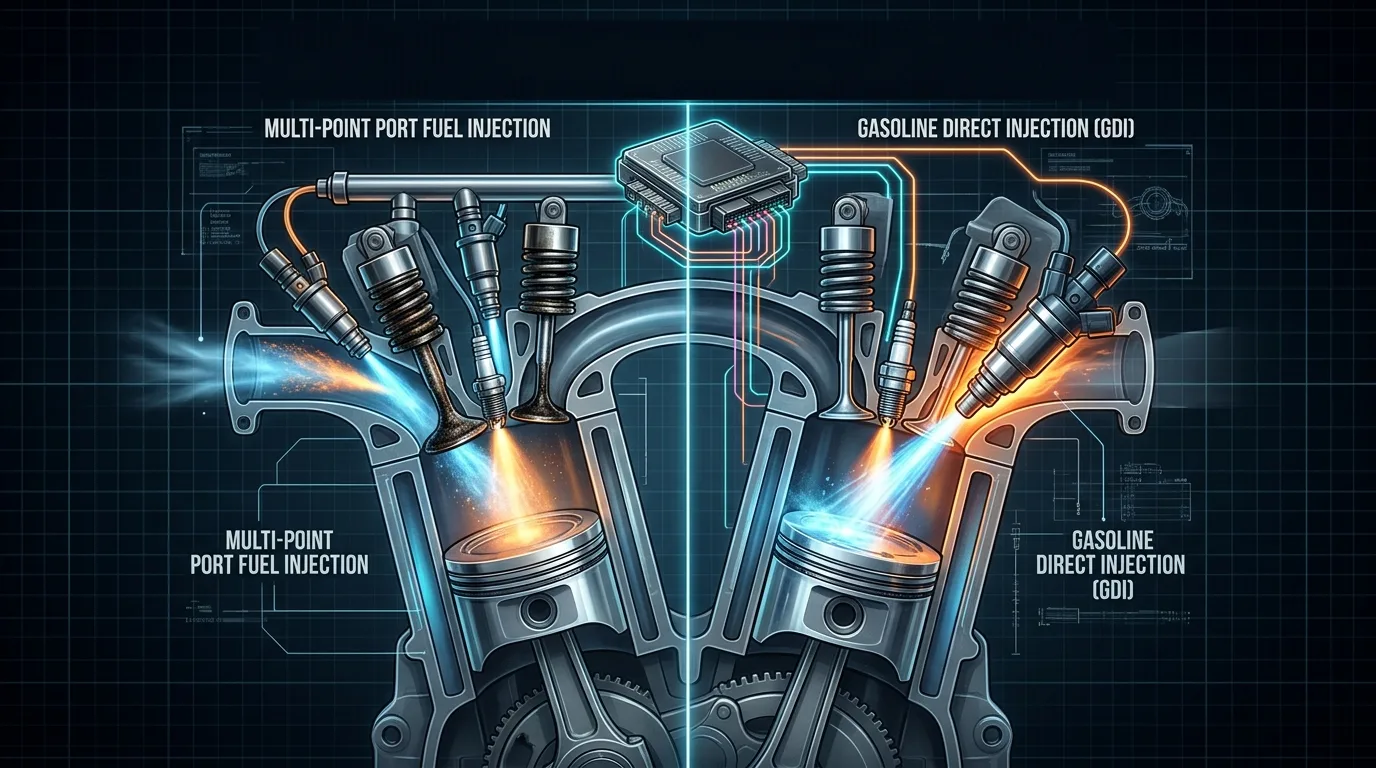
Your engine is basically an air pump that loves to burn things. Fuel injection is how it decides exactly how much gasoline to throw into the fire.
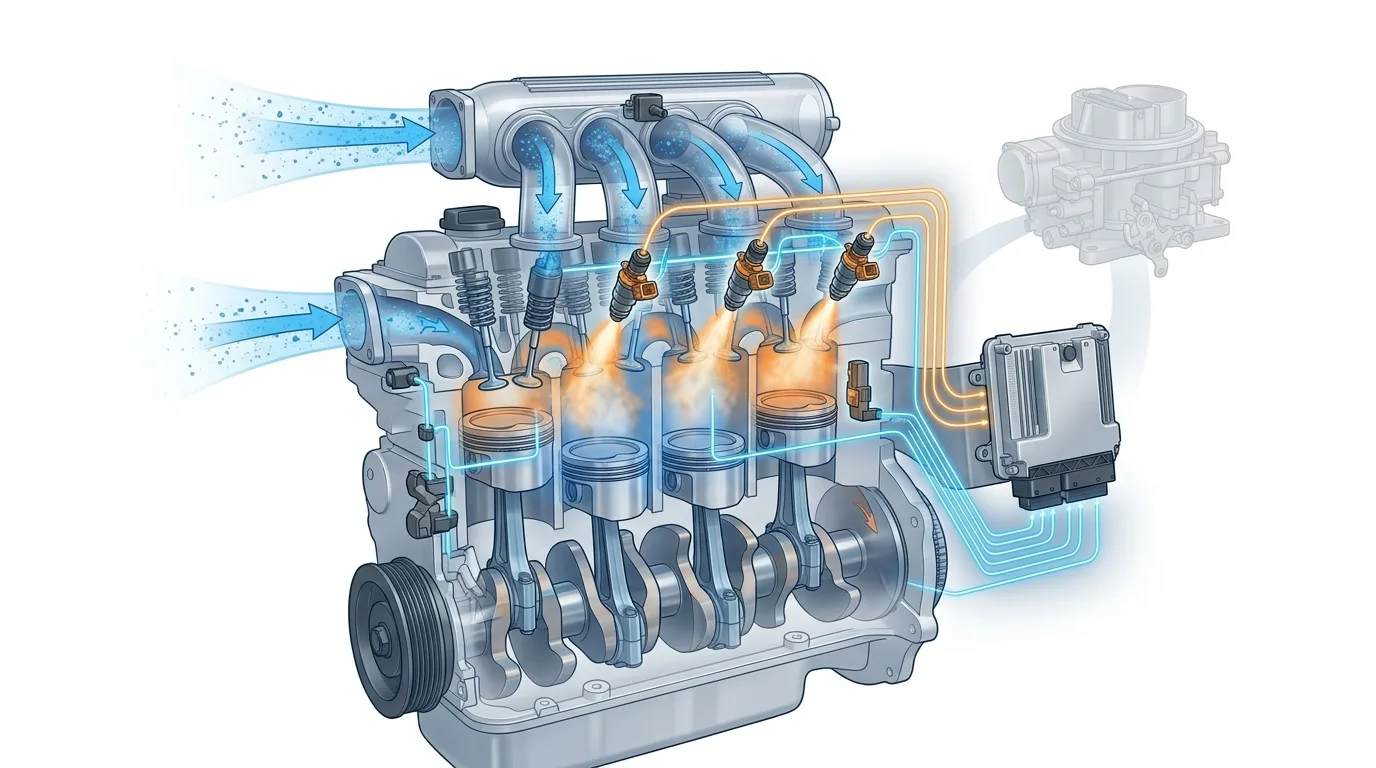
Get that wrong, and you get rough idles, terrible fuel economy, misfires, check-engine lights, and sometimes a repair bill that makes you question your life choices.
But here’s the good news: fuel injection isn’t some black magic. Once you understand the main types — single-point, multi-point, port, direct, and dual injection — the whole thing starts to make sense.
So let’s break it down like a human, not a textbook.
The 20-Second Version
A gasoline engine needs air and fuel mixed in the right ratio. Too much fuel, and you’re wasting gas and making pollution. Too little fuel, and you risk misfires, heat, and engine damage.
Carburetors used to handle this with vacuum, needles, jets, and guesswork. Fuel injection does it with sensors, a computer, and electrically controlled injectors.
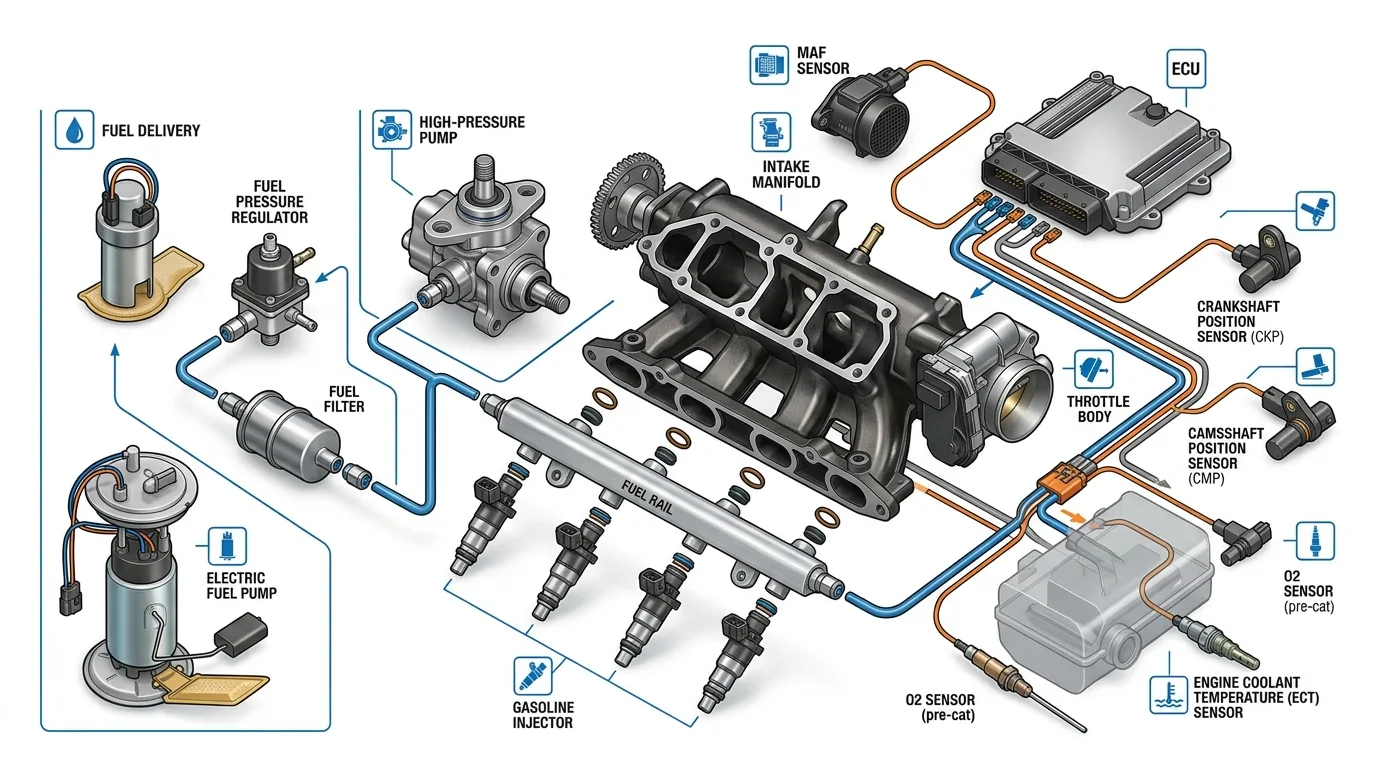
The computer — usually called the ECU — looks at how much air is coming in, how hot the engine is, how hard you’re pressing the gas, and what the exhaust oxygen sensor says. Then it opens the injectors for a precise amount of time.
That’s it. That’s fuel injection.
Everything else is just variations on where the fuel gets sprayed and how many injectors do the job.
Don’t Get Confused by the Labels
Before we go further, burn this into your brain:
- Single-point vs. multi-point = how many injectors and where they sit.
- Direct vs. indirect = where the fuel is injected.
- Sequential, batch-fire, simultaneous = when the injectors fire.
- EFI = electronic fuel injection, meaning a computer controls it.
These categories overlap. A car can have multi-point, port, sequential, electronic fuel injection. That’s not a contradiction. It’s just four different ways to describe the same system.
Now let’s go through the main types.
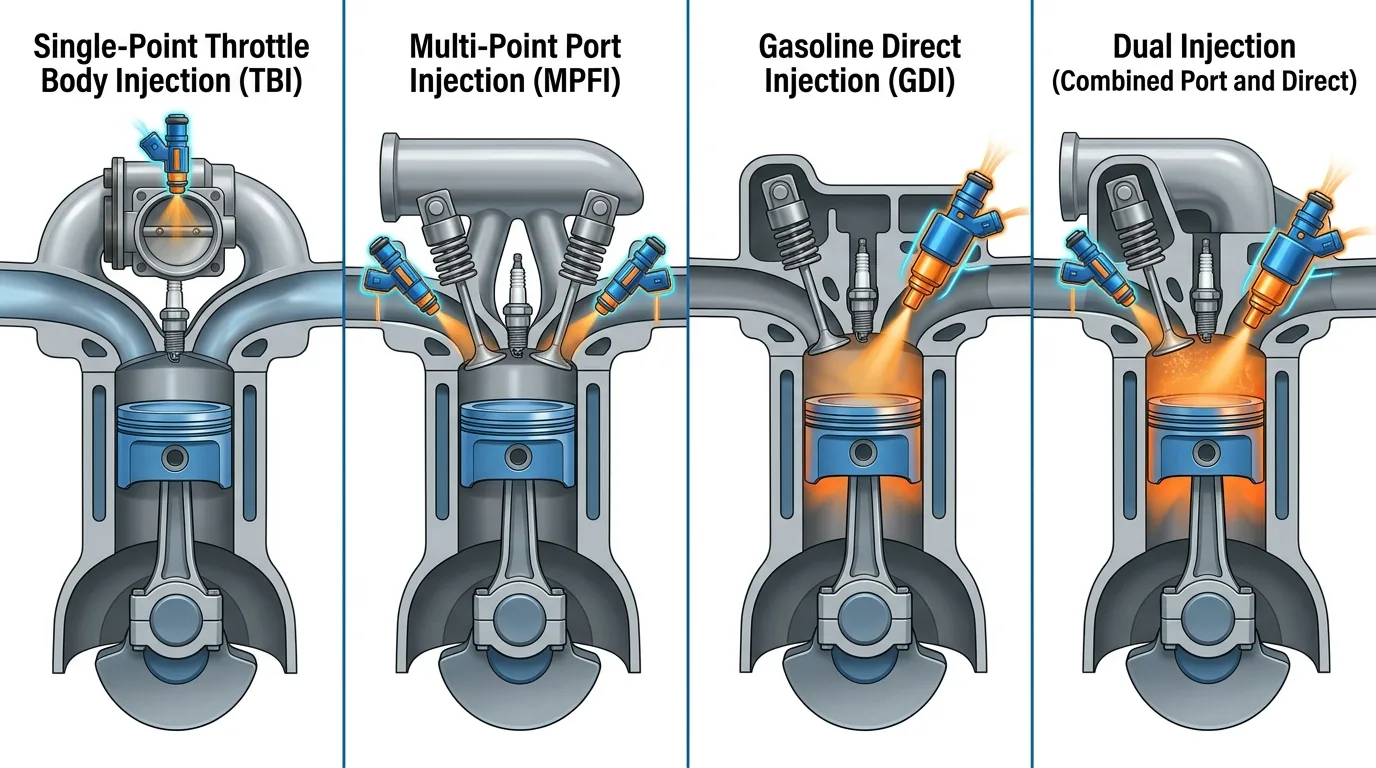
1. Single-Point Fuel Injection (SPI / TBI)
Also called throttle-body injection, or TBI.
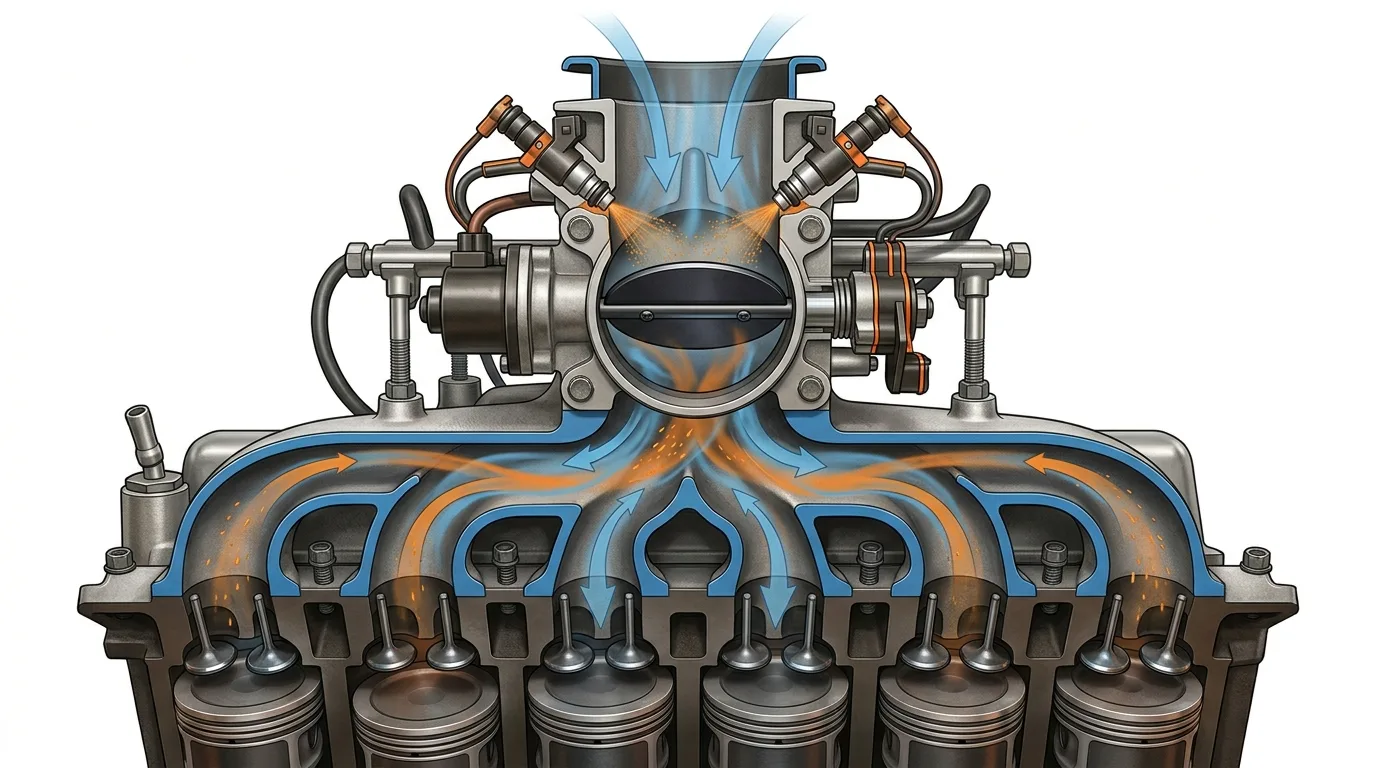
Imagine a carburetor, but instead of jets and floats, you have one or two fuel injectors sitting above the throttle plate. The fuel sprays into the incoming air, then the mixture gets pulled into the intake manifold and distributed to the cylinders.
It was a huge step up from carburetors in the 1980s and early 1990s. It was simpler, more reliable, and could adjust fuel delivery based on sensor feedback.
But it had problems.
Because the fuel has to travel through the whole intake manifold, some cylinders get a richer mix and some get leaner. Cold starts aren’t great. Performance is modest. And emissions aren’t as clean as modern systems.
Pros: cheap, simple, better than a carburetor.
Cons: uneven fuel distribution, weak cold-start behavior, limited precision.
Typical use: older economy cars, trucks, and engines from the 1980s and early 1990s.
If you own a classic fuel-injected car from that era, there’s a good chance it’s TBI.
2. Multi-Point Fuel Injection (MPFI / MPI)
This is the system most people grew up with. One injector per cylinder, mounted in the intake port just before the intake valve.
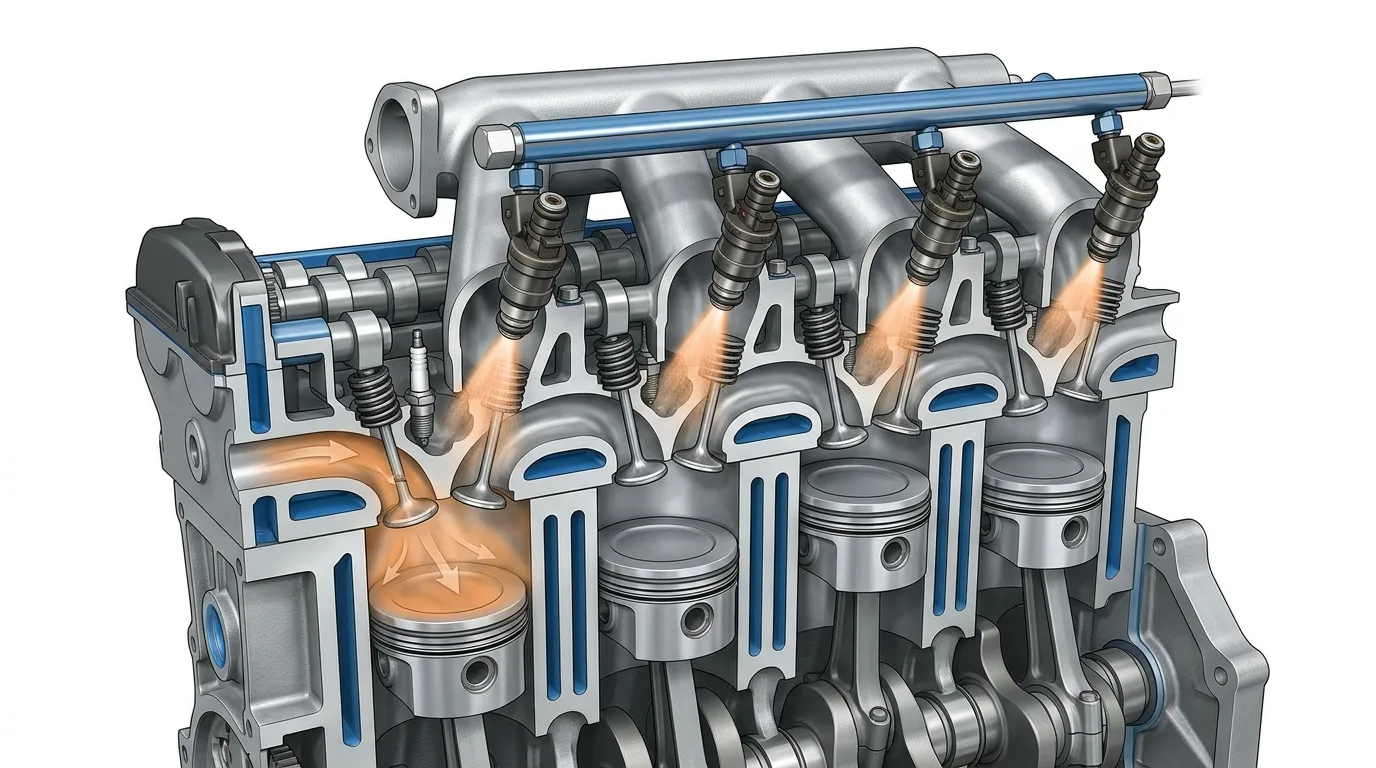
Instead of one central injector trying to feed everybody, each cylinder gets its own fuel delivery. That means better fuel distribution, better throttle response, and cleaner emissions.
There are a few timing strategies:
- Sequential injection: each injector fires right before its cylinder’s intake valve opens. Best control and efficiency.
- Batch-fire injection: injectors fire in groups. Simpler and cheaper.
- Simultaneous injection: all injectors fire at once. Old-school and less precise.
Most modern port-injection engines use sequential injection.
Pros: excellent reliability, good fuel economy, cheaper to repair than direct injection, fuel washes intake valves.
Cons: less precise than direct injection, some fuel can condense on port walls, lower efficiency potential.
Typical use: millions of cars from the 1990s, 2000s, and even today.
If you’ve ever replaced a fuel injector on a Honda, Toyota, or Ford from the 2000s, you’ve met MPFI.
3. Direct Injection (GDI / FSI / DISI)
This is where things get spicy.
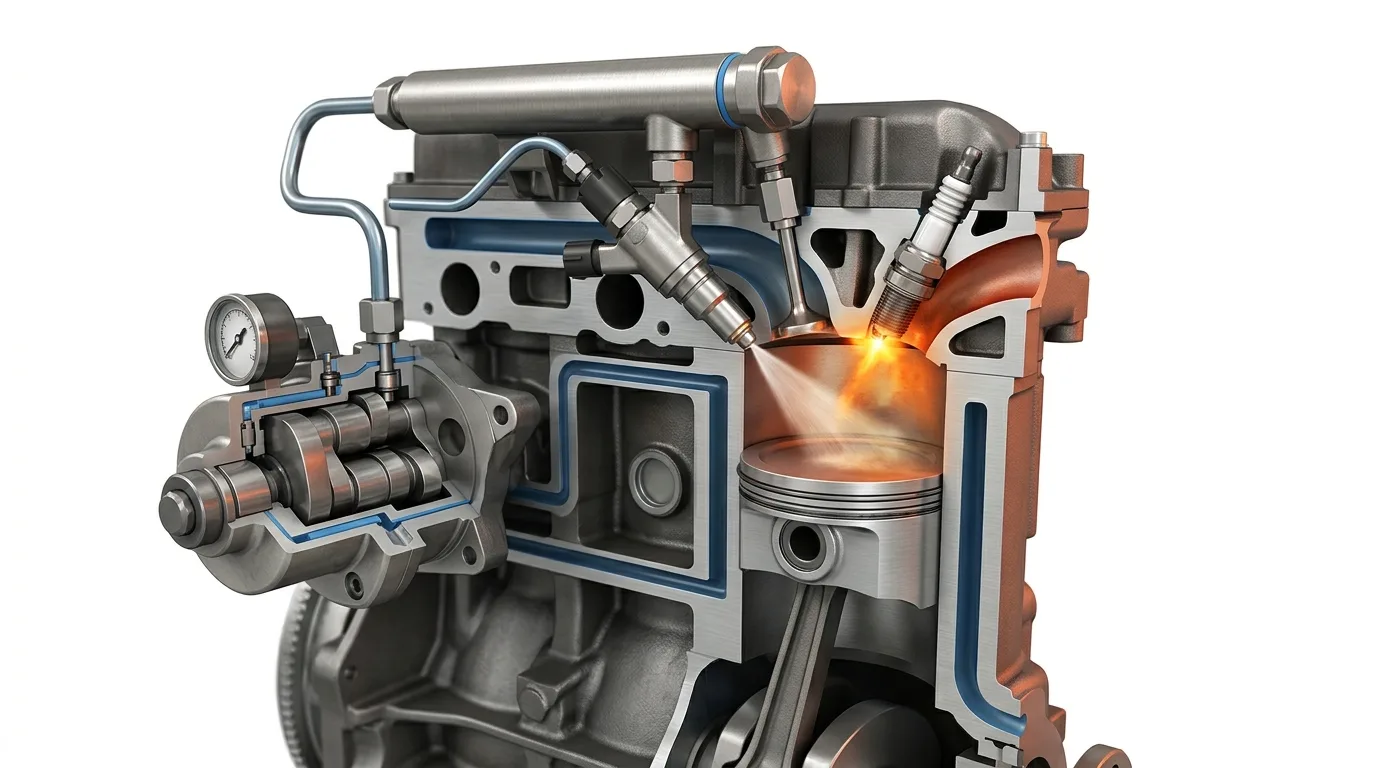
Gasoline direct injection puts the injector directly inside the combustion chamber. Instead of mixing fuel with air in the intake port, it sprays gasoline right into the cylinder.
That requires a high-pressure fuel pump, usually driven by the camshaft, and injectors built to survive extreme pressure and heat. We’re talking hundreds to a few thousand psi.
Direct injection allows two main strategies:
- Homogeneous charge: fuel and air are mixed evenly throughout the cylinder, like a normal engine.
- Stratified charge: a richer pocket of fuel forms near the spark plug, while the rest of the cylinder is lean. This can improve efficiency at light loads.
Pros: more power, better fuel economy, precise fuel control, cooling effect in the cylinder, ideal for turbocharged engines.
Cons: carbon buildup on intake valves, expensive high-pressure parts, complex diagnostics, and sometimes low-speed pre-ignition in turbo engines.
Typical use: modern turbocharged and naturally aspirated engines from Toyota, Honda, Ford, GM, BMW, Mercedes, Hyundai, Kia, and many more.
The big downside? Because fuel no longer washes over the intake valves, carbon deposits can build up over time. That’s why some GDI engines need walnut blasting.
Yes, walnut blasting. Tiny crushed walnut shells. It’s a real thing.
4. Indirect Injection in Gasoline Engines
“Indirect injection” just means the fuel is injected somewhere outside the combustion chamber.
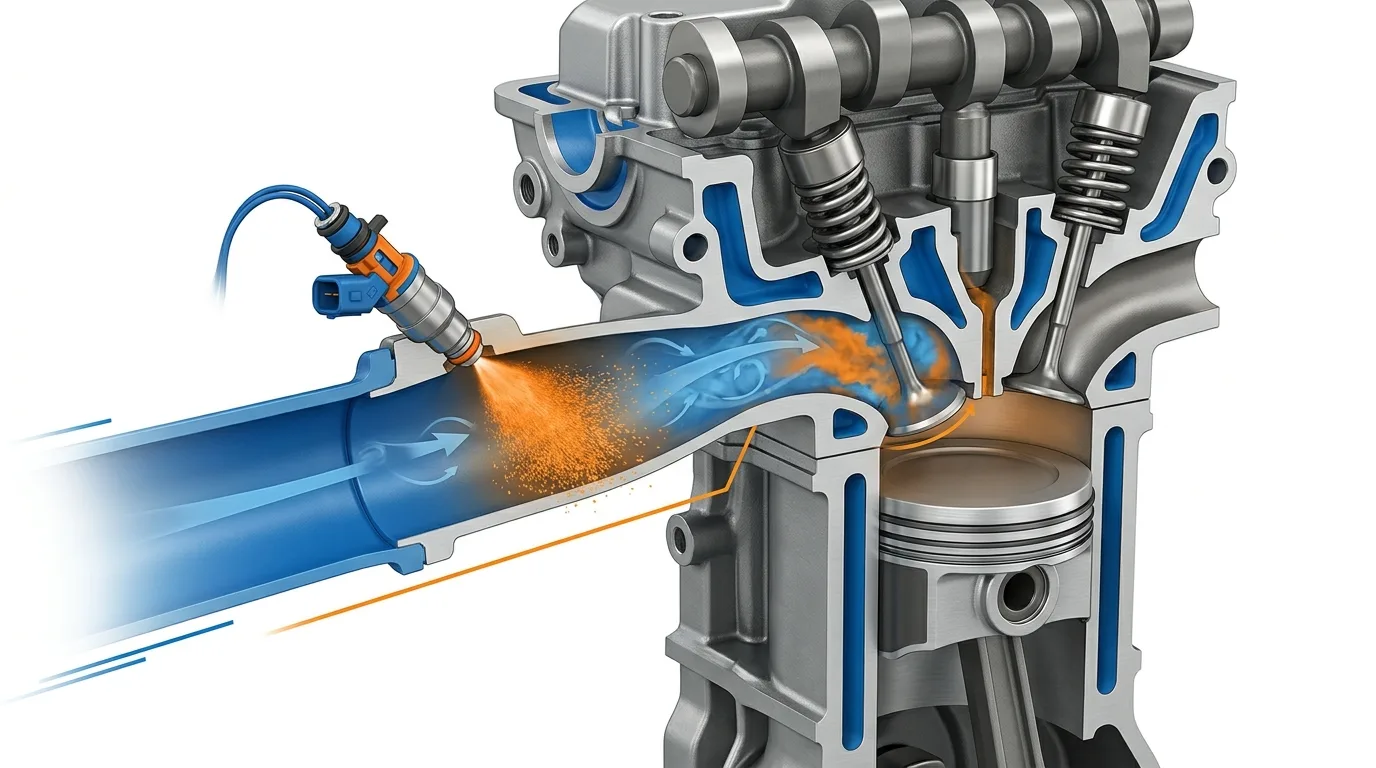
That includes both throttle-body injection and port fuel injection. So yes, most multi-point systems are indirect.
In a port-injection setup, fuel mixes with air in the intake port before the intake valve opens. By the time the air-fuel mixture enters the cylinder, it’s already reasonably well mixed.
This is different from diesel indirect injection, which uses a prechamber or swirl chamber. Gasoline indirect injection is usually just port or throttle-body injection. Diesel indirect injection is a whole different animal because diesel relies on compression ignition, not a spark plug.
Pros: simpler, cheaper, cleaner intake valves, easy to diagnose.
Cons: less efficient than direct injection, lower compression tolerance, less precise fuel control.
Typical use: still common on many non-turbo engines and older vehicles.
5. Dual Injection (Port + Direct)
If port injection is reliable and direct injection is efficient, why not both?
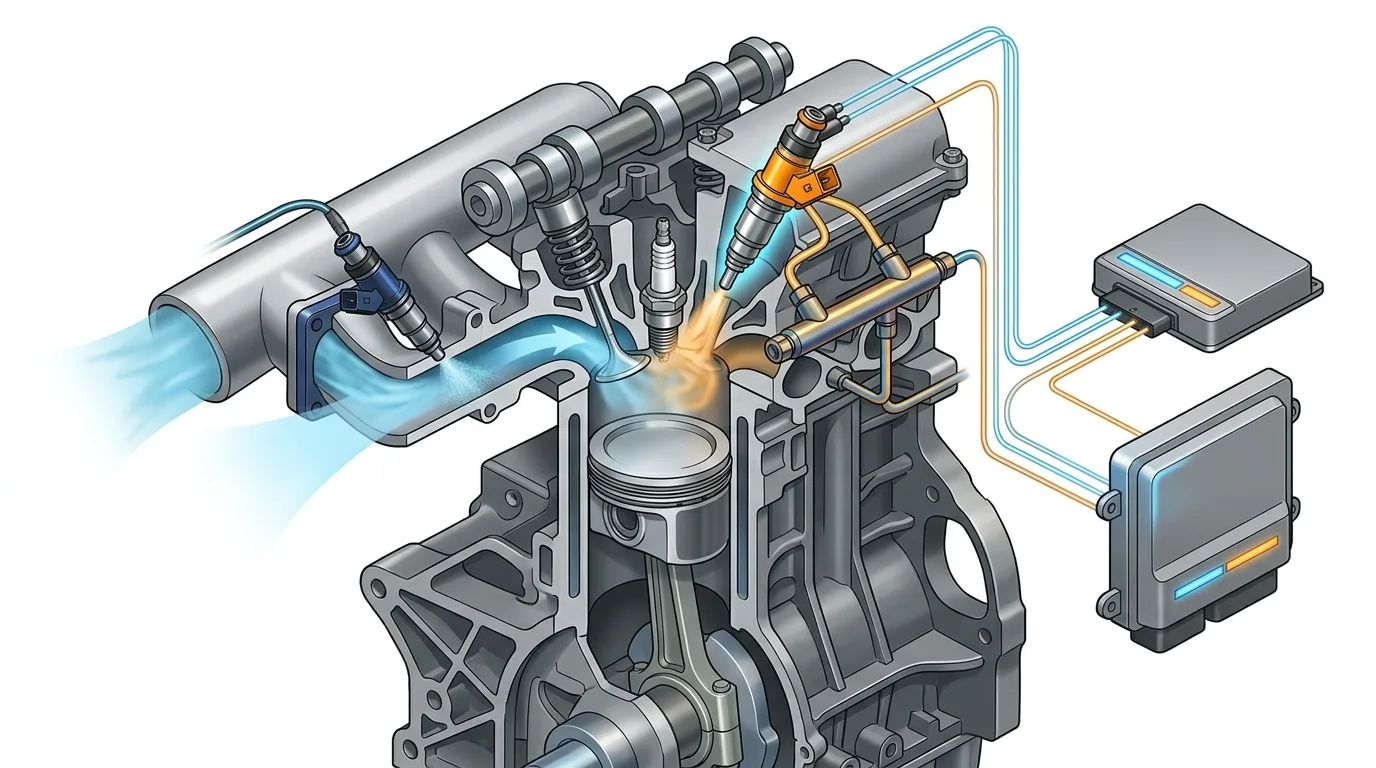
That’s exactly what dual injection does. It uses two injectors per cylinder: one port injector and one direct injector. The ECU decides which one to use — or both — depending on the situation.
At cold start, the port injectors can handle fuel delivery and help clean the intake valves. Under heavy load or high efficiency demands, the direct injectors take over. Sometimes both work together.
Pros: best of both worlds, reduced carbon buildup, better cold-start emissions, improved fuel economy and power.
Cons: more complexity, more parts, higher repair costs.
Typical use: Toyota D-4S, some Lexus, Volkswagen/Audi, and other premium modern engines.
It’s basically the belt-and-suspenders approach to fuel injection.
How Electronic Fuel Injection (EFI) Actually Works
The ECU is the brain. It reads a bunch of sensors:
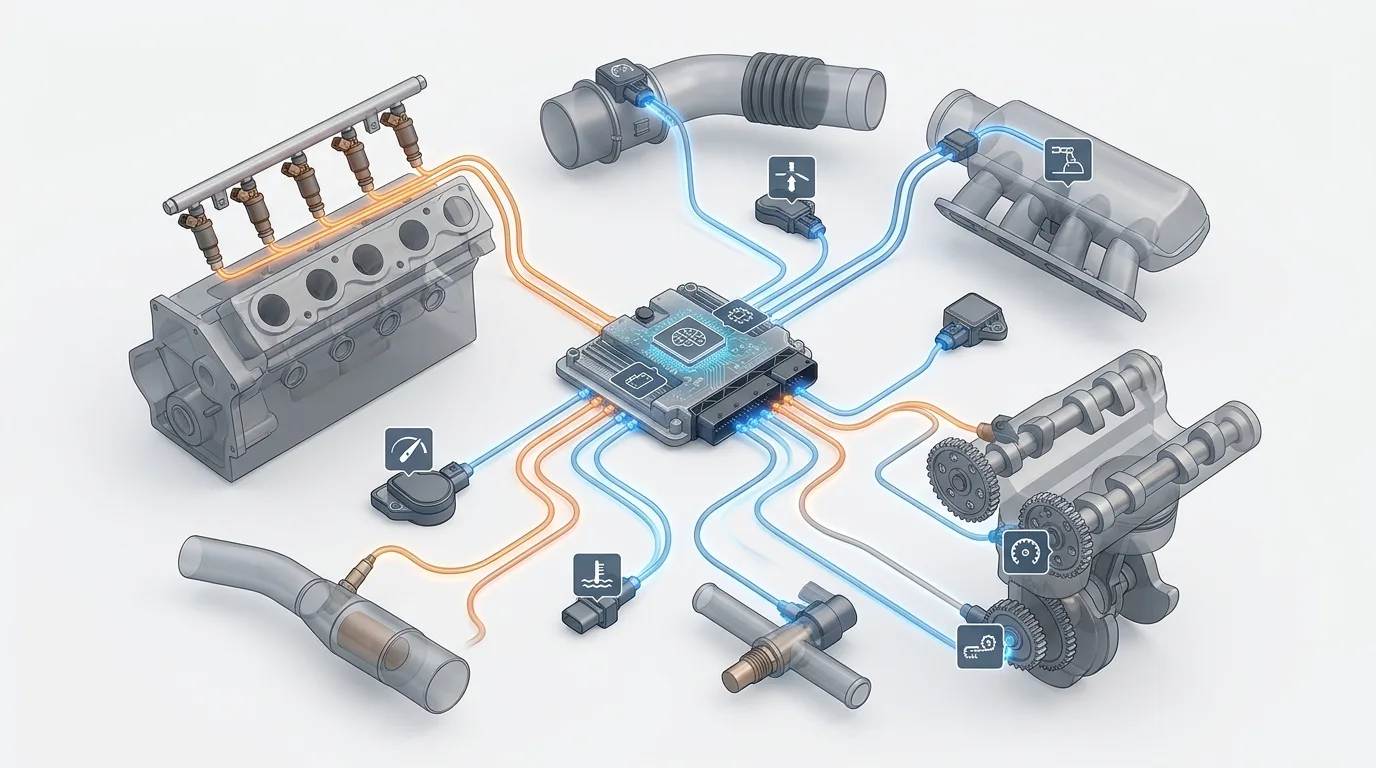
- Mass airflow sensor (MAF): how much air is entering.
- Manifold absolute pressure sensor (MAP): intake manifold pressure.
- Throttle position sensor (TPS): how far you’re pressing the gas.
- Oxygen sensor: how much oxygen is left in the exhaust.
- Engine coolant temperature sensor: how warm the engine is.
- Crankshaft and camshaft position sensors: engine speed and timing.
Then it calculates how much fuel to inject. The injectors open for a specific “pulse width,” measured in milliseconds.
In open-loop mode, the ECU uses preset maps and ignores the oxygen sensor. This happens during cold starts and wide-open throttle.
In closed-loop mode, the ECU uses oxygen sensor feedback to fine-tune fuel delivery. This is how it keeps the air-fuel ratio close to ideal during normal driving.
When something is off, the ECU adjusts fuel trims. Positive fuel trims mean it’s adding fuel. Negative fuel trims mean it’s pulling fuel. If the trims get too far out of whack, you get a check-engine light.
Air-Fuel Ratio: The Magic Number Isn’t Always Magic
For pure gasoline, the stoichiometric ratio is about 14.7:1 by mass. That means 14.7 parts air to 1 part fuel.
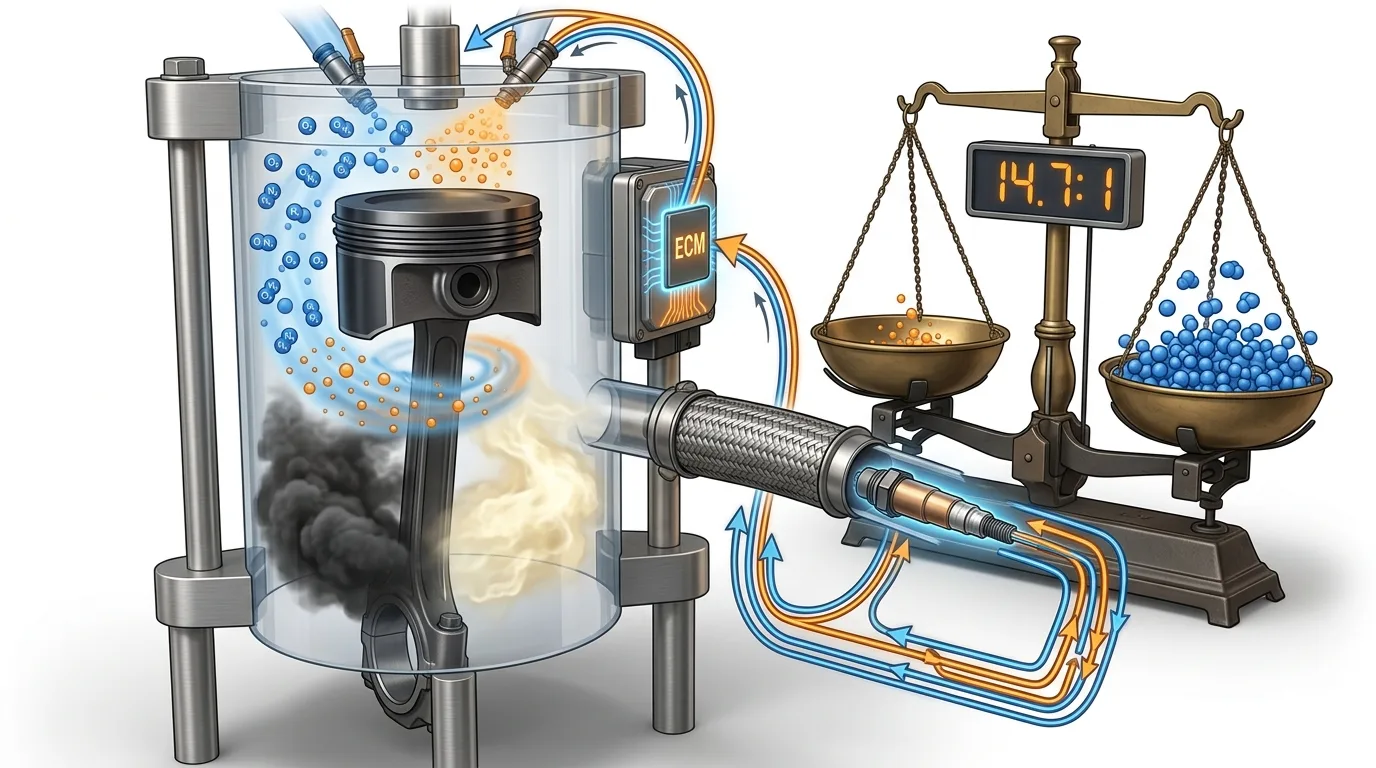
But real-world driving isn’t always stoichiometric.
- Cold start: richer mixture.
- Acceleration: richer mixture for power and cooling.
- Cruising: close to stoichiometric or slightly lean.
- High load: richer mixture to protect the engine.
- Light load: possibly lean or stratified in a GDI engine.
Lambda is another way to express it. Lambda 1.0 equals stoichiometric. Less than 1.0 is rich. Greater than 1.0 is lean.
Get the mixture wrong, and you’ll feel it. Too rich: black smoke, fouled plugs, poor economy. Too lean: hesitation, misfires, high temperatures, and potential engine damage.
Quick Comparison Table
| System | Where Fuel Is Injected | Injectors | Pressure | Pros | Cons | Typical Use |
|---|---|---|---|---|---|---|
| Single-point / TBI | Throttle body | 1–2 | Low | Simple, cheap | Uneven distribution, weak cold start | Old 80s/90s engines |
| Multi-point / MPFI | Intake ports | One per cylinder | Moderate | Reliable, good economy, cheap to fix | Less precise than GDI | Most 90s–2000s cars |
| Sequential MPFI | Intake ports | One per cylinder, timed | Moderate | Best port-injection control | Still indirect | Modern non-turbo engines |
| Direct Injection / GDI | Combustion chamber | One per cylinder | High | Power, efficiency, precise | Carbon buildup, expensive | Modern turbo and NA engines |
| Dual Injection | Port + combustion chamber | Two per cylinder | Both | Best compromise | Complex, costly | Premium modern engines |
Common Fuel Injection Problems
Fuel injectors are tough, but they’re not invincible.
Watch for:
- Hard starting — weak fuel pump, low pressure, leaking injector, bad sensor.
- Rough idle — clogged injector, vacuum leak, ignition problem.
- Poor fuel economy — dirty MAF, lazy oxygen sensor, leaking injector.
- Loss of power — clogged fuel filter, weak pump, restricted injector.
- Misfires — injector fault, spark plug, coil, compression issue.
- Black smoke — rich mixture, leaking injector, bad fuel pressure regulator.
- Check Engine Light — codes like P0171, P0174, P0300, P0301.
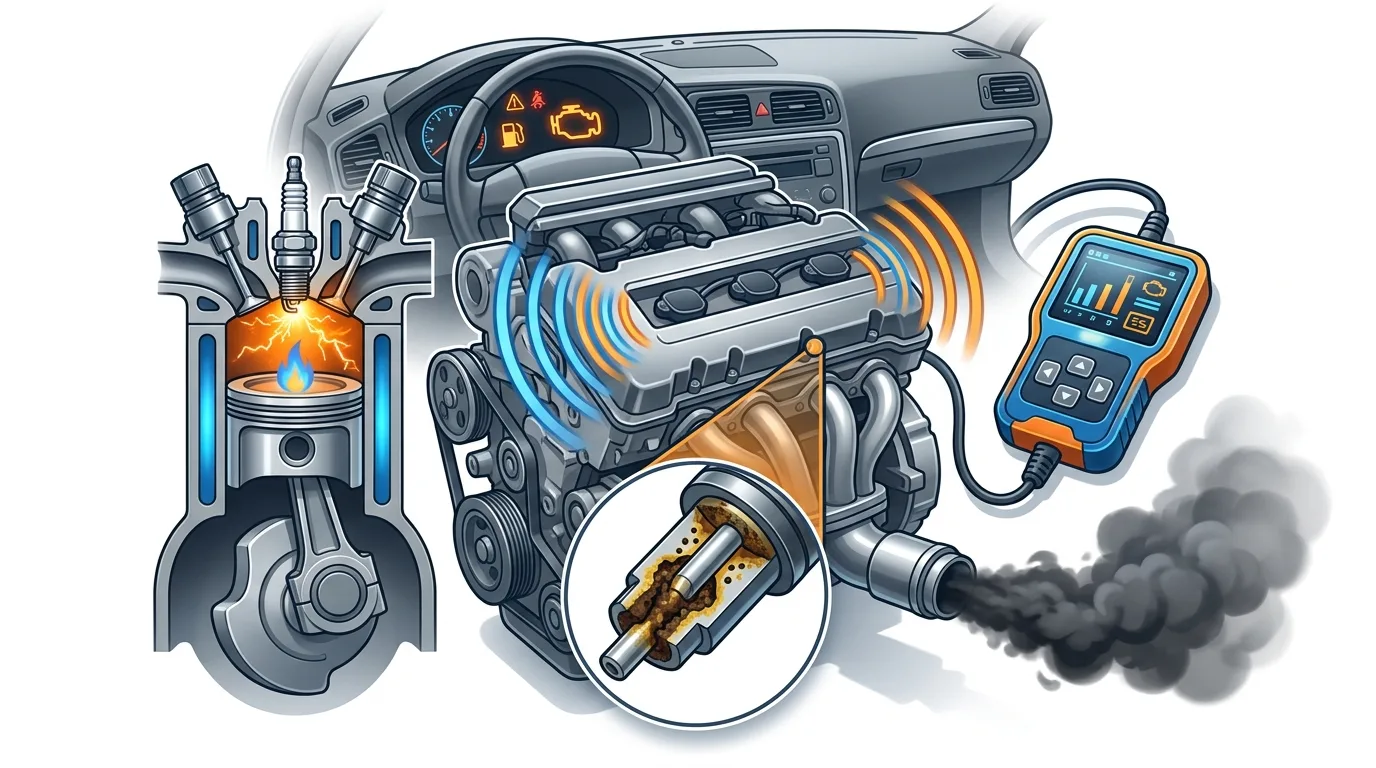
Don’t just throw parts at it. Scan the codes, check fuel trims, test fuel pressure, and inspect the injectors.
Fuel Injection Maintenance: What Actually Matters
There’s no universal “clean your injectors every 30,000 miles” rule. It depends on your engine, fuel quality, and driving conditions.

What you should do:
- Follow the owner’s manual.
- Use Top Tier detergent gasoline.
- Replace the fuel filter when recommended.
- Fix check-engine lights early.
- Consider professional injector cleaning if you have symptoms.
- For GDI engines, be aware of intake valve carbon buildup.
- Check fuel pressure and fuel trims with an OBD-II scanner.
Safety first: fuel is flammable and systems can stay pressurized. Relieve pressure, disconnect the battery, work in a ventilated area, and never smoke around fuel.
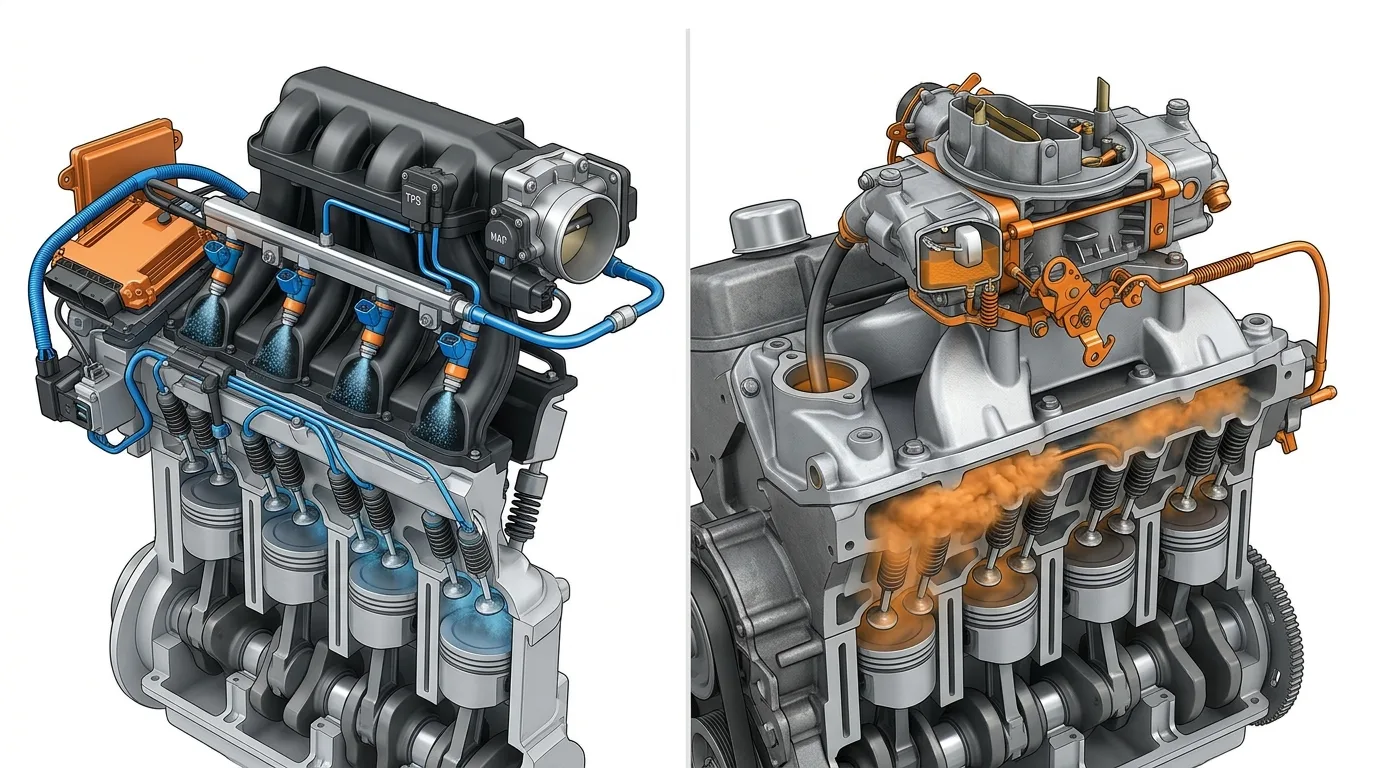
Fuel Injection vs. Carburetor
Carburetors are simple and nostalgic. Fuel injection is precise and smart.
| Category | Carburetor | Fuel Injection |
|---|---|---|
| Fuel metering | Mechanical, imprecise | Electronic, precise |
| Air-fuel control | Limited | Real-time adjustment |
| Cold start | Choke, often rough | Automatic and smooth |
| Fuel economy | Worse | Better |
| Emissions | Higher | Lower |
| Altitude compensation | Poor | Automatic |
| Reliability | Simple but needs tuning | Complex but consistent |
| Repair cost | Cheap parts, frequent tuning | Higher parts, less frequent tuning |
That’s why electronic fuel injection won. It’s cleaner, more efficient, more powerful, and more reliable in daily driving.
Which Gasoline Injection System Is Best?
There’s no single winner.
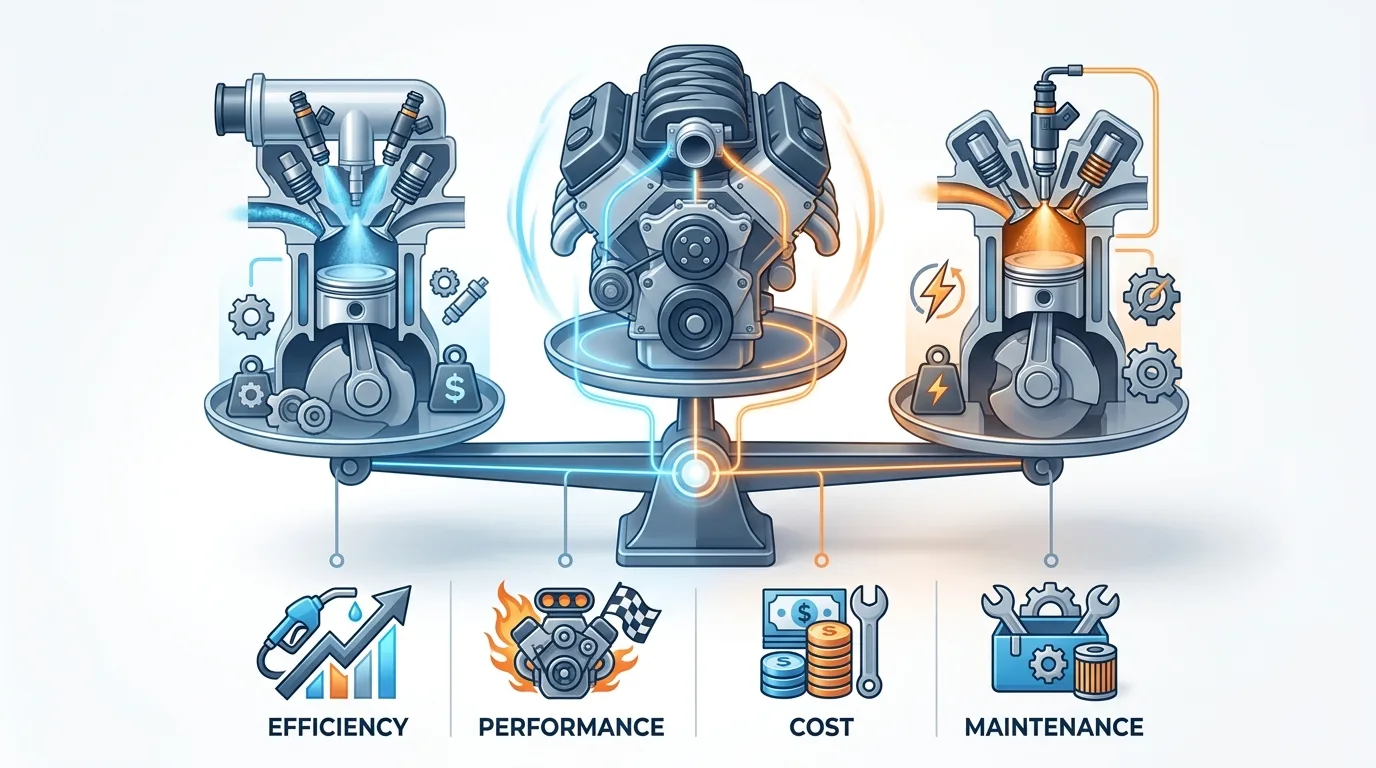
- Port injection is great for reliability, low maintenance, and older vehicles.
- Direct injection is great for efficiency, power, and turbocharging.
- Dual injection is the best of both worlds, but it costs more.
- Single-point injection is outdated but simple.
If you want a cheap, dependable commuter, port injection is fantastic. If you want maximum efficiency and performance, direct injection is the way. If you want the best of both and you’re willing to pay for it, dual injection is the premium answer.
The “best” system depends on the engine’s design, your budget, and how you drive.
The Future of Gasoline Fuel Injection
Fuel injection isn’t standing still.
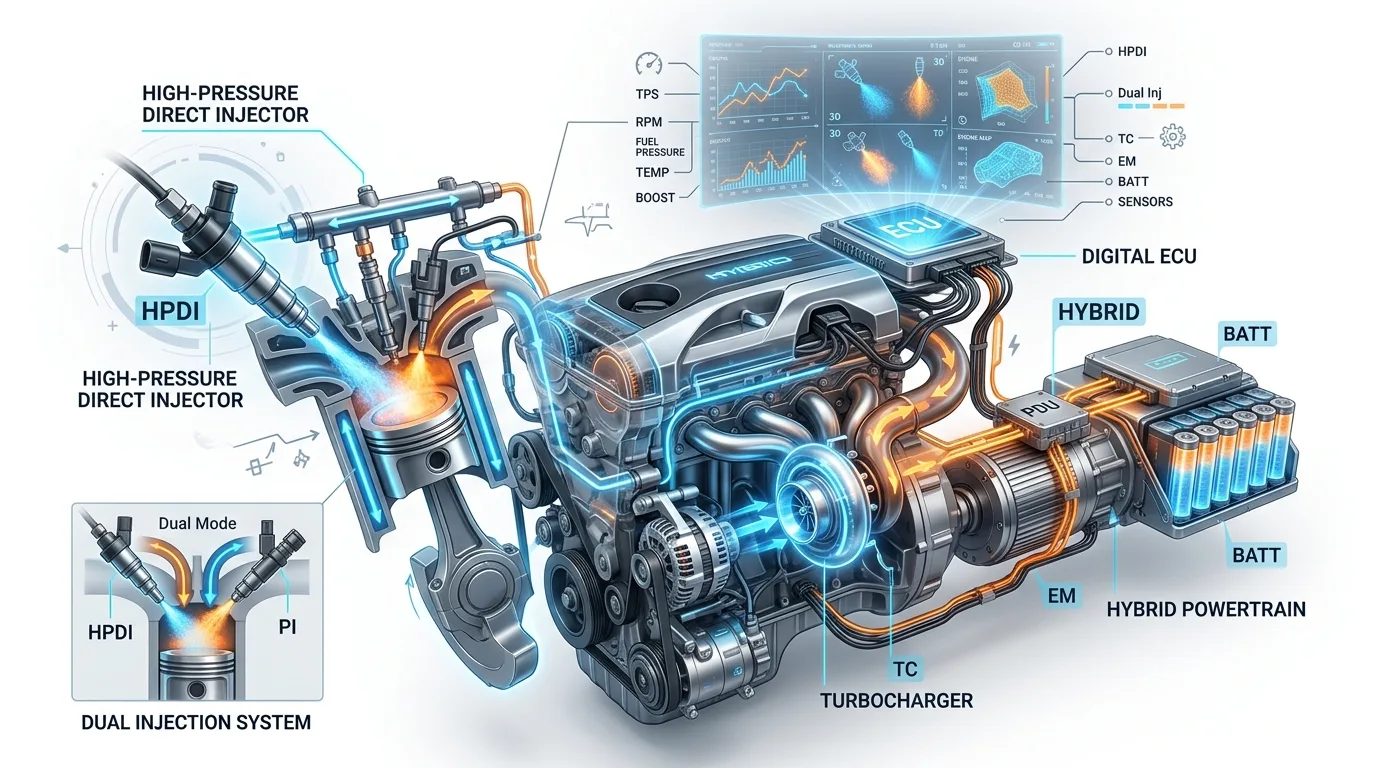
Expect to see:
- Higher-pressure direct injection.
- More advanced dual-injection strategies.
- Better turbocharged, downsized engines.
- Improved combustion control.
- Tighter emissions regulations.
- More integration with hybrid powertrains.
- Continued development of gasoline engine efficiency.
Even as electric cars grow, gasoline engines will keep getting smarter. Fuel injection is a huge part of that.
FAQ
What are the main types of gasoline fuel injection?
Single-point, multi-point, port, direct, and dual injection. Port and throttle-body are indirect. Direct sprays into the cylinder. Dual uses both.
What’s the difference between single-point and multi-point injection?
Single-point uses one or two injectors in the throttle body. Multi-point uses one injector per cylinder in the intake ports.
Is direct injection better than port injection?
For efficiency and power, often yes. For simplicity and lower maintenance, port injection can be better. Direct injection can suffer from carbon buildup on intake valves.
What do SPI, MPI, MPFI, and GDI mean?
SPI: single-point injection. MPI/MPFI: multi-point fuel injection. GDI: gasoline direct injection. They describe different layouts and injection locations.
Can a gasoline engine use both direct and indirect injection?
Yes. That’s dual injection. It uses port and direct injectors together.
Does direct injection consume less fuel?
It can improve efficiency, but real-world fuel economy depends on the engine, tuning, gearing, weight, and how you drive.
What are the symptoms of a faulty fuel injector?
Rough idle, misfires, hard starting, fuel smell, poor economy, loss of power, and check-engine lights.
How often should gasoline injectors be cleaned?
There’s no universal interval. Follow your owner’s manual and address symptoms when they appear.
What is the ideal air-fuel ratio for a gasoline engine?
About 14.7:1 for pure gasoline at stoichiometric. Real-world conditions change the required mixture.
Can a fuel injection system cause the Check Engine Light to turn on?
Absolutely. Injector faults, sensor issues, fuel pressure problems, and mixture errors can all trigger it.
The Bottom Line
Gasoline fuel injection isn’t one thing. It’s a family of systems that all do the same basic job: mix air and fuel as precisely as possible.
Single-point was the first big step. Multi-point made it better. Direct injection made it sharper. Dual injection combined the strengths of both.
If you understand your system, you can diagnose problems faster, maintain it better, and avoid getting ripped off at the repair shop.
And honestly? That’s a superpower every car owner should have.
Related articles
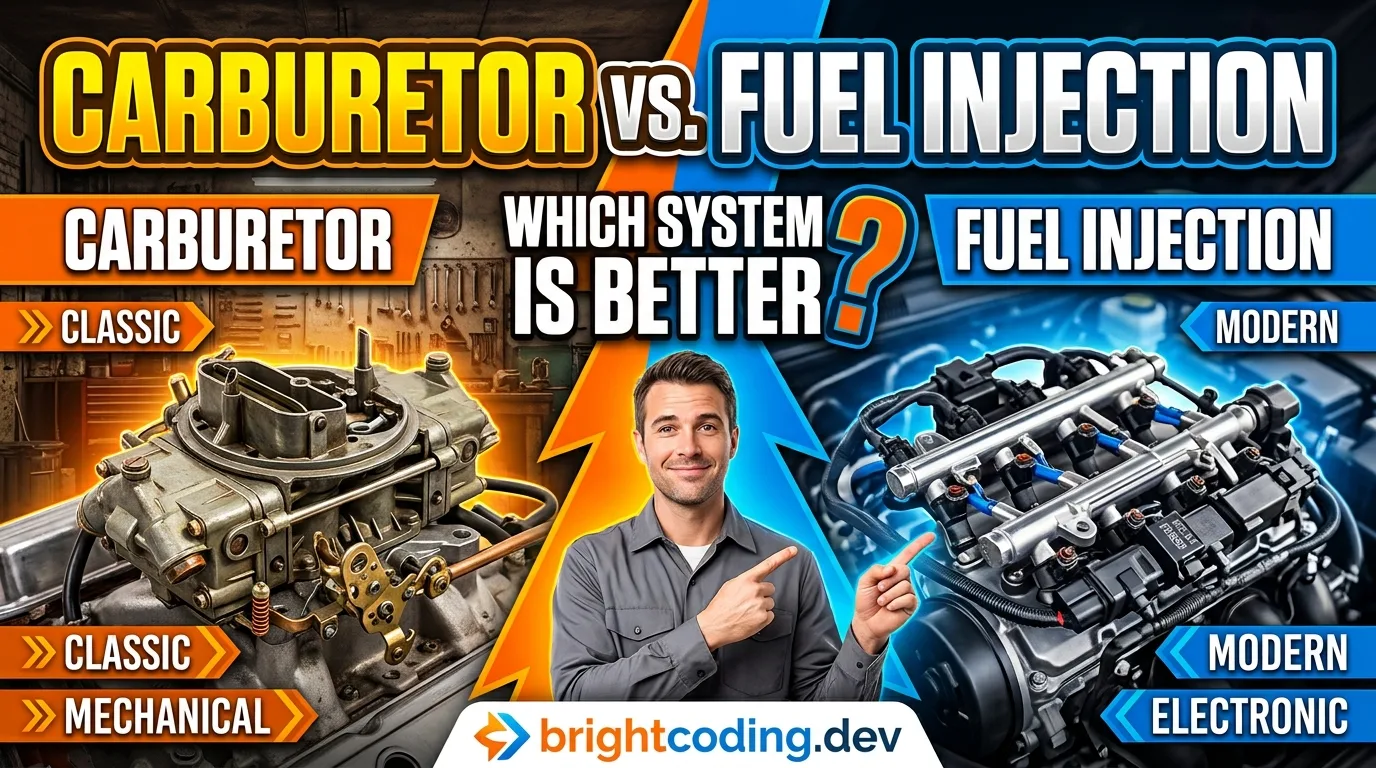
Carburetor vs. Fuel Injection: Which System Is Better?
You already know the short answer: fuel injection wins on paper. It has won in showrooms for decades, and there is no serious argument left about which system meters fuel more precisely. So why does the question still come up in the bay every week?
Read the article →
How to Parallel Park Like a Pro: Simple Tricks That Work
Parallel parking is the one driving skill most people never really learn. They pass the test, then spend the next twenty years circling the block for a spot they can just pull into. That ends today.
Read the article →
How to Keep Your Car Safe When Parking Overnight
Most cars are stolen at night, and most of those thefts are crimes of opportunity, not master criminals outsmarting an alarm. A door left unlocked, a key fob hanging by the front door, a bag visible on the passenger seat: that is what gets a car taken.
Read the article →
What Thieves Look for Before Breaking Into a Car
Most car thefts are not spontaneous. A thief walks or drives past your car first, checks a short list of easy signals, and decides in seconds whether it is worth the risk. This article breaks down what that list looks like, why certain cars get picked over others, and the practical steps that actua…
Read the article →
25 Amazing Car Features Hidden in Plain Sight That Will Surprise You
Most cars carry a stack of clever features the owner never touches. The manual is 400 pages, nobody reads it, and the salesperson only had twenty minutes. This guide walks you through 25 of those features, one at a time, with what to do, why it matters and a tip that saves you the trial and error.
Read the article →
Gasoline Engine Systems: From Carburetor to Fuel Injection
Your car either has a carburetor or fuel injection, and the difference explains a lot about how it starts, idles, and drinks gas. Maybe you just bought an old truck with a carb under the hood and you are not sure what you are looking at. Or your modern car is running rough and someone told you it i…
Read the article →