ECU Explained: How a Car's Engine Control Unit Works
If you have ever wondered what that silver box under the hood actually does, this guide is for you. By the time you finish reading, you will understand how an engine control unit (ECU) reads sensors, calculates fuel and spark, and stores the fault codes you pull with a scan tool. You will also know…
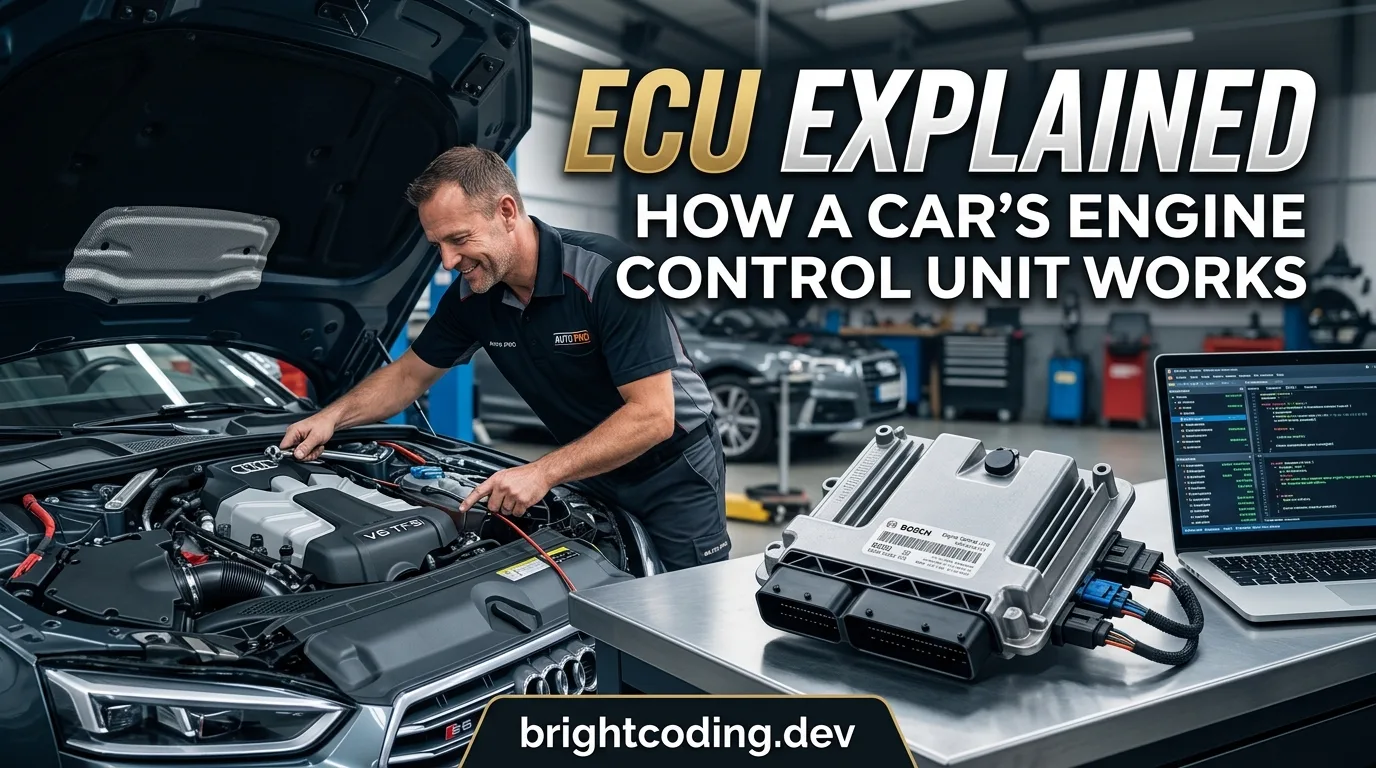
If you have ever wondered what that silver box under the hood actually does, this guide is for you. By the time you finish reading, you will understand how an engine control unit (ECU) reads sensors, calculates fuel and spark, and stores the fault codes you pull with a scan tool. You will also know how to approach real ECU diagnosis without firing the parts cannon. Give it about 20 minutes to read, and maybe an hour in the shop to practice on a real car.
What you need before you start
- A scan tool or OBD2 adapter and a phone or laptop
- A multimeter with fine probes
- Basic hand tools: sockets, ratchet, screwdriver set
- The factory service manual or a reputable repair database for your vehicle
- A notebook or phone for logging readings
- Safety glasses and nitrile gloves
You do not need an oscilloscope to start, though it helps later. A decent scan tool with live data is the single most useful purchase here. If you do not own one yet, the free OBD code lookup is a good place to start translating what your scanner pulls.
Step 1: Understand what the ECU actually is
The engine control unit is a computer, usually mounted in the engine bay or under the dash, that runs the engine. It takes inputs from sensors, runs them through stored maps and calculations, and commands outputs like fuel injectors, ignition coils, and the throttle body. That loop repeats thousands of times per minute.
Think of it as a manager who never sleeps. It reads the room (sensors), makes a decision (fuel and timing), and checks the result (feedback from oxygen sensors and knock sensors) to adjust next time. Once that picture clicks, diagnosis stops feeling like magic.
Tip: Before you touch anything, identify the ECU location on your specific model. It is usually in the service manual under "Powertrain Control Module" or "Engine Control Module." Some cars call it PCM, ECM, or DME. Same idea, different badge.
Step 2: Learn the input side, sensor by sensor
The ECU trusts its sensors. If a sensor lies, the ECU makes bad decisions with confidence. The core inputs to know:
- Mass airflow (MAF) or manifold absolute pressure (MAP): tells the ECU how much air is entering
- Crankshaft and camshaft position: tells it engine speed and stroke
- Coolant temperature: cold enrichment and fan control
- Throttle position: driver demand
- Oxygen sensors (upstream and downstream): fuel trim feedback and catalyst monitoring
- Knock sensor: retards timing to protect the engine
Spend an afternoon tracing these on a wiring diagram. You will start seeing patterns: a lean condition often traces back to unmetered air, a rich condition to a leaking injector or a lazy sensor.
Practical time note: Tracing the main sensor circuits on a four-cylinder engine usually takes 45 to 90 minutes the first time. Budget more if the intake plumbing is buried.
Step 3: Learn the output side
Outputs are what the ECU commands. Fuel injectors, ignition coils, the electronic throttle body, variable valve timing solenoids, the EVAP purge valve, and the fuel pump relay are the usual suspects. Each output has a driver circuit inside the ECU, and those drivers fail more often than the processor itself.
Why it matters: A dead injector driver looks exactly like a dead injector from the driver's seat. Testing the circuit, not just the part, is how you tell the difference. Back-probe the injector connector with a noid light or a scope while cranking. If the ECU is commanding the injector and there is no pulse, the problem is upstream of the injector.
Safety warning: Fuel is pressurized. Depressurize the system per the manual before opening any fuel line, and keep a fire extinguisher within reach. Never smoke or work near a water heater or open flame.
Step 4: Read live data like a technician, not a scanner owner
Plug in your scan tool and pull live data. Watch these PIDs at idle and at around 2,500 rpm:
- Short-term and long-term fuel trims (bank 1 and bank 2 if applicable)
- MAF or MAP reading versus expected
- Coolant temperature after a cold soak
- Upstream O2 sensor switching
- Calculated load and throttle position
Healthy fuel trims hover near zero, usually within plus or minus 10 percent, though exact normal ranges vary by manufacturer. Verify against the service manual. If trims climb steadily, you have a vacuum leak or a fuel delivery problem. If they sit negative, look for a rich condition.
The OBD live-data tool is a good way to log and review these values without scribbling on your hand. Pair it with a notebook and record the same snapshot before and after any repair.
Step 5: Pull and interpret fault codes properly
Read the codes, write them down, then clear nothing yet. A code is a symptom, not a diagnosis. P0171 means the ECU saw a lean condition on bank 1; it does not mean "replace the oxygen sensor." Look up the code and its likely causes using the free OBD code lookup, then check the freeze-frame data. Freeze frame tells you the conditions when the fault set: engine speed, load, coolant temp, and fuel trim.
Tip: Codes that set together often share a cause. A P0300 misfire plus a P0171 lean code on the same bank usually point to one root problem, not two.
Step 6: Test the circuit before condemning the ECU
This is where most DIY diagnoses go wrong. The ECU is rarely the failure. Before you replace it, verify:
- Power and ground at the ECU connector with a load test, not just a voltmeter
- Sensor reference voltage (usually around 5 volts, confirm in the manual)
- Continuity and resistance on the suspect circuit
- No corrosion or pushed pins at the connector
Safety warning: Disconnect the battery negative terminal before unplugging the ECU, and wait a few minutes for capacitors to discharge. Static electricity can damage circuit boards. Touch a grounded metal surface before handling the unit.
Approximate cost note: A remanufactured or used ECU typically runs from a few hundred to over a thousand dollars depending on the model, and many require programming or immobilizer matching. That is why you test first. A dealer programming fee alone can be a couple hundred dollars.
Step 7: Understand programming and adaptation
Modern ECUs are married to the car. Replacing one often requires flashing software, transferring the immobilizer data, and performing relearns for the throttle body, crankshaft position sensor, and idle. Some of this you can do with a capable scan tool; some requires a dealer or a specialist with the factory software.
After any ECU swap, expect to drive the car through a readiness cycle before emissions testing. The exact drive cycle varies by manufacturer, so check the manual or a repair database.
Step 8: Know when to stop and call in help
If you have verified power, ground, sensor inputs, and output commands, and the ECU still misbehaves, you may have an internal driver failure. That is the point to bring in a specialist with a bench test or a known-good replacement. Chasing an intermittent CAN bus or a chafed harness without a scope and a wiring diagram will eat your weekend.
If you are stuck, run the symptoms through the car symptom finder to see what other owners report, or ask the AI mechanic assistant to walk through a diagnostic tree with you. Neither replaces a proper test, but they can point you in the right direction.
Pro tips
- Log live data before and after every repair. The before-and-after comparison is the fastest proof your fix worked.
- Learn your car's normal fuel trim numbers on a healthy day. Then you will spot a drift before it sets a code.
- A noid light on the injector connector tells you in seconds whether the ECU is commanding fuel.
- Check grounds first. A corroded engine ground can mimic a dozen sensor failures.
- Keep a photo of every connector before you unplug it. Reassembly mistakes cost more time than the photo ever will.
- Use the mechanic quiz to sharpen your diagnostic instincts between jobs. It is a low-stakes way to spot gaps in your knowledge.
Common pitfalls
Throwing parts at a code. A P0420 catalyst code does not always mean a new catalytic converter. Check for exhaust leaks, lazy O2 sensors, and misfires first.
Ignoring freeze-frame data. That snapshot tells you exactly when the fault set. Skipping it turns a 20-minute diagnosis into a two-day guessing game.
Assuming the ECU is dead. Power and ground faults, bad grounds, and chafed harnesses account for far more no-start conditions than failed ECUs.
Skipping the battery disconnect. Unplugging sensors or the ECU with the key on can set false codes or damage electronics. Always key off, battery negative disconnected, before major electrical work.
Forgetting the relearn. A throttle body cleaning or ECU swap without the proper relearn can cause a rough idle that looks like a new fault.
Useful resources
- Your vehicle's factory service manual or a reputable online repair database for wiring diagrams and torque specs
- The step-by-step car guides for related jobs like sensor replacement and throttle body cleaning
- The mechanical encyclopedia for component background
- The free car tools section for calculators and lookup utilities
- The AutoTools blog and expert car tips for ongoing reading
- The tire size comparison tool when you need to check whether a wheel change affects speedometer calibration and, indirectly, what the ECU sees
- Manufacturer-specific forums and technical service bulletins, which often document known ECU quirks
FAQ
Can I drive with a failing ECU? Sometimes, but not safely. A failing ECU can cause stalling, misfires, or a sudden loss of power. If the car is running rough or cutting out, park it and diagnose before driving further.
Does a check engine light always mean the ECU is bad? No. The light means the ECU detected an out-of-range condition. Most of the time the ECU is doing its job and reporting a problem elsewhere.
How much does an ECU replacement cost? Estimates vary widely. A used or remanufactured unit might be a few hundred dollars, programming another few hundred, and dealer labor on top. Always get a quote for your specific model.
Can I program an ECU myself? Some vehicles allow relearns and basic flashing with a capable scan tool. Immobilizer matching and full software updates usually require dealer or specialist equipment.
Will disconnecting the battery reset my ECU? It will clear adaptive memory on many cars, and the ECU will relearn idle and fuel trims over the next few drive cycles. It will not fix a hard fault.
Final word
The ECU is not a mystery box. It is a computer that follows rules, and once you understand the inputs, outputs, and feedback loop, diagnosis becomes a process instead of a guess. Start with live data, verify the circuit, and only then suspect the brain. You will save money, time, and a lot of frustration.
Related articles

Bad ECU Symptoms: 15 Warning Signs You Should Never Ignore
Your car starts fine one morning, then cranks forever the next. Or it idles rough, stalls at a light, and the dash lights up like a Christmas tree. The ECU (engine control unit) is the computer that runs fuel, spark, and a dozen other systems, and when it misbehaves, the symptoms look like everythi…
Read the article →
Stop Throwing Parts at Your Car: The 4-Step Sensor Diagnostic Method That Actually Works
A fault code points to a circuit or behavior—not automatically a failed sensor. This practical guide covers the 8 engine sensors every DIYer and technician should understand, plus the 4-step test process that prevents expensive parts-swapping and misdiagnosis.
Read the article →
The Ultimate Guide to Engine Sensors: 40+ Types, Functions, and Failure Symptoms (Gasoline & Diesel)
Engine sensors control performance, fuel economy & emissions. Learn 40+ sensor types, failure symptoms, testing methods, and OBD-II codes for gas & diesel engines.
Read the article →
OBD2 Scanner Guide: How to Choose and Use One
A check engine light comes on and your stomach drops a little. It shouldn't. With a cheap OBD2 scanner and about twenty minutes, you can read the code, understand what it means, and decide whether to fix it yourself or hand it to a shop with a clear description of the problem. This guide walks you…
Read the article →
10 Hidden Car Settings You Can Activate Today
Most modern cars ship with features the previous owner never turned on, and the manual buries them three sections deep. This article answers the questions car owners actually search for: which settings are hiding in plain sight, how to find them, and what to do when the option seems missing. No too…
Read the article →
How to Reprogram a Car Key Remote After a Battery Change
You changed the battery in your key fob, and now the car won't lock. Or it locks but the trunk button does nothing. Annoying, and a little alarming.
Read the article →