How Fuses, Relays, Sensors, and the ECU Work Together in a Car
A car's electrical system looks like a nest of wires until you understand the four parts that run it: fuses protect it, relays switch it, sensors read it, and the ECU decides what to do with it. Once those roles click, a no-start, a dead accessory, or a mystery warning light stops being a guess and…
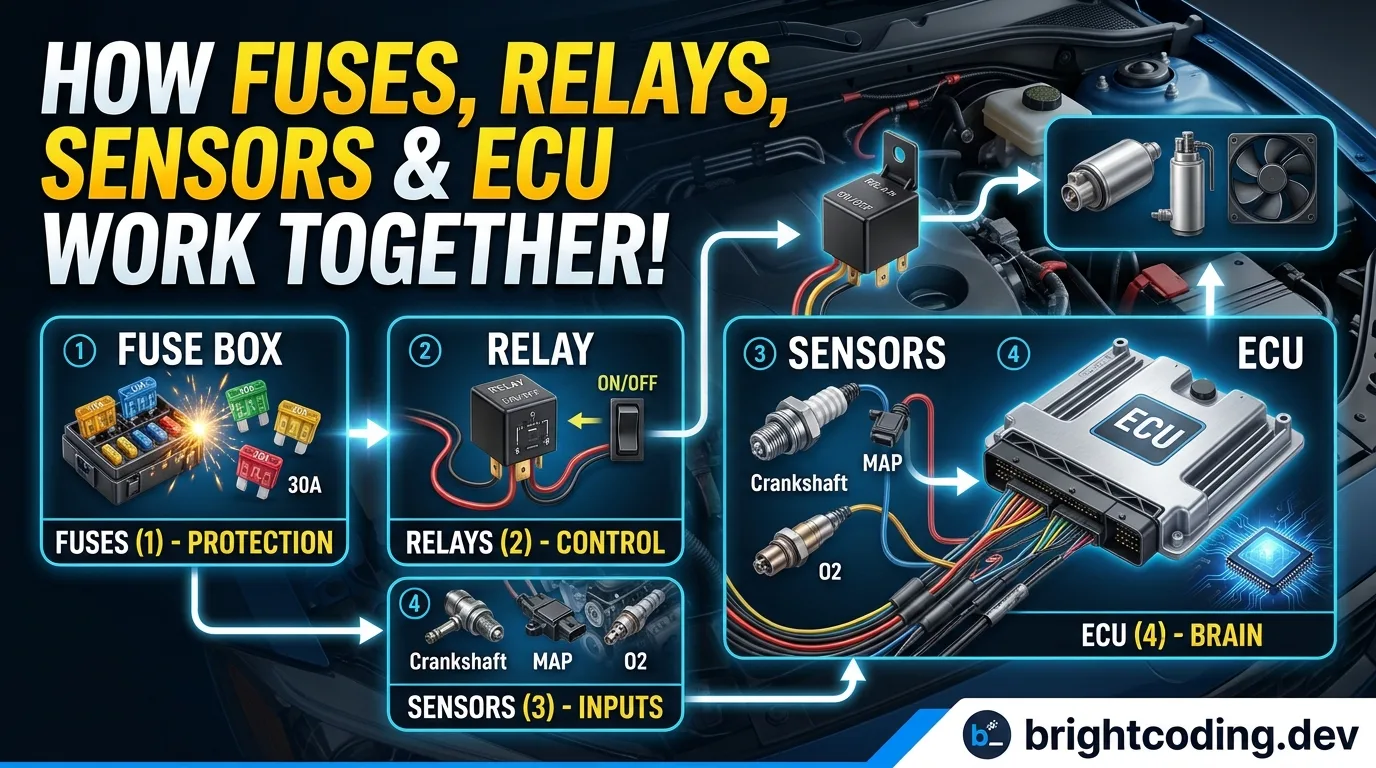
A car's electrical system looks like a nest of wires until you understand the four parts that run it: fuses protect it, relays switch it, sensors read it, and the ECU decides what to do with it. Once those roles click, a no-start, a dead accessory, or a mystery warning light stops being a guess and becomes a plan.
By the end of this guide you'll be able to trace a circuit from battery to load, test a fuse and a relay without melting anything, read a sensor's job in plain terms, and understand how the ECU ties it all together. Give it about 30 to 45 minutes of reading and a little time under the hood to try it for real.
What you need before you start
You don't need much, and none of it is expensive:
- Your owner's manual (fuse box maps live here, not in your head)
- A digital multimeter
- A test light
- A fuse puller or small needle-nose pliers
- A cheap set of spare fuses in the ratings your car uses
- A wiring diagram for your specific model, if you can find one (factory service info or a solid repair database)
- Safety glasses and gloves
If a job needs a relay swap or a sensor change, buy the exact part for your year, make, and model. Don't guess by looks.
Step 1: Understand the four players before you touch anything
Think of it like a house. The battery is the supply. Fuses are the breakers. Relays are the light switches that let a tiny finger control a big current. Sensors are the thermostats and motion detectors reporting conditions. The ECU is the homeowner reading it all and deciding what turns on.
That mental model matters because most electrical faults trace back to one of these four roles failing. A blown fuse is protection working. A dead relay is a switch that won't flip. A lazy sensor sends bad data. A confused ECU responds to bad data with a real symptom, like a rough idle or a no-start.
Tip: Keep this order in mind for every diagnosis: power, protection, switch, signal, decision. You'll move through it fast once it's habit.
Step 2: Locate the fuse boxes and read the map
Most cars have at least two: one under the hood and one inside the cabin, often near the dash or in the trunk. Open the lid and read the printed diagram. It tells you which fuse feeds which circuit.
Why it matters: Chasing a fault through the wrong circuit wastes hours. The fuse map is the shortcut.
Match the fuse rating printed on the map to the fuse in the slot. If someone before you stuffed a 30A fuse where a 10A belongs, that's a red flag and a fire risk.
Safety: Disconnect the battery negative terminal before pulling or replacing fuses if you're working near anything sensitive. Never bridge a blown fuse with wire or foil. Ever.
Cost/time: Fuses are cheap, usually a few dollars for a mixed pack. Two minutes to check.
Step 3: Test a fuse properly, not by eyeballing it
A fuse can look fine and still be open. Pull it and check continuity with your multimeter on the ohms setting, or use a test light with the circuit powered.
Why it matters: A hairline crack you can't see will send you hunting for a problem that's sitting right in your hand.
Tip: If a fuse blows again immediately after replacement, stop. You have a short to ground somewhere in that circuit. Replacing it repeatedly won't fix it and can damage wiring. That's the moment to grab a wiring diagram and work backward from the load.
Step 4: Learn how a relay actually switches
A relay is an electromagnetic switch. A small control current energizes a coil, which pulls a contact closed and sends power to the load. That's why your headlight switch doesn't carry the full headlight current, and why a relay can fail while the fuse stays intact.
Test it in three quick moves:
- Confirm the control side is getting power and ground at the coil pins when the switch is on.
- Listen or feel for a click when the circuit is energized.
- Swap in an identical relay from a non-critical spot (many cars share the same relay type) to see if the symptom moves.
Why it matters: A no-click often means the control circuit is dead, not the relay. A click with no output means the contacts are burned.
Safety: Ignition off, key out, battery negative disconnected before you pull relays unless you're doing a live voltage test with the meter.
Cost/time: Relays are typically inexpensive, often under $20 for common types. Five minutes to swap and test.
Step 5: Understand what sensors actually do
Sensors convert a physical condition into a voltage or signal the ECU can read: crankshaft position, camshaft position, coolant temperature, mass airflow, oxygen content, throttle position, wheel speed, and more. Each one has a reference voltage from the ECU and a return signal.
Two failure modes matter most. A sensor can go open or shorted, which usually sets a code and a default. Or it can drift, reporting plausible but wrong data, which is nastier because the ECU trusts it.
Why it matters: A dirty mass airflow sensor can make a healthy engine run lean. A failing coolant temp sensor can make cold starts miserable. Neither is a "broken part" in the obvious sense.
Tip: Before replacing any sensor, check its connector and wiring. Corroded pins and chafed wires cause more sensor codes than the sensors themselves. When you do get a code, run it through the free OBD code lookup at our tools page to see what the ECU is actually complaining about.
Step 6: See how the ECU makes decisions
The ECU (engine control unit) reads sensor inputs, compares them to programmed maps, and commands outputs: injector pulse width, ignition timing, idle speed, fan operation, fuel pump relay, and more. It's a decision engine, not a magic box.
When a sensor reads out of range, the ECU does two things: it stores a diagnostic trouble code and it substitutes a default value so the car can limp along. That's why a faulty sensor often produces a drivability symptom rather than a dead engine.
Why it matters: Understanding this stops you from blaming the ECU for everything. The ECU is usually the messenger. The fault is upstream in a sensor, a wire, or a ground.
Step 7: Trace a real circuit from battery to load
Pick a simple, non-critical circuit to practice on, like a horn or a dome light. With your wiring diagram open, follow the path: battery positive, fuse, relay (if present), load, ground. Check voltage at each point with the circuit on.
Why it matters: This is the single most useful skill in automotive electrical work. Every fault is somewhere on that path.
Tip: Voltage drop testing beats simple voltage checks. Measure across a connection while the load is on. A healthy connection drops very little. A corroded one drops a lot. If you're not sure what a reading should be, check the shop manual or ask a mechanic.
Step 8: Pull codes and read them in context
Plug in an OBD-II scanner and pull stored and pending codes. Write them down before you clear anything. Then think about what sensors share a circuit or a ground with the code you got.
Why it matters: One bad ground can trigger five unrelated codes. Clearing codes without diagnosing erases the evidence.
Safety: Never clear codes to "make the light go away" before a smog test. The monitors won't be ready and you'll fail anyway. Verify readiness with the scanner.
Cost/time: Basic code readers are cheap; a good scan tool costs more but pays for itself. Ten minutes to pull and log codes.
Step 9: Confirm the repair and recheck the whole system
After replacing a fuse, relay, or sensor, clear codes only after the repair is done, then drive the car through a normal cycle and recheck. Confirm the symptom is gone and the monitors set.
Why it matters: A repair that "seems fixed" in the driveway can return under load or heat. A test drive confirms it.
Tip: If you're new to this, follow a structured sequence from a reliable guide. Our step-by-step car guides walk through common electrical jobs in order, which keeps you from skipping a check.
Pro tips
- Load-test, don't just voltage-test. A circuit can show 12V and still fail under current. Use a test light or a load to prove it.
- Chase grounds first. Bad grounds cause more weird electrical behavior than anything else. Clean and tighten them before buying parts.
- Freeze frame data is gold. Many scanners save the sensor readings at the moment a code set. That snapshot tells you what the ECU saw, not what you see now.
- One change at a time. Swap one part, test, then move on. Stacking repairs hides which one worked.
- Keep a log. Note the symptom, the code, the test result, and the fix. You'll thank yourself next time.
- When in doubt, look it up. The mechanical encyclopedia is a solid place to check how a component is supposed to behave before you condemn it.
Common pitfalls
- Replacing the ECU first. It's rarely the ECU. Test sensors, wiring, and grounds before you spend on a module, and remember a replacement ECU may need programming.
- Using a bigger fuse to stop it blowing. That defeats the protection and risks a fire. Find the short instead.
- Ignoring corroded connectors. A shiny new sensor plugged into a green, crusty connector will still misbehave. Clean the pins.
- Clearing codes before writing them down. You lose the freeze frame and the history. Log first, clear later.
- Skipping the wiring diagram. Guessing wire colors and pin locations wastes time and can damage circuits. Get the diagram for your model.
Useful resources
- Your owner's manual for fuse maps and basic specs
- Factory service information or a reputable repair database for wiring diagrams
- A quality digital multimeter and test light (any decent brand works)
- The free OBD code lookup at our tools page for decoding what the ECU is telling you
- NHTSA for recall information that sometimes explains electrical faults
FAQ
Can a bad relay cause a no-start? Yes. If the relay feeding the fuel pump or starter circuit fails, the engine won't get fuel or crank. Test the control side first, then swap the relay.
Why does my car throw a sensor code but run fine? The ECU may be substituting a default value. It runs, but often less efficiently. Don't ignore it, because it can mask a real problem or hurt fuel economy.
Do I need a professional scan tool? For basic codes, a cheap reader is fine. For live data, bidirectional tests, and module communication, you'll want a better tool or a shop. Verify what your car needs before buying.
Can a blown fuse cause multiple symptoms? Yes, if that fuse feeds several accessories or a shared module. Check the fuse map before assuming several parts failed at once.
Is it safe to replace a fuse myself? Yes, with the ignition off and the correct rating. Never upsize the fuse and never bypass it. If it blows again, stop and diagnose.
Final word
Electrical work rewards patience more than brilliance. Learn the four roles, follow the path from power to ground, and test before you replace. Do that and you'll solve most faults faster than the guy guessing at parts. Start with a fuse map and a multimeter today, and the wiring stops looking like a nest and starts looking like a map.
Related articles
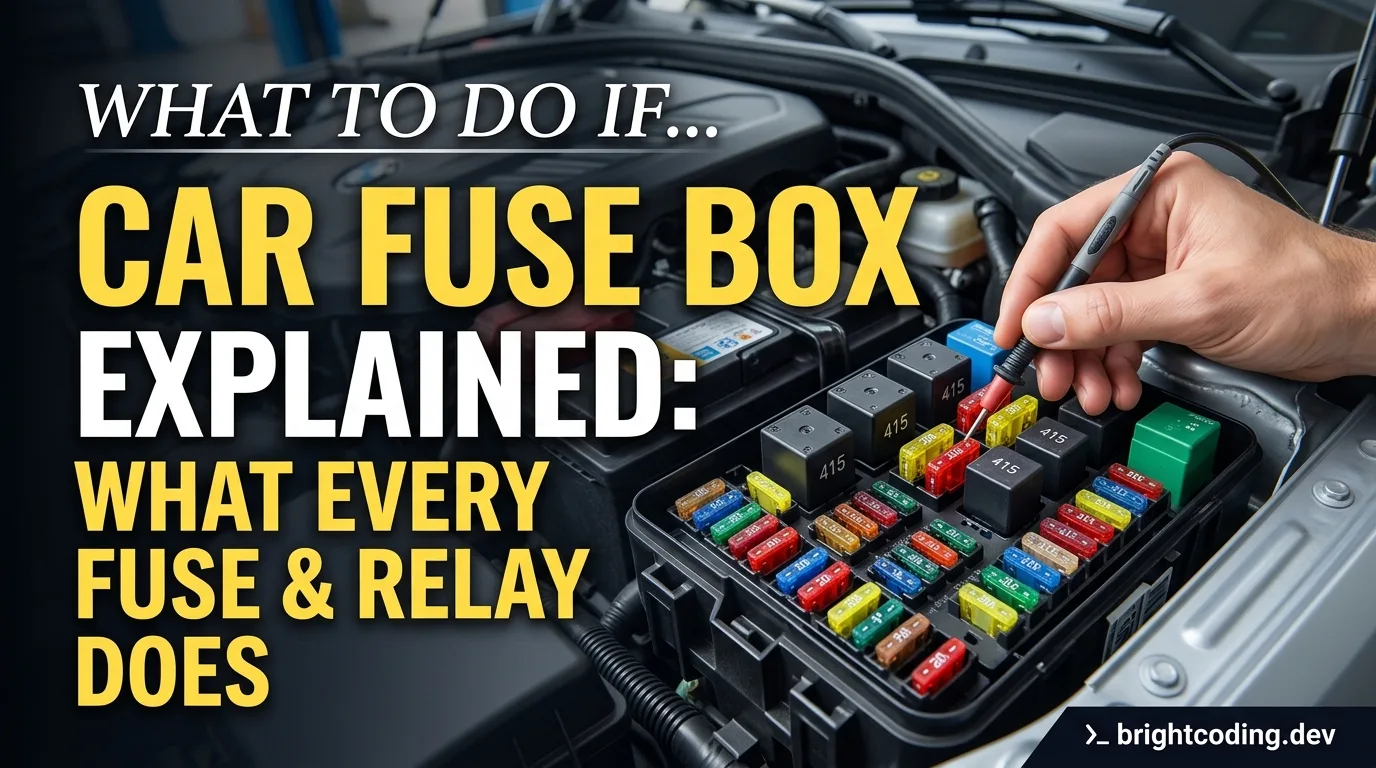
Car Fuse Box Explained: What Every Fuse and Relay Does
A dead cigarette lighter, a radio that won't wake up, headlights that quit on one side: these are fuse problems far more often than people expect. By the end of this guide you'll know how to find your fuse box, read the car fuse box diagram printed on it, test a fuse in under a minute, and tell the…
Read the article →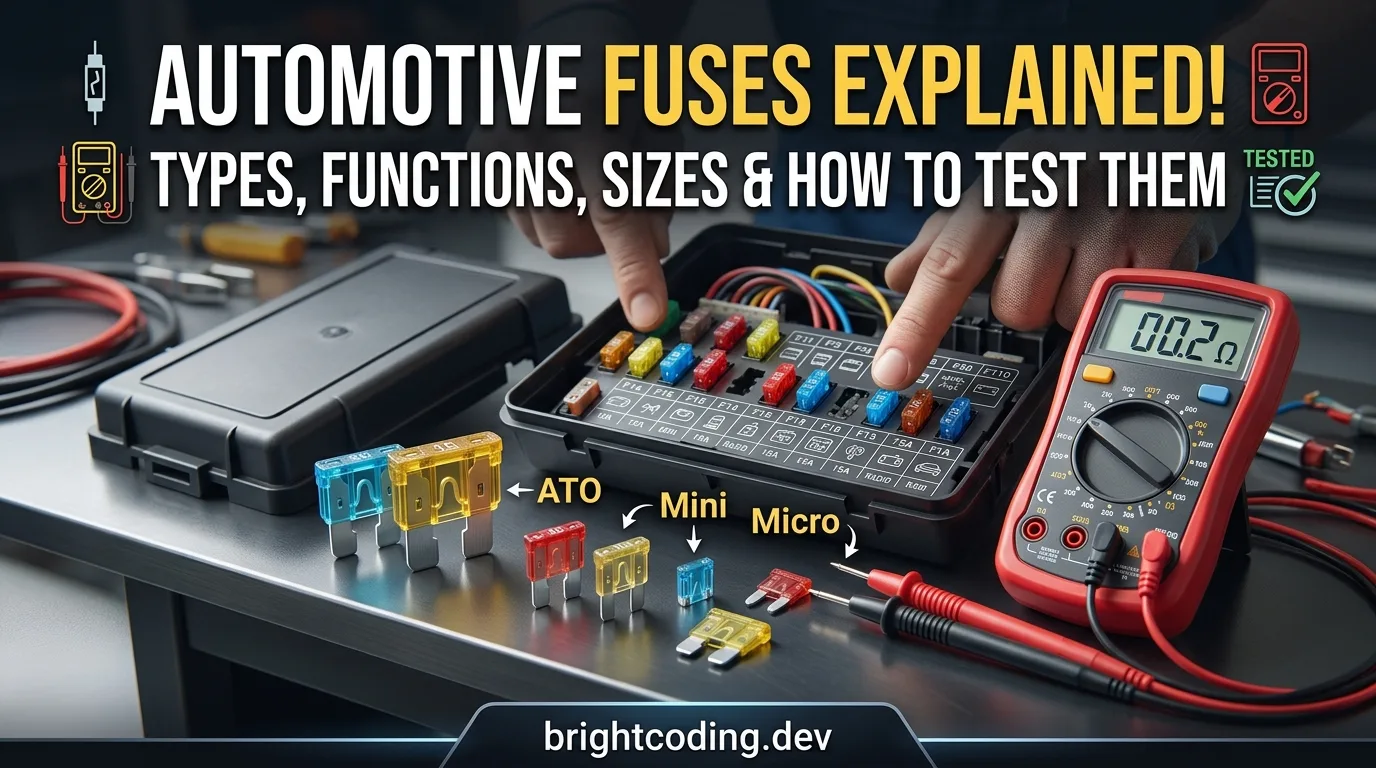
Automotive Fuses Explained: Types, Functions, Sizes, and How to Test Them
A blown fuse is one of the few car problems you can diagnose completely on your own, with a tool that costs less than a coffee. By the end of this guide you will know what fuses actually do, how to tell the different types and sizes apart, how to test one in under a minute, and how to replace it sa…
Read the article →
Stop Throwing Parts at Your Car: The 4-Step Sensor Diagnostic Method That Actually Works
A fault code points to a circuit or behavior—not automatically a failed sensor. This practical guide covers the 8 engine sensors every DIYer and technician should understand, plus the 4-step test process that prevents expensive parts-swapping and misdiagnosis.
Read the article →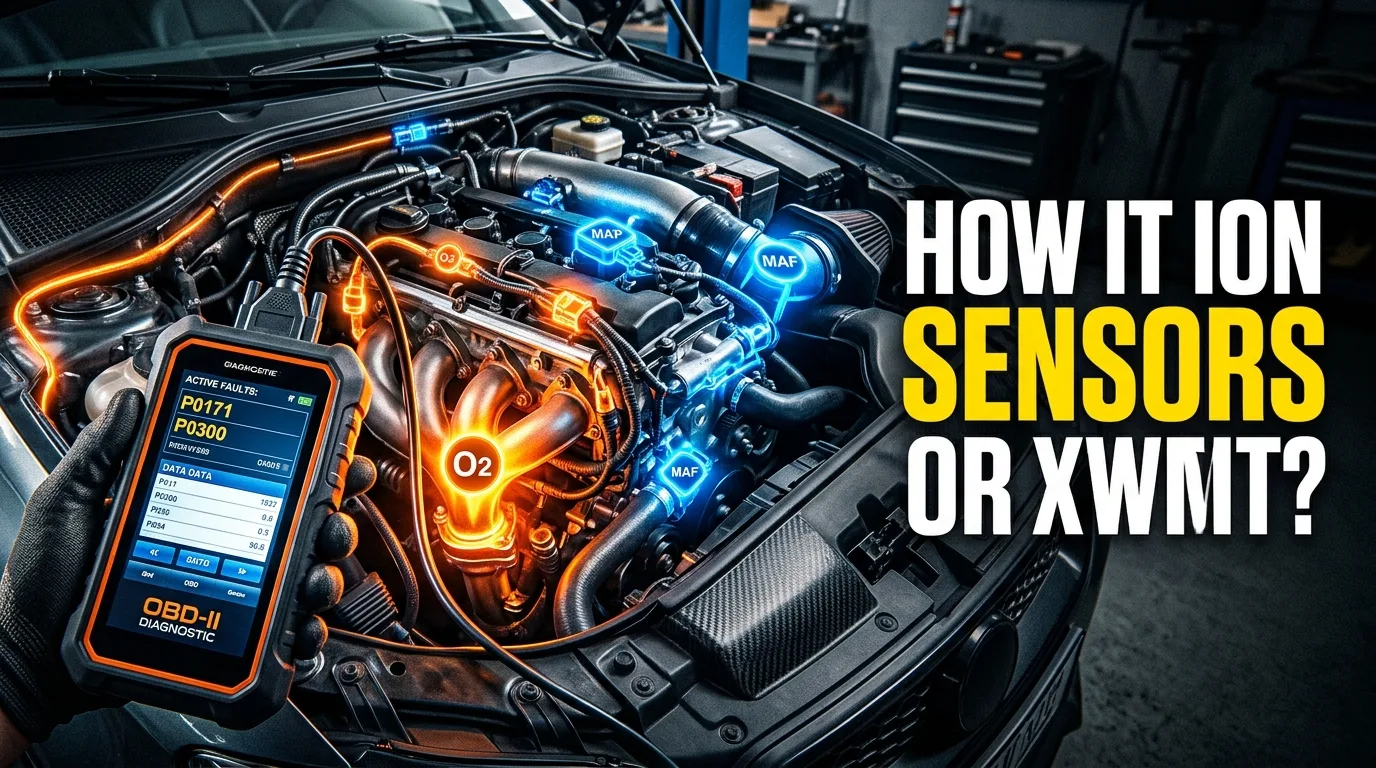
The Ultimate Guide to Engine Sensors: 40+ Types, Functions, and Failure Symptoms (Gasoline & Diesel)
Engine sensors control performance, fuel economy & emissions. Learn 40+ sensor types, failure symptoms, testing methods, and OBD-II codes for gas & diesel engines.
Read the article →
OBD2 Scanner Guide: How to Choose and Use One
A check engine light comes on and your stomach drops a little. It shouldn't. With a cheap OBD2 scanner and about twenty minutes, you can read the code, understand what it means, and decide whether to fix it yourself or hand it to a shop with a clear description of the problem. This guide walks you…
Read the article →
10 Hidden Car Settings You Can Activate Today
Most modern cars ship with features the previous owner never turned on, and the manual buries them three sections deep. This article answers the questions car owners actually search for: which settings are hiding in plain sight, how to find them, and what to do when the option seems missing. No too…
Read the article →