Car Relay vs. Fuse: What's the Difference and When Do You Need Each?
A fuse and a relay both live in the same little plastic box under your hood, and both are there to keep your car's wiring from turning into a very expensive smell. Beyond that, they do completely different jobs. This is where a lot of beginners get stuck.
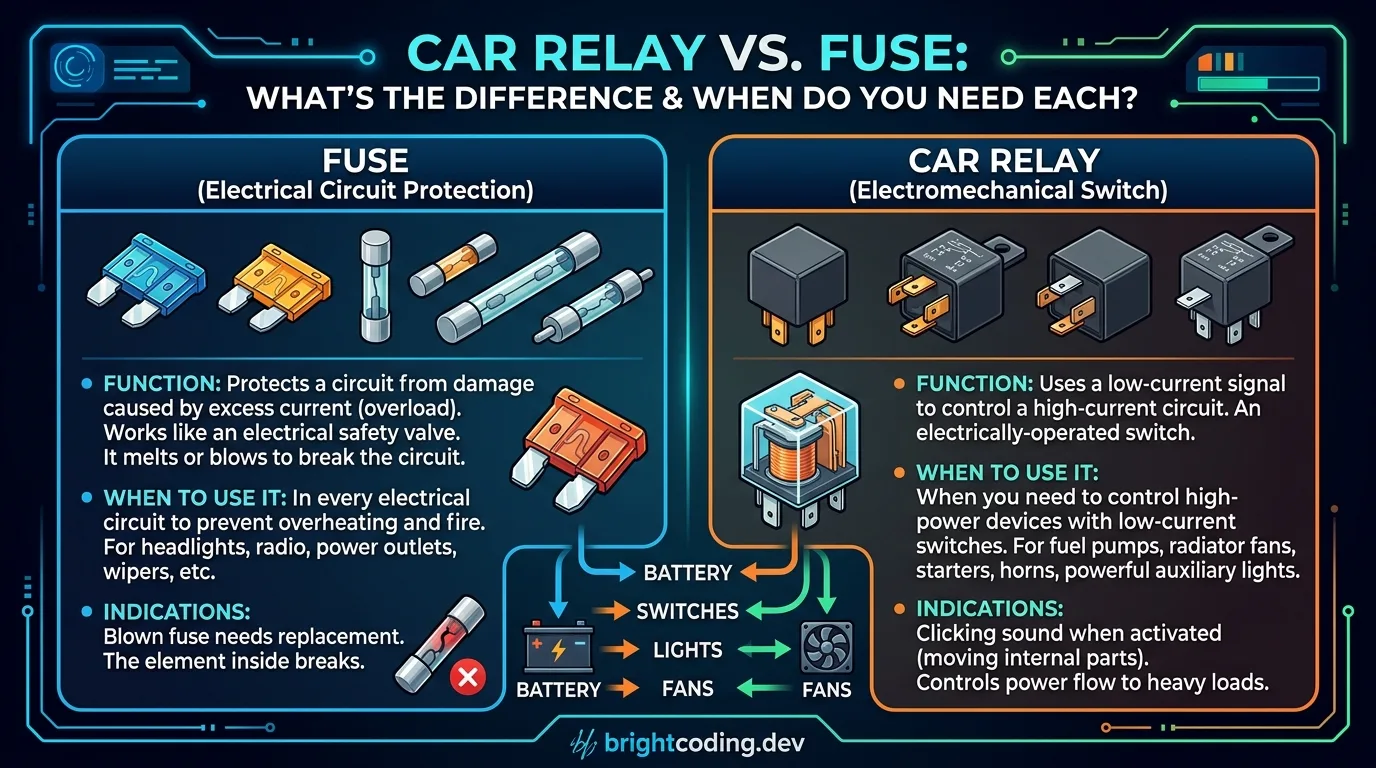
A fuse and a relay both live in the same little plastic box under your hood, and both are there to keep your car's wiring from turning into a very expensive smell. Beyond that, they do completely different jobs. This is where a lot of beginners get stuck.
Here is the honest version: you are not really choosing between a relay and a fuse. You are trying to figure out which one failed, which one you need to replace, or which one to add when you wire up a new accessory.
The criteria that actually matter are simple. Cost (both are cheap, but not equally). Longevity (fuses are meant to die, relays are meant to last). Safety (they protect against different things). And difficulty (swapping a fuse is a two-minute job, diagnosing a relay takes a bit more thought).
Let's break down each one properly.
What a fuse actually does
A fuse is a deliberate weak link. It sits in the circuit and its metal strip is sized to melt before the wiring does. That's it. No moving parts, no coil, no clicking.
If too much current flows, the strip burns through and the circuit goes dead. That is the fuse doing its job perfectly. You then replace it and carry on.
Pros of fuses:
- Dirt cheap. A single blade fuse is often under a dollar, and a mixed assortment box usually runs somewhere in the $10 to $25 range depending on brand and count.
- Foolproof to replace. Pull the old one, push in a new one of the same rating.
- They fail visibly. A blown strip is usually obvious, and you can confirm it with a cheap test light or multimeter.
- Great for protecting wiring from overloads and short circuits.
Cons of fuses:
- They only protect. They cannot switch anything on or off.
- They blow for a reason. If a fuse keeps popping, the fuse is telling you something is wrong upstream. Replacing it and hoping is how people end up with melted harnesses.
- They are a one-shot device. Every trip they take is permanent.
Fuses suit any circuit that needs overload protection: lights, wipers, the radio, the fuel pump feed, all of it. Nearly every circuit in your car has one somewhere.
What a relay actually does
A relay is an electrically operated switch. A small control current energizes a coil, the coil pulls a set of contacts closed, and a much larger current can then flow through the main circuit.
That sounds like a small thing. It isn't. It means a skinny wire from a dashboard switch can control a fat wire feeding a cooling fan, a horn, or a set of driving lights, without running all that heavy current up to the switch and back.
Pros of relays:
- They let low-current controls manage high-current loads. This is the whole point.
- They last a long time. A quality relay can click away for years. Contacts do wear out eventually, but it is not a routine wear item like a fuse.
- They make wiring safer and simpler. Short, thick runs from battery to load, controlled by a thin signal wire.
- They are still affordable. A standard automotive relay is often in the $5 to $15 range, with kits including a socket and wiring pigtail costing a bit more.
Cons of relays:
- They are harder to diagnose. A relay can fail open, fail closed, or develop dirty contacts that work sometimes. That "sometimes" is the frustrating part.
- They don't protect anything. A relay is a switch, not a safety device. You still need a fuse in the circuit.
- Cheap relays are cheap for a reason. Bargain-bin units can have weak coils or contacts that pit early.
Relays suit high-current accessories and anything where a small switch has to control a big load. Fans, horns, fuel pumps, headlight upgrade harnesses, auxiliary lights, that sort of thing.
The point beginners miss: they work together
This is the part worth tattooing on the inside of your toolbox lid. A relay and a fuse are not competitors. They are teammates.
A typical relay circuit goes: battery, then fuse, then relay contacts, then the load, then ground. The fuse protects the heavy wiring. The relay does the switching. You need both.
If you are adding a light bar or a second horn, wiring it through a relay without a fuse is asking for trouble. Wiring it through a fuse without a relay means your switch carries the full load and will eventually cook.
If you are troubleshooting instead of building, start by checking the fuse on that circuit. If it is intact, move to the relay, and test whether the coil is getting its control signal. Our step-by-step car guides walk through this in more detail than I can fit here.
Relay vs. Fuse: side by side
| Criterion | Fuse | Relay |
|---|---|---|
| Job | Protects wiring from overload | Switches a high-current load with a low-current signal |
| Typical cost (estimate) | Under $1 each, assortments around $10 to $25 | Roughly $5 to $15 each, more with socket and harness |
| Lifespan | One-shot, designed to blow | Long-lived, contacts wear slowly |
| Failure mode | Blows open, usually obvious | Can fail open, closed, or intermittently |
| DIY difficulty | Very easy to replace | Easy to replace, harder to diagnose |
| Protects against shorts | Yes | No |
| Can switch a load on/off | No | Yes |
| Needs the other one? | Often paired with a relay on high-current circuits | Almost always needs a fuse nearby |
Which one should you choose?
There is no single right answer here, because it depends entirely on what you are doing. Here is how I would call it.
If you are a DIY owner adding an accessory: you need both, and you should buy a relay kit that includes a fuse holder. Skipping the fuse to save five dollars is a bad trade. If you are unsure of the current draw, check the accessory's spec sheet or ask before you pick a fuse rating. Guessing high is not safer than guessing right.
If you are a daily commuter chasing a dead circuit: check the fuse first. It takes two minutes and costs almost nothing. If it is good, then think about the relay. A quick scan with an OBD code lookup can point you toward circuits the car's computer already knows are misbehaving, which saves a lot of hunting.
If you drive a high-mileage car: relays are more likely to be your culprit than you might expect, especially originals that have clicked millions of times. Fuses rarely fail on their own without a reason. If you keep blowing the same fuse, stop replacing it and find the short.
If you run a shop: you already know the answer. Stock both, test both, and never let a customer leave with a bypassed fuse. A wiring diagram from the mechanical encyclopedia will save your technician more time than any parts cannon.
FAQ
Can I replace a relay with a fuse? No. They do different jobs. A fuse cannot switch a circuit on and off, and a relay does not protect wiring. Never substitute one for the other.
Why does my fuse keep blowing? A fuse blows because current exceeded its rating. That usually means a short, a failing component, or a wiring fault. The fuse is the messenger. Find the cause before you replace it again.
How do I test a relay? Listen for the click when the circuit is energized, then check whether power is reaching the load side. A multimeter or a simple test light will tell you most of what you need. If the coil gets power but the contacts do not close, the relay is done.
Do I need a relay for LED lights? It depends on the current draw. Small LED pods may not need one. Larger light bars and anything drawing serious current should go through a relay and a fuse. Check the manufacturer's recommendation.
Are all car fuses the same? No. Blade fuses come in different physical sizes and current ratings, and mixing them up is a real fire risk. Always match the rating printed on the fuse box lid or in your owner's manual.
The bottom line
A fuse protects. A relay switches. Most circuits that matter use both, and understanding that pairing will get you further than memorizing part numbers.
Start with the fuse when something dies. Think about the relay when something big needs to be controlled by something small. And when you are wiring anything new, fuse it. Every time.
Related articles
Stop Throwing Parts at Your Car: The 4-Step Sensor Diagnostic Method That Actually Works
A fault code points to a circuit or behavior—not automatically a failed sensor. This practical guide covers the 8 engine sensors every DIYer and technician should understand, plus the 4-step test process that prevents expensive parts-swapping and misdiagnosis.
Read the article →
The Ultimate Guide to Engine Sensors: 40+ Types, Functions, and Failure Symptoms (Gasoline & Diesel)
Engine sensors control performance, fuel economy & emissions. Learn 40+ sensor types, failure symptoms, testing methods, and OBD-II codes for gas & diesel engines.
Read the article →
OBD2 Scanner Guide: How to Choose and Use One
A check engine light comes on and your stomach drops a little. It shouldn't. With a cheap OBD2 scanner and about twenty minutes, you can read the code, understand what it means, and decide whether to fix it yourself or hand it to a shop with a clear description of the problem. This guide walks you…
Read the article →
10 Hidden Car Settings You Can Activate Today
Most modern cars ship with features the previous owner never turned on, and the manual buries them three sections deep. This article answers the questions car owners actually search for: which settings are hiding in plain sight, how to find them, and what to do when the option seems missing. No too…
Read the article →
How to Reprogram a Car Key Remote After a Battery Change
You changed the battery in your key fob, and now the car won't lock. Or it locks but the trunk button does nothing. Annoying, and a little alarming.
Read the article →
Bad ECU Symptoms: 15 Warning Signs You Should Never Ignore
Your car starts fine one morning, then cranks forever the next. Or it idles rough, stalls at a light, and the dash lights up like a Christmas tree. The ECU (engine control unit) is the computer that runs fuel, spark, and a dozen other systems, and when it misbehaves, the symptoms look like everythi…
Read the article →