7 Simple Tricks to Improve Fuel Economy in Gasoline Engines
Gas prices move around, but your driving habits and a few cheap maintenance checks don't have to. This article answers the questions drivers actually search for: does cruise control save gas, does idling waste fuel, do fuel additives work, and what actually moves the needle on your MPG. Below are q…

Gas prices move around, but your driving habits and a few cheap maintenance checks don't have to. This article answers the questions drivers actually search for: does cruise control save gas, does idling waste fuel, do fuel additives work, and what actually moves the needle on your MPG. Below are quick answers first, then the details behind each one, plus a few related questions you'll probably ask next.
Quick answers
- Does cruise control save gas? Usually yes on flat highways at steady speed, but no on hilly roads where it downshifts and surges to hold speed. Your right foot is often smarter than the computer on rolling terrain.
- Does idling waste gas? Yes. Idling gets zero miles per gallon, and modern engines don't need a long warm-up. If you're stopped for more than about a minute and it's safe, shut it off.
- Do fuel additives improve gas mileage? Mostly no. Most over-the-counter additives won't measurably improve MPG. Some fuel system cleaners help if your injectors are actually dirty, but don't expect a jump on a healthy engine.
- What's the single biggest factor in fuel economy? Your right foot. Aggressive acceleration and high cruising speed cost more fuel than any bolt-on part or additive.
- Does tire pressure affect gas mileage? Yes, but modestly. Underinflated tires raise rolling resistance. Keeping them at the pressure on your door-jamb sticker helps, though it's usually a small percentage, not a miracle.
Does cruise control actually save gas?
On a long, flat highway run, cruise control typically wins. It holds a steady speed, and steady speed means a steady throttle, which is what your engine wants for efficiency.
Hills change the math. Cruise control can't see the road ahead, so it reacts. Going uphill, it floors the throttle to maintain speed. Going downhill, it might brake to hold you back instead of letting you coast. Both waste fuel compared to a driver who lets speed build slightly on the descent and eases off on the climb.
My rule: use cruise on flat interstates, turn it off in hill country and in traffic where speeds keep changing. If you want to see how your driving style actually affects things, a cheap scan tool and a fuel-economy app can show real numbers instead of guesses.
Does idling waste gas and wear out your engine?
Idling burns fuel and returns nothing. You're getting zero miles per gallon while the engine runs. The amount varies by engine size, but it adds up fast if you idle in drive-throughs, school pickup lines, or while "warming up."
The old advice about warming up your car for ten minutes comes from carbureted engines. Modern fuel-injected engines don't need it. Start it, let the oil circulate for 30 seconds or so, and drive gently until it's warm. That warms the engine faster than idling anyway.
If you're waiting more than a minute and it's safe to do so, shut the engine off. This is exactly what auto start-stop systems do on newer cars, and they exist for a reason.
Do fuel additives improve gas mileage?
Be skeptical here. The fuel you buy already contains a detergent package designed to keep injectors and intake valves reasonably clean. Adding a bottle of "MPG booster" to a healthy engine rarely shows a measurable gain in real-world testing.
There's one honest exception: if your injectors are genuinely clogged, a quality fuel system cleaner can restore lost efficiency. But that's fixing a problem, not creating a bonus. You'll usually feel rough idle, hesitation, or a check-engine light first. If a code shows up, look it up with a free OBD code lookup before you start pouring bottles into the tank.
Skip the magnet-on-the-fuel-line gadgets and the "fuel saver" chips that plug into your intake sensor. Those are the ones to walk past.
What's the biggest factor in your fuel economy?
You are. Specifically, how hard you press the pedal and how fast you cruise.
Hard acceleration dumps fuel. High cruising speed does too, because aerodynamic drag rises sharply as speed climbs. Dropping from, say, 75 mph to 65 mph on the highway often makes a noticeable difference, though the exact gain depends on your car's shape and gearing.
You don't have to drive like you're carrying eggs. Just accelerate smoothly to your target speed, then hold it. Anticipate stops so you coast instead of braking hard. That alone beats most "fuel-saving" products you can buy.
Does tire pressure affect gas mileage?
Yes, and it's one of the easiest things to fix. Underinflated tires flex more, and that flexing eats energy. Keeping tires at the pressure listed on your driver's door jamb (not the max on the tire sidewall) helps.
Don't overinflate to chase MPG. Too much pressure reduces grip and wears the center of the tread. Check pressure monthly and before long trips, and remember that cold weather drops it.
Does removing weight or roof racks help?
Lighter is better, but the gains are small unless you're hauling something heavy. Clearing out a trunk full of junk won't transform your mileage.
Roof racks and cargo boxes are a different story. They add drag, especially at highway speed. If you're not using them, take them off. That's a real, measurable improvement on long drives, not a marginal one.
Does A/C or open windows use more gas?
At low speeds, open windows cost less. At highway speeds, the drag from open windows usually costs more than running the A/C. So the honest answer is: it depends on your speed.
If you want a simple habit, run the A/C on the highway and crack the windows around town. Neither will wreck your mileage. The bigger wins are still your speed and your right foot.
Related questions
How much can I really save by changing my driving?
Realistically, a careful driver can often improve fuel economy by somewhere in the range of 10 to 20 percent compared to an aggressive one, though it varies a lot by car and conditions. That's a range, not a promise. Verify against your own fill-up records rather than believing a single number.
Does maintenance really affect fuel economy?
Yes, but it's about keeping the engine running as designed, not squeezing out extra. A dirty air filter, worn spark plugs, a faulty oxygen sensor, or a stuck thermostat can all hurt mileage. If your MPG drops suddenly, that's a symptom worth diagnosing, not just a reason to change your driving. A check-engine light often points you toward the cause, and browsing practical car tips can help you sort out which fixes matter.
When should I stop chasing MPG and just accept it?
Some cars are simply thirsty, and some commutes are all stop-and-go. If your mileage matches what other owners of the same model report, you're probably fine. Focus on the free stuff: tire pressure, less idling, steadier speed. Those cost nothing and add up.
Bottom line
The tricks that work are boring: easy on the gas, steady speed, proper tire pressure, less idling, and skip the additive aisle. Fix a real problem if you have one, but for everyday driving, your habits beat your wallet every time.
Ready to act on what you just read? Decode that warning light with the free OBD code lookup, run the matching car tools to check the numbers yourself, or browse more practical car articles for ideas.
Related articles
10 Diesel Engine Maintenance Tips Every Owner Should Know
Diesel engines reward owners who pay attention. Treat yours well and it can run for hundreds of thousands of miles; neglect a few basics and you will be funding a very expensive repair.
Read the article →
How to Test a Car Relay With a Multimeter: Step-by-Step Guide
A relay is one of the cheapest parts in your car and one of the most common reasons a fan, fuel pump, horn or headlight stops working. By the end of this guide you will be able to pull a suspect relay, test it on the bench with a multimeter, and know for certain whether it is dead or fine. Plan on…
Read the article →
Automotive Fuses Explained: Types, Functions, Sizes, and How to Test Them
A blown fuse is one of the few car problems you can diagnose completely on your own, with a tool that costs less than a coffee. By the end of this guide you will know what fuses actually do, how to tell the different types and sizes apart, how to test one in under a minute, and how to replace it sa…
Read the article →
10 Hidden Features in Your Car That Dealerships Rarely Explain
Most of the useful stuff in your car is buried in the owner's manual, and nobody reads the owner's manual. Not the salesperson, not the service advisor, and probably not you. That is fine. I am going to walk you through the features that actually change how you live with a car, the ones that make y…
Read the article →
Diesel Engine: 10 Mistakes Drivers Make Without Knowing It
Diesel engines are tough, and that toughness fools people. A petrol car will often complain loudly when you treat it badly. A diesel just keeps going, quietly accumulating damage until the day it doesn't. That gap between "running fine" and "facing a four-figure repair bill" is where most owners lo…
Read the article →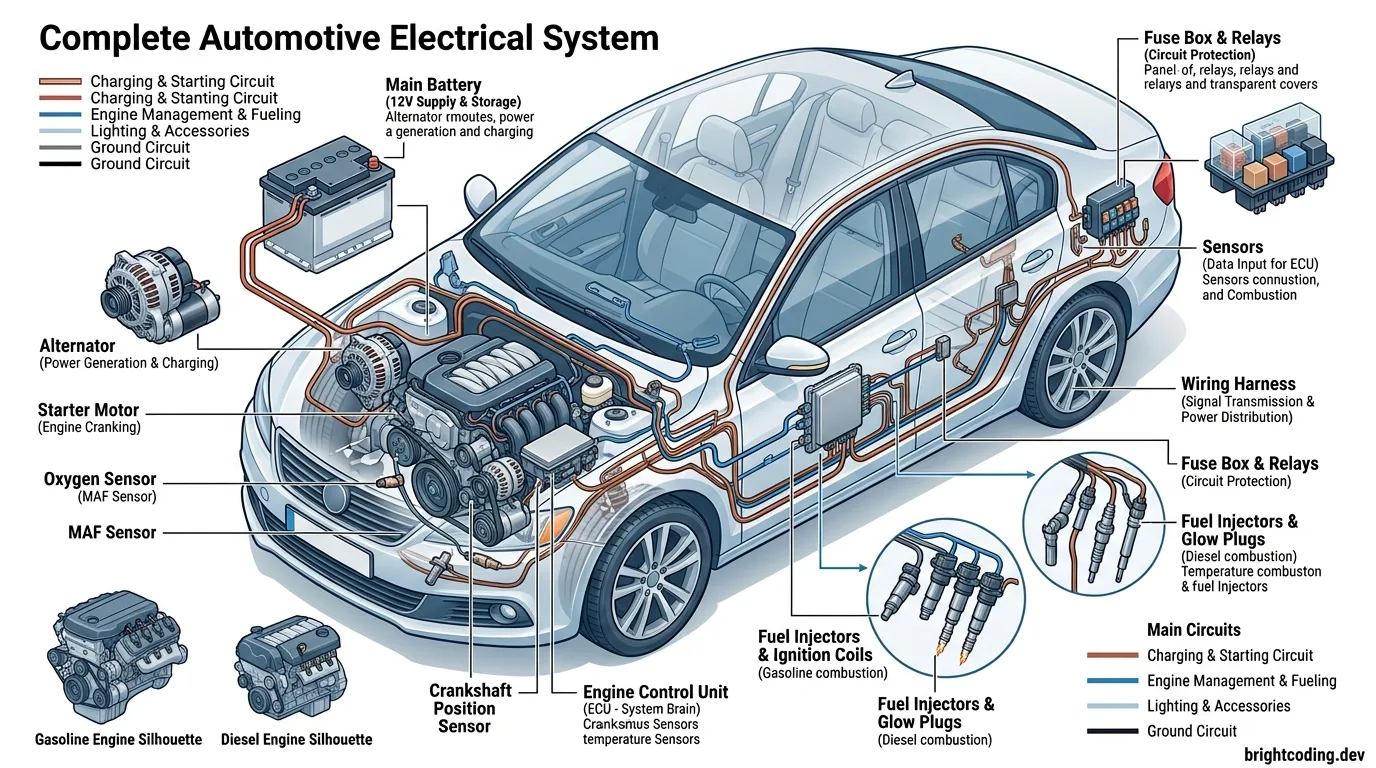
Understanding Automotive Electrical Systems: ECU, Sensors & Wiring
A complete guide to automotive electrical systems, covering batteries, alternators, starters, ECUs, sensors, actuators, wiring diagrams, diagnostics, safety, and the key differences between gasoline and diesel engine electrical systems.
Read the article →