Top 10 Must-Have Car Diagnostic Tools in 2026
Discover the 10 best car diagnostic tools for 2026 — from Bluetooth OBD2 scanners to professional bi-directional tablets. Learn which tool matches your budget and skill level, and stop guessing when your check engine light appears.
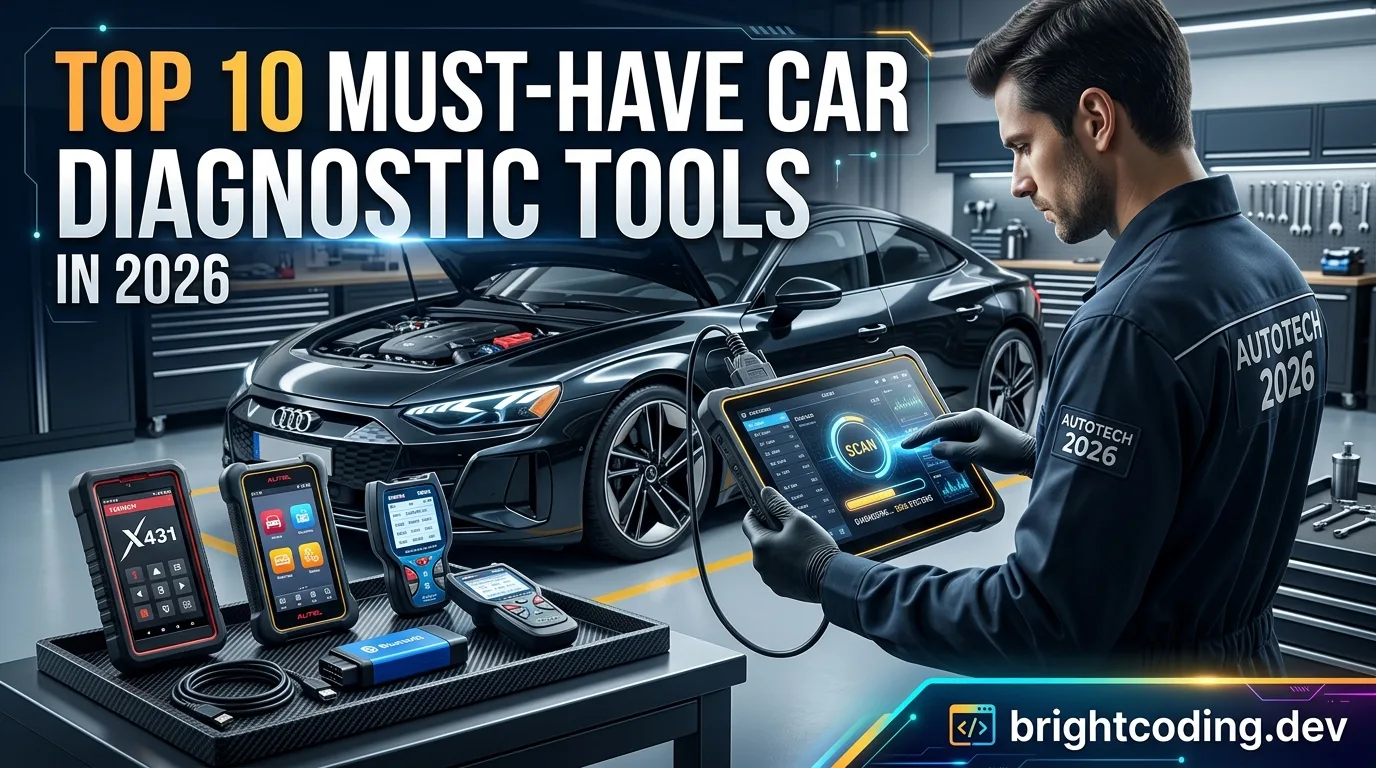
Opening: Why Your Check Engine Light Keeps Coming Back
You start your car, and there it is again — that glowing amber check engine light staring back at you from the dashboard. Your stomach drops. Is it a loose gas cap? A failing catalytic converter? Or something that will leave you stranded on the highway?
If you have ever paid a mechanic $100 just to tell you your gas cap was loose, you already know the frustration. Modern vehicles are essentially computers on wheels, packed with sensors, control modules, and communication networks that most drivers cannot interpret without help. The good news? You do not need a dealership service bay to understand what your car is trying to tell you. The right car diagnostic tools can turn that cryptic warning light into actionable information — and save you hundreds, sometimes thousands, of dollars in unnecessary repairs.
This guide breaks down the ten most valuable diagnostic tools available in 2026, explains who each one is for, and shows you exactly how to build a toolkit that matches your needs and budget.
The Problem: Car Trouble Signals Are Everywhere, but the Meaning Is Hidden
Every vehicle built after 1996 in the United States uses the OBD-II (On-Board Diagnostics II) system, a standardized protocol that monitors engine performance, emissions, and dozens of subsystems. When something drifts outside normal parameters, your car stores a fault code and often triggers a warning light.
Here is what is actually happening:
- Your car knows what is wrong before you do. Sensors continuously monitor oxygen levels, engine misfires, transmission behavior, brake pressure, and more.
- The dashboard only shows symptoms. A single light can represent dozens of possible issues. The light itself tells you almost nothing specific.
- Ignoring it gets expensive. A small vacuum leak might cost $20 to fix today. Left unchecked, it can destroy a $1,200 catalytic converter.
This problem affects everyone — daily commuters, weekend DIYers, fleet managers, and even professional technicians who need to work faster and more accurately.
The most common mistake? Relying solely on free auto parts store code readings. Those services typically pull only generic codes, ignore manufacturer-specific definitions, and never provide live data or bidirectional testing. You get a number, not a diagnosis.
Why It Happens: Cars Got Smarter, and So Did the Problems
In the 1990s, a skilled mechanic could diagnose most engine issues with a timing light and a vacuum gauge. That era is gone.
Modern vehicles contain 30 to 100 electronic control modules (ECUs) managing everything from throttle response to adaptive cruise control. A 2026 model year vehicle might have over 100 million lines of code running its systems. When a sensor reports an anomaly, the problem might be the sensor itself, a wiring fault, a software glitch, or an actual mechanical failure.
For example, a "P0420 — Catalyst System Efficiency Below Threshold" code does not necessarily mean your catalytic converter is dead. It could mean:
- A failing oxygen sensor sending bad data
- An exhaust leak upstream of the converter
- Contaminated fuel causing rich running conditions
- A software calibration issue
Without the right tool, you are guessing. With the right tool, you can view live oxygen sensor waveforms, run fuel trim analysis, and determine whether the converter truly needs replacement.
The Solutions: 10 Diagnostic Tools That Actually Matter
1. Bluetooth OBD2 Scanner for Smartphones
What it is: A small dongle that plugs into your car's OBD-II port and transmits data to an app on your phone or tablet.
How it works: It reads and clears generic fault codes, displays live engine data, and often includes emission readiness monitors for pre-inspection checks.
Advantages: Extremely portable, affordable, and intuitive. Apps like Torque Pro, OBD Fusion, or manufacturer-specific apps provide surprisingly deep data.
Disadvantages: Most lack bidirectional control (you cannot activate components for testing). Some cheap units have slow data refresh rates.
When it makes sense: Perfect for everyday drivers who want to know why the check engine light is on before visiting a mechanic.
Cost: $20–$100 for the hardware; apps range from free to $50.
2. Dedicated Handheld Code Reader
What it is: A pocket-sized device with its own screen, buttons, and internal database — no phone required.
How it works: Plug it in, read codes, view definitions, and clear warnings. Higher-end models include freeze-frame data showing exactly what the engine was doing when the fault occurred.
Advantages: Works instantly without pairing or battery drain on your phone. Rugged and simple enough for non-technical users.
Disadvantages: Limited to engine and emissions codes. Cannot access ABS, airbag, or transmission systems on most budget models.
When it makes sense: Keep one in your glove box for roadside peace of mind.
Cost: $35–$150.
3. Professional All-System Scan Tool
What it is: A handheld or tablet-based scanner that communicates with every control module in the vehicle — engine, transmission, ABS, SRS airbags, climate control, and more.
How it works: It speaks manufacturer-specific protocols, reads deep body and chassis codes, and often supports special functions like oil service resets, electronic parking brake retraction, and steering angle calibration.
Advantages: One tool covers nearly every diagnostic scenario on most makes and models.
Disadvantages: Higher learning curve and significant upfront investment. Software updates may require subscriptions.
When it makes sense: Home mechanics who work on multiple vehicles, or anyone running a small repair operation.
Cost: $300–$1,500 depending on brand and coverage.
4. Bi-Directional Diagnostic Tablet
What it is: An advanced scan tool that not only reads data but also sends commands to the vehicle.
How it works: You can manually activate fuel injectors, cycle the ABS pump, run evaporative emission system leak tests, and command the cooling fan on or off — all from the tool.
Advantages: Dramatically speeds up troubleshooting by letting you test components without removing them.
Disadvantages: Expensive. Overkill for someone who only needs to read engine codes occasionally.
When it makes sense: Serious DIYers, mobile technicians, and shops needing dealer-level functionality without dealer prices.
Cost: $800–$3,500.
5. Battery and Electrical System Tester
What it is: A handheld device that measures cold cranking amps, state of charge, and alternator output.
How it works: Connect clamps to the battery terminals and follow the on-screen prompts. Most testers apply a simulated load and measure voltage drop.
Advantages: Prevents no-start surprises. Many electrical "problems" are actually caused by weak batteries that cannot maintain stable voltage for sensitive electronics.
Disadvantages: Cannot diagnose parasitic drains or wiring faults by itself.
When it makes sense: Every driver in a cold climate, and anyone with a vehicle over three years old.
Cost: $50–$200.
6. Digital Multimeter
What it is: The classic electrical measurement tool, now with automotive-specific features like duty cycle and frequency testing.
How it works: Measures voltage, resistance, amperage, and continuity. Essential for tracing wiring faults, testing sensors, and verifying ground connections.
Advantages: Inexpensive, versatile, and fundamental. No diagnostic toolkit is complete without one.
Disadvantages: Requires basic electrical knowledge to use safely and effectively.
When it makes sense: Anyone doing their own electrical or sensor diagnostics.
Cost: $30–$300.
7. Borescope (Inspection Camera)
What it is: A flexible camera on a long cable, usually 3 to 10 feet, with a light source at the tip.
How it works: Feed it into cylinders through the spark plug hole, behind dashboards, inside intake manifolds, or through small access ports to visually inspect components that are otherwise unreachable.
Advantages: Reveals physical damage — carbon buildup, coolant leaks into cylinders, broken piston rings — without major disassembly.
Disadvantages: Image quality varies widely. Cheap units have poor lighting and fuzzy resolution.
When it makes sense: Engine builders, used car inspectors, and anyone diagnosing internal engine or hard-to-reach problems.
Cost: $40–$400.
8. TPMS Programming Tool
What it is: A dedicated device for tire pressure monitoring system sensors.
How it works: Reads sensor IDs, checks battery status, programs new sensors after tire rotation or replacement, and often triggers the vehicle's relearn procedure.
Advantages: Saves a trip to the tire shop every time you swap wheels or install new sensors.
Disadvantages: Only useful if you regularly work on TPMS-equipped vehicles. Most drivers never need one.
When it makes sense: Home mechanics with multiple vehicles, tire shops, and anyone running winter and summer wheel sets.
Cost: $60–$300.
9. ABS and SRS Airbag Scanner
What it is: A specialized scan tool focused on anti-lock braking and supplemental restraint systems.
How it works: Reads codes from the ABS module and airbag control module, which standard OBD2 scanners usually cannot access.
Advantages: Critical for safety-related diagnostics. An airbag light means your supplemental restraint system is compromised. An ABS light means you may not have anti-lock protection in a panic stop.
Disadvantages: Narrow focus. Many all-system scan tools already include this functionality.
When it makes sense: If you own an older vehicle with an airbag or ABS warning and do not want to buy a full professional scanner.
Cost: $80–$250.
10. Smoke Machine for Evap and Intake Leak Detection
What it is: A device that generates non-toxic smoke and pumps it into sealed systems to reveal leaks visually.
How it works: Connect to the intake, evap system, or exhaust, introduce smoke under low pressure, and watch where it escapes.
Advantages: Finds vacuum and evap leaks that are impossible to locate otherwise — the leading cause of check engine lights and failed emission tests.
Disadvantages: Bulky, requires power, and needs a relatively enclosed workspace.
When it makes sense: Anyone diagnosing persistent lean codes, evap faults, or rough idle conditions.
Cost: $150–$800.
The Best Choice: Matching the Tool to Your Situation
There is no single "best" car diagnostic tool. The right choice depends entirely on what you drive, how often you work on cars, and what problems you typically face.
- If you just want to know why the check engine light is on: Start with a Bluetooth OBD2 scanner or a handheld code reader. Either will give you the code, the definition, and the ability to clear it.
- If you maintain multiple vehicles or run a side business: Invest in a professional all-system scan tool. The time savings on transmission, ABS, and body module diagnostics will pay for the tool quickly.
- If you are chasing intermittent electrical issues or building engines: A multimeter and borescope are non-negotiable additions.
- If you are a professional or aspiring technician: A bi-directional tablet is the closest you can get to dealership-level capability without the monthly subscription traps.
For the average driver in 2026, the sweet spot is a quality Bluetooth scanner for everyday use paired with a battery tester for preventive maintenance. That combination catches 80 percent of common problems before they become expensive surprises.
Step-by-Step Action Plan: Build Your Diagnostic Toolkit
-
Locate your OBD-II port. It is usually under the dashboard on the driver's side. Knowing where it is saves time when a warning appears.
-
Start with a basic scanner. Buy a Bluetooth OBD2 adapter or handheld code reader. Learn to read and clear engine codes on your own vehicle before you need it in an emergency.
-
Check your battery twice a year. Use a battery tester before winter and summer. Weak batteries cause erratic sensor behavior that triggers false codes.
-
Document everything. When a code appears, write down the number, the mileage, and any symptoms. This history helps you spot patterns and gives real mechanics a head start if you do need professional help.
-
Expand based on your needs. If you find yourself borrowing tools or hitting diagnostic dead ends, upgrade to an all-system scanner or add specialized equipment like a borescope.
-
Update your tools. Diagnostic databases evolve as new vehicles are released. Check whether your tool manufacturer offers software updates, and factor subscription costs into your purchase decision.
-
Know your limits. A scanner tells you what the computer sees. It does not replace mechanical knowledge, visual inspection, or safety-critical repairs that require professional certification.
Common Mistakes to Avoid
-
Buying the cheapest scanner available. Ultra-low-cost tools often fail to read manufacturer-specific codes, provide inaccurate definitions, or lack the build quality to last. A $30 tool that gives you wrong information is more expensive than a $100 tool that works correctly.
-
Clearing codes without fixing the root cause. Turning off the check engine light does not repair the underlying fault. The light will return, and you may mask a problem that is damaging other components.
-
Ignoring freeze-frame data. When a code sets, your vehicle records a snapshot of operating conditions. Skipping this data means missing clues about temperature, speed, and engine load at the exact moment of failure.
-
Assuming one code means one problem. A single fault can trigger multiple codes. Replacing the oxygen sensor because you see an oxygen sensor code may waste money if the real issue is a vacuum leak causing a lean condition.
-
Forgetting about pending codes. These are faults that have occurred once but have not yet triggered the warning light. They are early warnings. Good scanners show them; cheap ones often do not.
-
Overlooking physical inspection. Diagnostic tools read electronic signals. They cannot see a cracked vacuum hose, a corroded ground wire, or a rat's nest in the air filter housing. Always inspect before you replace parts.
Expert Takeaway
The most important lesson in automotive diagnostics is this: the tool does not fix the car — the interpretation does.
A $3,000 scan tool in the hands of someone who does not understand fuel trims, sensor logic, or mechanical systems will not produce better results than a $50 code reader in the hands of someone who thinks critically. Start with a tool you can afford and understand. Learn what the data means. Build your skills alongside your toolkit. In 2026, information is cheaper than ever, but wisdom still comes from experience.
FAQ
What is the best car diagnostic tool for a beginner?
A Bluetooth OBD2 scanner paired with a reputable smartphone app is the easiest entry point. It is affordable, portable, and provides enough information to understand most check engine light causes without overwhelming you with advanced features.
Can a diagnostic tool tell me exactly what part to replace?
No. A scan tool points you toward the system or circuit reporting a fault. It is your job — or your mechanic's — to perform further testing and determine whether the sensor is bad, the wiring is damaged, or a mechanical issue is causing the abnormal reading.
Do I need different diagnostic tools for different car brands?
Most modern tools support multiple manufacturers through the standardized OBD-II protocol. However, accessing deep body, chassis, or proprietary systems often requires a tool with expanded coverage or manufacturer-specific software. Check compatibility before purchasing.
Are free auto parts store code scans reliable?
They are a starting point, not a diagnosis. Free scans typically read only generic engine codes and do not include live data, freeze-frame information, or manufacturer-specific definitions. Use them for basic awareness, not repair decisions.
How much should I realistically spend on car diagnostic tools?
For casual home use, budget $50–$200 for a solid entry-level setup. For serious DIYers maintaining multiple vehicles, expect to invest $400–$1,000 for comprehensive coverage. Professional-grade equipment starts around $1,500 and increases based on features and update subscriptions.
Related articles
Best Multimeters for Automotive Diagnostics in 2026
Discover the best multimeters for automotive diagnostics in 2026. From budget picks to professional-grade tools, learn which features matter and how to choose the right meter for your garage.
Read the article →
Le voyant moteur : le guide complet
Ce que signifie le voyant moteur, que faire en premier, lire les codes et ce que dit chaque code courant.
Read the article →Comprendre l’OBD-II : codes, ports et données live
Ce qu’est l’OBD-II, lire les codes, où est le port et comment les données live transforment un diagnostic.
Read the article →
The Best Way to Keep Your Car Cool During Extreme Summer Heat
Your steering wheel is hot enough to brand cattle, the air conditioning is blowing lukewarm air, and the temperature gauge is creeping past where it usually sits. If that sounds like your July commute, you are not imagining things. Extreme heat is genuinely hard on cars, and the ways to keep yours…
Read the article →
10 Signs It's Time to Replace Your Car Battery
Your battery rarely dies with a dramatic announcement. Usually it whispers first — a slow crank on a cold morning, lights that dim at idle, a clock that resets itself. This article walks through the ten signs that actually matter, answers the questions people ask most about car batteries, and tells…
Read the article →
How to Save Money on Car Repairs Without Taking Risks
Here's the honest version up front: most common repairs land somewhere between $150 and $1,200 when you pay a shop, and a few big-ticket jobs (timing belts, clutches, head gaskets) can run past $2,000. That range is wide on purpose. Your make and model, where you live, and whether you walk into a d…
Read the article →