How to Negotiate the Best Price When Buying a Car
You can walk into a dealership or a private seller's driveway and pay hundreds or thousands less than the sticker, without being pushy or playing games. This guide walks you through the whole process, from the research you do at your kitchen table to the moment you sign. Set aside an hour or two fo…

You can walk into a dealership or a private seller's driveway and pay hundreds or thousands less than the sticker, without being pushy or playing games. This guide walks you through the whole process, from the research you do at your kitchen table to the moment you sign. Set aside an hour or two for prep, and the actual negotiation usually takes less than a day.
The single biggest mistake buyers make is showing up to negotiate before they know what the car is actually worth. Fix that first and everything else gets easier.
What you need before you start
You do not need special tools, but you do need information and a way to organize it.
- A phone or laptop with internet access.
- Your financing sorted in advance, or a clear cash budget. A pre-approved loan from a bank or credit union gives you real leverage.
- Your current car's details if you are trading in: year, mileage, condition, and any recent maintenance records.
- A notebook or notes app for tracking offers.
- Your state's rules on sales tax and documentation fees (these vary a lot, so check your DMV website).
- A printout or screenshot of comparable listings for the exact model, trim, and mileage you want.
One thing worth doing before you even leave the house: run the car's VIN or any warning lights through the free OBD code lookup if you are buying used. A check engine light that the seller brushes off can be a bargaining chip, or a reason to walk away.
Step 1: Pick the exact car, not a category
"I want a used SUV" is not a negotiating position. "I want a 2019 RAV4 XLE with under 60,000 miles in this color range" is.
Why it matters: when you are flexible on model, the salesperson can steer you toward whatever has the most markup. When you are specific, you can compare apples to apples and know instantly whether a price is fair.
Tip: Build a shortlist of two or three acceptable cars. That gives you options without making you look desperate.
Step 2: Find the real market value
Look up the same car on at least three sources: a pricing guide site, current dealer listings within 100 miles, and private-party listings. Write down the range.
Dealers price above market on purpose so they have room to "give" you a discount. Private sellers often price emotionally. Knowing the spread tells you what a fair number looks like.
Tip: Ignore the asking price and focus on what similar cars actually sold for. If you cannot find sold data, use the lowest comparable listing as your anchor.
Step 3: Get your financing locked in first
Walk in with a pre-approved loan or a firm cash number. This is the move that saves the most money, and almost nobody does it.
Why it matters: dealer financing is a profit center. When you have your own loan, you can compare their offer against a real number instead of a vague monthly payment. You can also negotiate the total price instead of the monthly payment, which is where they hide the markup.
Tip: Ask your bank or credit union for the APR and the total amount financed. Compare that to the dealer's offer in total dollars, not monthly.
Step 4: Set your walk-away number
Before you talk to anyone, write down the maximum you will pay, including tax, title, registration, and dealer fees. This is your ceiling, not your opening offer.
Why it matters: emotions run high in a showroom. A written number keeps you honest.
Tip: If the deal crosses your ceiling, you leave. You can always come back tomorrow. The car will still be there, or another one will.
Step 5: Negotiate the out-the-door price, never the monthly payment
This is the heart of car negotiation. Ask for the "out-the-door" price in writing: vehicle price, tax, title, registration, and every fee.
Why it matters: monthly payment negotiations let the dealer stretch the loan term, bump the rate, or add products to hit a number you like while the total price climbs.
Tip: Say it plainly: "I only talk in out-the-door numbers." If they quote a monthly figure, ask for the total. Repeat as needed.
Step 6: Make your first offer low but defensible
Open below your target, backed by your research. If comparable cars are selling for $18,000 to $19,500 out the door, opening at $16,500 with your printouts is reasonable.
Why it matters: a lowball with no evidence gets ignored. A lowball with three listings and a printout gets a counteroffer.
Tip: Stay calm and factual. "Here are three similar cars at this price. Can you match it?" works better than a hard stare.
Step 7: Let them counter, then hold
They will counter. You counter once more. Then stop moving and let the silence do the work.
Why it matters: buyers who keep splitting the difference teach the seller that you will keep moving.
Tip: If they will not budge on price, ask them to throw in something concrete: new tires, a full tank, floor mats, or the first service. That is real value.
Step 8: Handle the trade-in separately
Negotiate the new car price first, then discuss your trade-in. Never combine them into one "deal."
Why it matters: dealers can lowball your trade-in and hide it inside a "great" price on the new car.
Tip: Get a quote from an online buyer or two local dealers for your trade-in before you go. That gives you a floor.
Step 9: Read the paperwork before you sign
Check the out-the-door number matches what you agreed. Look for add-ons you did not ask for: paint protection, VIN etching, extended warranties, gap insurance.
Why it matters: add-ons are where a good price quietly becomes a bad one.
Tip: Everything is negotiable, including the finance office. You can decline any add-on you do not want.
Step 10: Inspect the car before money changes hands
For any used car, get a pre-purchase inspection from an independent mechanic. Budget roughly $100 to $200, depending on your area, and confirm the price locally.
Why it matters: a $150 inspection can save you thousands in hidden repairs.
Safety note: If you are checking fluid levels yourself, do it with the engine cold. Radiator caps and coolant reservoirs can spray scalding fluid. Never open a hot cooling system. If you are checking brakes or tires, use jack stands on level ground, never just a jack, and never crawl under a car supported only by a jack.
Tip: If the seller refuses an inspection, that is your answer. Walk away.
Step 11: Close the deal and confirm everything in writing
Get the agreed price, fees, and any promised extras in the contract. Confirm the final loan terms, the APR, and the total you will pay.
Why it matters: verbal promises vanish. Paper does not.
Tip: Take a photo of the signed contract. Keep it with your maintenance records.
Pro tips
- Shop at the end of the month or quarter. Salespeople have quotas, and that can loosen things up. It is not a guarantee, but it helps.
- Get quotes by email from several dealers. Competing written offers are powerful, and you avoid the showroom pressure.
- Bring a calm friend. A second set of ears catches fees and pressure tactics you might miss.
- If you are unsure what a warning light or noise means, run it through the car symptom finder before you commit. It is free and takes a minute.
- Use the free car tools to sanity-check tire sizes, costs, and other numbers before you agree to anything.
- Do not mention your trade-in or financing until after the price is set. Keep the pieces separate.
Common pitfalls
- Negotiating the monthly payment. You will pay more over a longer loan. Always ask for the out-the-door total.
- Revealing your budget too early. Once they know your number, they will build the deal to hit it, not beat it.
- Falling for "today only" pressure. Real deals do not expire in an hour. If they push, leave and come back.
- Skipping the inspection. A clean-looking used car can hide expensive problems. Always get it checked.
- Buying add-ons you did not plan for. Decline everything in the finance office unless you genuinely want it, and negotiate the price if you do.
Useful resources
- Your bank or credit union for pre-approval and loan terms.
- Your state DMV website for tax, title, and registration rules.
- Pricing guide sites and current listings for market value.
- The step-by-step car guides for inspection and maintenance walkthroughs.
- The AutoTools blog and expert car tips for more buying and ownership advice.
- The mechanical encyclopedia if a seller uses a term you do not recognize.
FAQ
How much can I realistically save? It depends on the car, the market, and how prepared you are. Buyers who research and negotiate the out-the-door price often save several hundred to a few thousand dollars compared to the first offer. Treat any specific number as an estimate and verify against current listings in your area.
Should I tell the dealer I am paying cash? Not until the price is settled. Cash is not always king at dealerships because they make money on financing. Negotiate the price first, then decide how to pay.
Is it rude to make a low offer? No. It is expected. Just back it up with comparable listings so it reads as informed, not random.
What if the dealer will not budge at all? Ask for extras instead: tires, service, or accessories. If they still will not move and the price is above your ceiling, walk. Another car will come along.
Do I need a mechanic for a new car? A new car with a full warranty usually does not need a pre-purchase inspection. A used car almost always does, especially if it is out of warranty.
One last thing
Negotiating a car is a skill, not a personality trait. Do the research, set your number, keep the pieces separate, and be willing to walk. The worst outcome is paying too much. The second worst is walking away from a genuinely good deal because you got stubborn. Know the difference, and you will do fine.
Related articles

How to Know When Your Tires Need to Be Replaced
You can check your own tires in about 15 minutes with a coin, a pressure gauge and a flashlight. By the end of this guide you will know how to read tread depth, spot the damage that means "replace now," decode the numbers on your sidewall, and judge whether that slow leak is a cheap fix or a new-ti…
Read the article →
What Does It Mean When Your Car Won't Start?
You turn the key or push the button, and nothing. Or worse, that awful click-click-click. Your stomach drops because you know this is going to cost you time, money, or both.
Read the article →
Why Is My Car Shaking? 8 Common Causes Explained
Your coffee is sitting in the cupholder, and it looks like it's trying to escape. Maybe the steering wheel vibrates at highway speed. Maybe the whole cabin shudders when you brake. Either way, a shaking car is one of those problems you can feel in your teeth, and it never fixes itself.
Read the article →
10 Car Noises You Should Never Ignore
Your car talks to you constantly. Most of the time it's mumbling, and you tune it out like a radio ad. Then one day it screams, and you're staring at a repair bill that could have been a $40 part three months ago.
Read the article →
Composants d'un moteur de voiture : guide complet des pièces, fonctions, problèmes et solutions
Le moteur thermique est le cœur de la voiture. Il transforme le carburant en énergie mécanique grâce au cycle à quatre temps : admission, compression, combustion et échappement. Il est composé de nombreuses pièces essentielles comme le bloc moteur, la culasse, les pistons, le vilebrequin, les arbres à cames, les soupapes, ainsi que les systèmes d’admission, d’allumage, de lubrification et de refroidissement.
Read the article →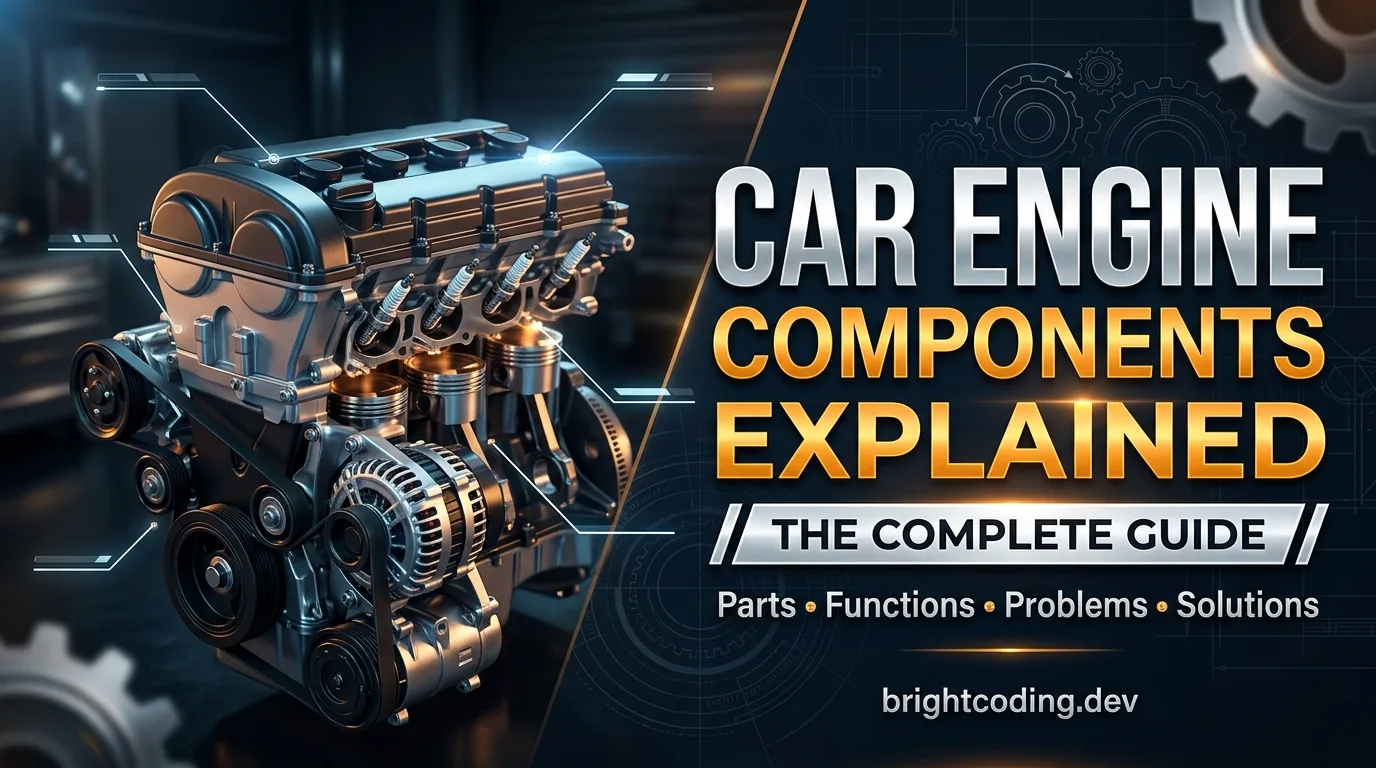
Car Engine Components Explained: The Complete Guide to Parts, Functions, Problems, and Solutions
Your car’s engine is a complex system of parts working together to turn fuel into motion. This complete guide breaks down every major car engine component from the engine block, cylinder head, and DOHC valvetrain to pistons, crankshaft, timing system, fuel delivery, ignition, exhaust, lubrication, and cooling. You’ll also learn common engine problems, warning signs you should never ignore, diagnostic steps, and maintenance tips to keep your engine running reliably
Read the article →