Car Engine Components Explained: The Complete Guide to Parts, Functions, Problems, and Solutions
Your car’s engine is a complex system of parts working together to turn fuel into motion. This complete guide breaks down every major car engine component from the engine block, cylinder head, and DOHC valvetrain to pistons, crankshaft, timing system, fuel delivery, ignition, exhaust, lubrication, and cooling. You’ll also learn common engine problems, warning signs you should never ignore, diagnostic steps, and maintenance tips to keep your engine running reliably
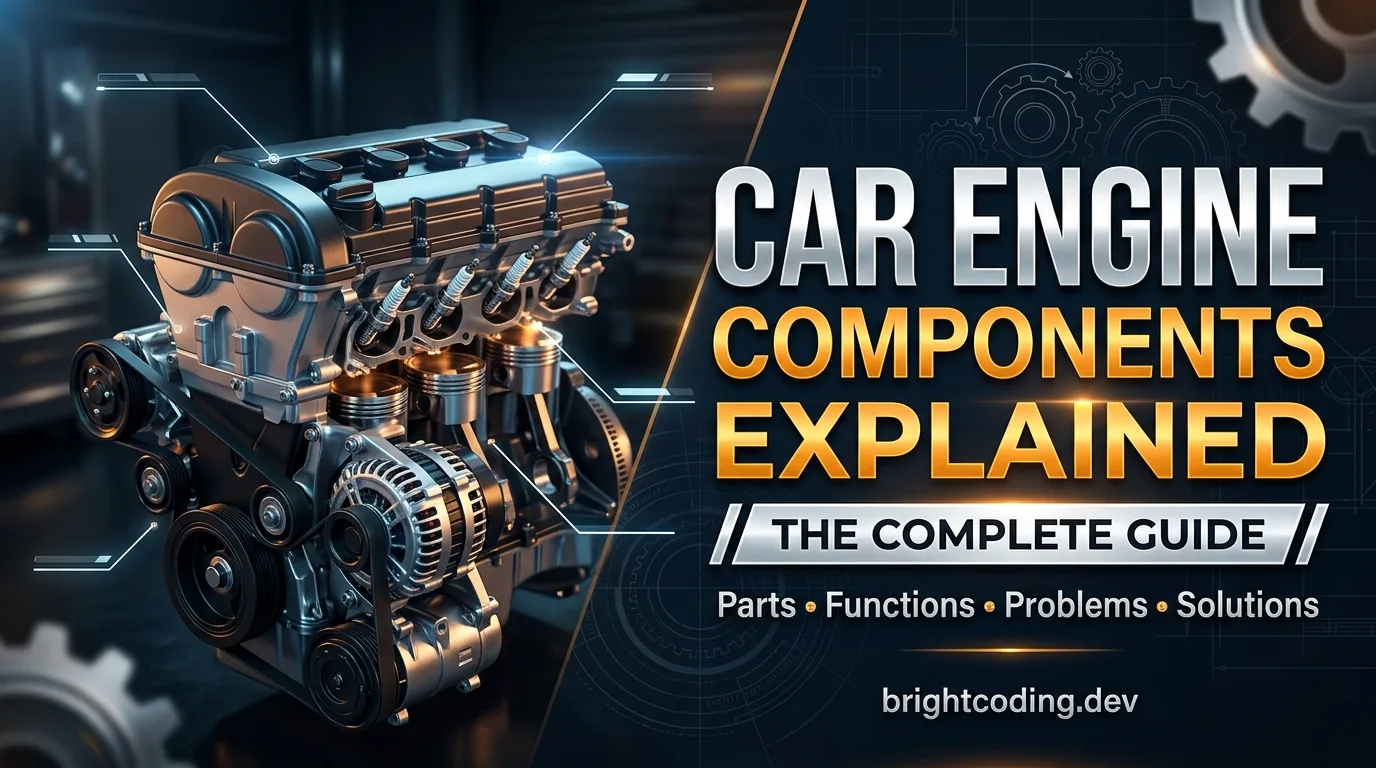
Your car's engine is a masterpiece of engineering—a complex symphony of metal, fire, and precision that transforms simple fuel into the power that moves you down the road. Whether you're a curious car owner, a budding DIY mechanic, or an automotive student, understanding what's under the hood can save you money, prevent breakdowns, and give you confidence when talking to your mechanic.
In this comprehensive guide, we'll walk through every major engine component, explain how they work together, and help you diagnose common problems before they become expensive disasters.
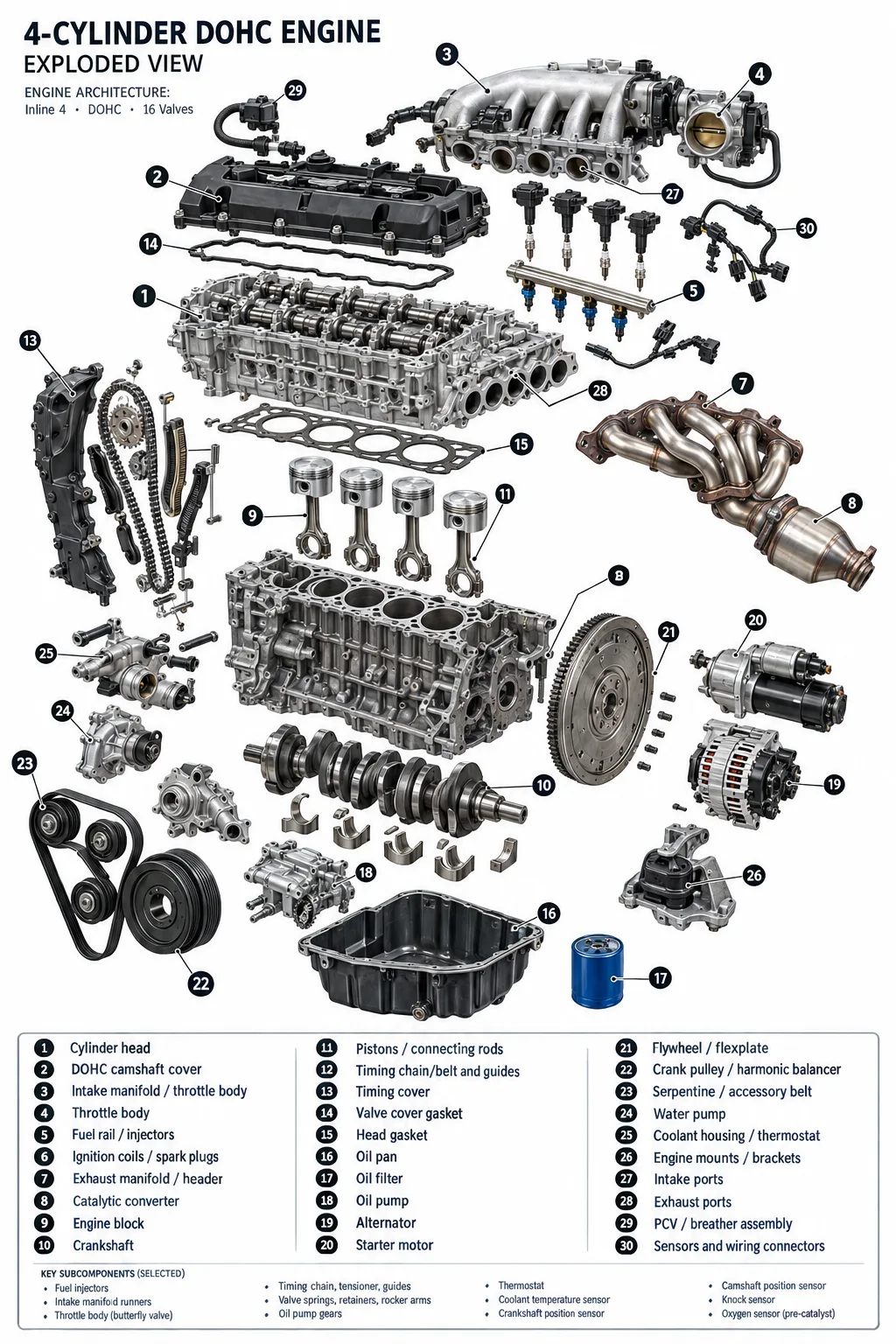
Understanding the Heart of Your Car
What Exactly Is a Car Engine?
At its core, a car engine is a device that converts fuel into motion. It takes the chemical energy stored in gasoline or diesel and transforms it into mechanical energy through controlled explosions—yes, actual tiny explosions happening thousands of times per minute beneath your hood.
The most common type is the internal combustion engine, where fuel burns inside the engine rather than in an external furnace (like a steam engine). This design is efficient, powerful, and has powered automobiles for over a century.
The Basic Sequence: How Power Is Made
Every gasoline engine follows the same fundamental process:
Air + Fuel → Compression → Combustion → Power → Exhaust
Think of it like a controlled fire. You need air (oxygen), fuel (gasoline), and a spark to create combustion. The engine manages this process with incredible precision, timing these events to within milliseconds.
The Four-Stroke Cycle Explained
Most modern car engines use the four-stroke cycle, also known as the Otto cycle. Here's what happens inside each cylinder:
1. Intake Stroke The piston moves down, creating a vacuum that pulls air and fuel into the cylinder through open intake valves. Think of it like a syringe drawing in liquid.
2. Compression Stroke The piston moves back up with both valves closed, squeezing the air-fuel mixture to a fraction of its original volume. This compression makes the mixture volatile and ready to burn.
3. Power Stroke The spark plug ignites the compressed mixture. The resulting explosion forces the piston down with tremendous force—this is where actual power is generated.
4. Exhaust Stroke The piston moves up again, pushing spent gases out through the open exhaust valves. The cycle then repeats, hundreds of times per minute.
What Is a 4-Cylinder Engine?
A 4-cylinder engine has four pistons working together, typically arranged in a straight line (called an inline-4 configuration). This is the most common engine type in modern economy cars for good reason.
Advantages of 4-Cylinder Engines:
- Fuel efficient
- Compact and lightweight
- Lower manufacturing costs
- Adequate power for daily driving
Limitations:
- Less power than larger engines
- Can feel strained under heavy loads
- More vibration than V6 or V8 engines (though modern balance shafts help)
What Does DOHC Mean?
DOHC stands for Double Overhead Camshaft. This means the engine has two camshafts mounted in the cylinder head—one to operate the intake valves and another for the exhaust valves.
Why DOHC Matters:
- Better breathing at high RPMs
- More precise valve control
- Allows for variable valve timing
- Typically produces more power than SOHC (Single Overhead Camshaft) designs
Most modern 4-cylinder engines use DOHC designs because they offer an excellent balance of power and efficiency.
Complete Engine Components Overview
Here's your roadmap to every major engine component. We'll cover each in detail throughout this guide.
| # | Component | Main Function |
|---|---|---|
| 1 | Cylinder Head | Houses valves and combustion chambers |
| 2 | DOHC/Camshaft Cover | Protects the valvetrain |
| 3 | Intake Manifold | Distributes air to cylinders |
| 4 | Throttle Body | Controls incoming air |
| 5 | Fuel Rail & Injectors | Deliver fuel |
| 6 | Ignition Coils & Spark Plugs | Ignite the air-fuel mixture |
| 7 | Exhaust Manifold | Collects exhaust gases |
| 8 | Catalytic Converter | Reduces harmful emissions |
| 9 | Engine Block | Main structural body |
| 10 | Crankshaft | Converts piston movement into rotation |
| 11 | Pistons & Connecting Rods | Transfer combustion force |
| 12 | Timing Chain/Belt | Synchronizes crankshaft and camshafts |
| 13 | Timing Cover | Protects timing components |
| 14 | Valve Cover Gasket | Seals the valve cover |
| 15 | Head Gasket | Seals cylinder head and block |
| 16 | Oil Pan | Stores engine oil |
| 17 | Oil Filter | Removes contaminants |
| 18 | Oil Pump | Circulates engine oil |
| 19 | Alternator | Produces electrical power |
| 20 | Starter Motor | Starts the engine |
| 21 | Flywheel/Flexplate | Transfers engine rotation |
| 22 | Crankshaft Pulley | Drives accessories and reduces vibration |
| 23 | Serpentine Belt | Drives accessories |
| 24 | Water Pump | Circulates coolant |
| 25 | Thermostat/Coolant Housing | Controls coolant flow |
| 26 | Engine Mounts | Secure and isolate the engine |
| 27 | Intake Ports | Deliver air into cylinders |
| 28 | Exhaust Ports | Remove combustion gases |
| 29 | PCV/Breather System | Controls crankcase gases |
| 30 | Sensors & Wiring | Monitor and control engine operation |
The Engine Block: The Foundation of Everything
What Is the Engine Block?
The engine block is the main structural component of your engine—the heavy metal casting that contains the cylinders and provides mounting points for virtually every other component. If the engine is the heart of your car, the block is its skeleton.
Its Critical Functions
The engine block:
- Houses the cylinders where combustion occurs
- Supports the crankshaft and bearing surfaces
- Contains passages for oil and coolant
- Provides mounting points for the cylinder head, accessories, and transmission
Inside the Block
Within the engine block, you'll find:
Cylinders — Precision-bored holes where pistons travel up and down. In a 4-cylinder engine, there are four cylinders arranged in a line.
Crankshaft — The rotating shaft that converts the up-and-down motion of pistons into rotary motion.
Pistons — The moving plugs that fit snugly inside the cylinders and receive the force of combustion.
Connecting Rods — Link the pistons to the crankshaft, transferring force between them.
Main Bearings — Precision bearings that support the crankshaft and allow it to spin smoothly.
Oil Passages — Internal channels that deliver lubricating oil to critical surfaces.
Coolant Passages — Channels that allow coolant to flow around the cylinders, carrying away heat.
Common Engine Block Problems
Cracked Block Usually caused by overheating or freezing (if coolant isn't properly mixed). A cracked block often means the engine is beyond repair.
Cylinder Wear Over time, cylinder walls wear, creating an oval shape that reduces compression and causes oil consumption.
Overheating Damage Excessive heat can warp the block deck surface, causing head gasket failures.
Oil Leaks Failed gaskets and seals allow oil to escape, potentially leading to catastrophic damage if unnoticed.
Coolant Leaks Internal or external coolant leaks can cause overheating and engine damage.
Symptoms of Block Problems
- White smoke from exhaust (coolant entering combustion)
- Milky oil (coolant mixing with oil)
- Persistent overheating
- Low compression
- Excessive oil consumption
Prevention Tips
- Never let your engine overheat
- Change oil regularly
- Use the correct coolant mixture
- Address minor leaks immediately
- Avoid aggressive driving until the engine is at operating temperature
The Cylinder Head: Where the Magic Happens
Definition and Function
The cylinder head sits atop the engine block, sealing the cylinders and forming the combustion chambers. It's where the intake and exhaust valves live, along with the camshafts in DOHC engines.
The cylinder head must:
- Seal combustion pressure (which can exceed 1,000 PSI)
- Manage airflow in and out of the engine
- Support the valvetrain components
- Dissipate heat
Main Components
Valves — Poppet valves that open and close to allow air/fuel in and exhaust out. A typical 4-cylinder engine has 16 valves (4 per cylinder).
Camshafts — Rotating shafts with egg-shaped lobes that push the valves open at precisely the right time.
Valve Springs — Return valves to their closed position after the camshaft releases them.
Rockers/Followers — Mechanical links that transfer camshaft motion to the valves.
Combustion Chambers — Shaped cavities where the air-fuel mixture burns.
Intake Ports — Passages that guide air toward the valves.
Exhaust Ports — Passages that guide burned gases away from the valves.
Common Cylinder Head Problems
Warped Cylinder Head Overheating causes the head to warp, breaking the seal with the block and causing head gasket failure.
Cracks Thermal stress can crack the cylinder head, often between valve seats or in the combustion chamber.
Valve Problems Burned valves, bent valves, or worn valve guides cause compression loss and poor performance.
Oil Leaks Failed valve cover gaskets or cam seals allow oil to escape.
Coolant Leaks Cracks or failed gaskets can allow coolant to enter cylinders or leak externally.
Symptoms, Causes, and Solutions
| Symptom | Likely Cause | Solution |
|---|---|---|
| White exhaust smoke | Coolant entering combustion | Check head gasket, inspect head for cracks |
| Overheating | Warped head, failed gasket | Machine or replace head, replace gasket |
| Rough idle | Valve problems | Valve job or head replacement |
| Oil in coolant | Internal head crack | Replace cylinder head |
| Compression loss | Burned/bent valves | Valve replacement |
DOHC Camshafts and Valvetrain
What Is a Camshaft?
A camshaft is a rotating shaft with precisely shaped lobes (cams) that open and close the engine's valves at exactly the right moment. It's driven by the crankshaft through a timing belt or chain, ensuring perfect synchronization.
What Does DOHC Mean?
DOHC (Double Overhead Camshaft) means the engine has two camshafts in the cylinder head:
- One operates the intake valves
- One operates the exhaust valves
This design allows for more precise valve control and better engine breathing, especially at high RPMs.
Intake Camshaft
The intake camshaft controls when air and fuel enter the cylinders. Its lobes are timed to open the intake valves as the piston descends on the intake stroke.
Exhaust Camshaft
The exhaust camshaft controls when burned gases exit. Its lobes open the exhaust valves as the piston rises on the exhaust stroke.
Cam Lobes
The lobes are the egg-shaped bumps on the camshaft that actually push the valves open. Their shape determines:
- How far the valve opens (lift)
- How long the valve stays open (duration)
- When the valve opens and closes (timing)
Valves
Engine valves are precision-machined pieces that must:
- Withstand extreme temperatures (exhaust valves can reach 1,500°F)
- Seal perfectly against their seats
- Operate millions of times without failure
Valve Springs
These heavy-duty springs close the valves after the camshaft releases them. They must be strong enough to close the valve against high combustion pressures.
Rocker Arms/Followers
These mechanical links transfer motion from the camshaft to the valve. Some engines use direct-acting buckets, while others use rocker arms.
Common Valvetrain Problems
Worn Camshaft Lobes wear down, reducing valve lift and engine power.
Incorrect Valve Timing A stretched timing chain or jumped tooth causes valves to open at the wrong time.
Broken Components Valve springs can break, causing valves to drop into cylinders and catastrophic damage.
Excessive Valve Noise Ticking or tapping sounds indicate worn components or low oil pressure.
Diagnostic Symptoms
- Ticking or tapping from the top of the engine
- Rough idle
- Loss of power
- Check engine light with camshaft codes
- Metal debris in oil
Solutions
- Regular oil changes with quality oil
- Timing chain/belt maintenance
- Professional diagnosis of unusual noises
- Prompt repair of any valvetrain issues
Pistons and Connecting Rods
Piston Definition and Function
The piston is a cylindrical plug that moves up and down inside the cylinder. It receives the force of combustion and transfers it to the connecting rod. Pistons must be:
- Lightweight (to minimize inertia)
- Strong (to withstand combustion forces)
- Heat-resistant (to survive extreme temperatures)
Connecting Rod Function
The connecting rod links the piston to the crankshaft. It must be incredibly strong yet lightweight, as it changes direction thousands of times per minute.
Piston Rings
Piston rings seal the gap between the piston and cylinder wall. There are two types:
Compression Rings (top two rings)
- Seal combustion pressure
- Transfer heat from piston to cylinder wall
Oil-Control Ring (bottom ring)
- Scrapes excess oil from cylinder walls
- Returns oil to the crankcase
Common Problems
Piston Ring Wear Rings lose tension and sealing ability, causing:
- Low compression
- Oil consumption
- Blow-by (combustion gases entering crankcase)
Piston Damage Detonation, overheating, or foreign objects can crack or melt pistons.
Connecting Rod Failure Usually caused by oil starvation or over-revving, this can send a rod through the engine block.
Symptoms
- Excessive oil consumption
- Blue smoke from exhaust
- Low compression
- Knocking sounds
- Poor performance
Causes and Solutions
| Problem | Cause | Solution |
|---|---|---|
| Oil consumption | Worn rings | Engine rebuild |
| Low compression | Worn rings/cylinders | Rebuild or replace engine |
| Knocking | Rod bearing failure | Immediate engine stop, major repair |
| Piston damage | Detonation, overheating | Replace pistons, address root cause |
The Crankshaft: Converting Motion
Definition and Function
The crankshaft is the backbone of your engine—a precision-machined shaft that converts the reciprocating (up-and-down) motion of pistons into rotating motion that ultimately turns your wheels.
Key Features
Crankshaft Journals — Precision-ground surfaces where the crankshaft rides in bearings.
Connecting Rod Journals — Offset surfaces where connecting rods attach.
Main Bearings — Support the crankshaft in the block.
Counterweights — Balance the crankshaft and smooth out vibrations.
Common Crankshaft Problems
Bearing Wear Worn bearings cause knocking sounds and can lead to crankshaft damage.
Crankshaft Damage Scoring, cracking, or bending requires crankshaft replacement or machining.
Excessive Vibration Can indicate balance problems or worn bearings.
Oil Starvation Lack of lubrication destroys bearings and journals quickly.
Symptoms and Solutions
- Knocking from deep in the engine → Stop driving immediately
- Low oil pressure → Check oil level and pressure
- Excessive vibration → Have crankshaft inspected
The Timing System: Keeping Everything in Sync
Components
Timing Chain or Belt — Connects crankshaft to camshafts.
Tensioner — Maintains proper tension on the chain or belt.
Guides — Keep the chain running straight.
Camshaft Gears — Sprockets on the camshafts.
Crankshaft Sprocket — Gear on the crankshaft.
Function
The timing system synchronizes: Crankshaft ↔ Camshafts ↔ Valves
This synchronization is critical—if the timing is off, valves can open at the wrong time, causing power loss or catastrophic valve-to-piston contact.
Common Problems
Stretched Chain Chains stretch over time, retarding timing and causing poor performance.
Broken Timing Belt A snapped belt causes immediate engine shutdown and often valve damage.
Failed Tensioner Causes chain/belt slack, leading to jumping teeth or complete failure.
Incorrect Timing Results in poor running or engine damage.
Consequences of Timing Failure
- Rough running
- Loss of power
- Engine misfire
- Valve damage (pistons hit valves)
- Complete engine failure
Maintenance
- Replace timing belts every 60,000-100,000 miles
- Inspect timing chains at 100,000+ miles
- Replace tensioners and guides with the belt/chain
The Intake System: Breathing In
Components
Air Filter — Cleans incoming air.
Intake Duct — Channels air to the throttle body.
Intake Manifold — Distributes air to cylinders.
Intake Ports — Passages in the cylinder head.
Throttle Body — Controls airflow.
Sensors — Measure airflow and temperature.
Function
The intake system delivers clean, measured air to the engine for combustion.
Common Problems
Dirty Throttle Body Carbon deposits cause sticking and poor idle.
Vacuum Leaks Unmetered air enters the engine, causing lean conditions.
Carbon Buildup Direct injection engines accumulate carbon on intake valves.
Intake Manifold Leaks Cracked or failed gaskets cause vacuum leaks.
Symptoms and Solutions
| Symptom | Cause | Solution |
|---|---|---|
| Rough idle | Vacuum leak | Smoke test, replace gaskets |
| Poor acceleration | Dirty throttle body | Clean throttle body |
| Check engine light | Various | Scan codes, diagnose |
| Whistling noise | Vacuum leak | Locate and repair leak |
The Throttle Body: Controlling Power
What Is a Throttle Body?
The throttle body is a valve that controls how much air enters the engine. When you press the gas pedal, you're actually controlling the throttle body (in modern cars, electronically).
Electronic vs. Mechanical
Mechanical Throttle — Cable connects gas pedal to throttle plate.
Electronic Throttle — Sensor detects pedal position, computer controls throttle motor.
Common Problems
Carbon Deposits Cause sticky throttle and poor idle.
Sticking Throttle Can cause unintended acceleration or poor response.
Electronic Failure Throttle position sensor or motor failure triggers limp mode.
Solutions
- Clean throttle body every 30,000-60,000 miles
- Replace if electronic components fail
- Address any drive-by-wire faults promptly
The Fuel System: Delivering Energy
Components
Fuel Tank — Stores gasoline.
Fuel Pump — Pressurizes and delivers fuel.
Fuel Filter — Removes contaminants.
Fuel Rail — Distributes fuel to injectors.
Fuel Injectors — Spray fuel into intake or cylinders.
Pressure Regulator — Maintains proper fuel pressure.
Fuel Injector Function
Fuel injectors are precision solenoids that spray a fine mist of fuel at exactly the right moment. Modern engines use either:
- Port injection — Fuel sprayed into intake ports
- Direct injection — Fuel sprayed directly into cylinders
Common Problems
Clogged Injectors Cause misfires, poor performance, and rough idle.
Injector Leakage Drips fuel when closed, causing rich conditions.
Low Fuel Pressure Weak pump or clogged filter causes lean conditions.
Failed Fuel Pump Engine won't start or stalls.
Symptoms and Solutions
| Symptom | Cause | Solution |
|---|---|---|
| Misfire | Clogged injector | Clean or replace injectors |
| Hard starting | Weak fuel pump | Replace fuel pump |
| Poor economy | Leaking injector | Replace injectors |
| No start | Failed pump | Diagnose fuel pressure |
The Ignition System: Lighting the Fire
Components
Spark Plugs — Create the spark.
Ignition Coils — Generate high voltage.
Wiring — Delivers voltage to coils.
ECU Control — Times the spark.
Function
The ignition system creates a high-voltage spark at precisely the right moment to ignite the compressed air-fuel mixture.
Common Problems
Worn Spark Plugs Worn electrodes increase gap, requiring more voltage and causing misfires.
Failed Ignition Coil Causes dead cylinder and misfire.
Misfire Can be caused by plugs, coils, or fuel issues.
Symptoms
- Rough idle
- Poor acceleration
- Check engine light (flashing = serious)
- Increased fuel consumption
Solutions
- Replace spark plugs every 30,000-100,000 miles
- Replace failed coils
- Diagnose misfire codes systematically
The Exhaust System: Breathing Out
Components
Exhaust Manifold — Collects exhaust from cylinders.
Oxygen Sensors — Monitor exhaust oxygen content.
Catalytic Converter — Reduces harmful emissions.
Exhaust Pipes — Carry gases to the rear.
Muffler — Reduces noise.
Catalytic Converter Explained
The catalytic converter uses precious metals (platinum, palladium, rhodium) to convert harmful gases into less harmful ones:
- Carbon monoxide → Carbon dioxide
- Hydrocarbons → Water and carbon dioxide
- Nitrogen oxides → Nitrogen and oxygen
Common Problems
Exhaust Leaks Cause noise, poor performance, and failed emissions tests.
Clogged Catalytic Converter Restricts exhaust flow, causing power loss.
Failed Oxygen Sensor Causes rich or lean conditions and poor economy.
Symptoms and Solutions
| Symptom | Cause | Solution |
|---|---|---|
| Loud noise | Exhaust leak | Repair or replace components |
| Power loss | Clogged cat | Replace catalytic converter |
| Check engine light | O2 sensor | Replace sensor |
| Failed emissions | Various | Diagnose and repair |
The Lubrication System: Lifeblood of Your Engine
Components
Engine Oil — Lubricates and cools.
Oil Pan — Stores oil.
Oil Pump — Circulates oil.
Oil Filter — Removes contaminants.
Oil Passages — Deliver oil throughout engine.
How Engine Lubrication Works
The oil pump draws oil from the pan and pushes it through the filter and into passages that lead to:
- Crankshaft bearings
- Camshaft bearings
- Cylinder walls
- Valve train
Oil creates a thin film that prevents metal-to-metal contact, reducing friction and wear.
Why Engine Oil Matters
- Reduces friction and wear
- Cools internal components
- Cleans engine internals
- Seals gaps between parts
- Prevents corrosion
Common Problems
Low Oil Pressure Caused by low oil level, worn pump, or worn bearings.
Oil Leaks Failed gaskets and seals allow oil to escape.
Oil Consumption Worn rings or valve guides allow oil into combustion chamber.
Dirty Oil Neglected changes cause sludge and accelerated wear.
Solutions and Maintenance
- Check oil level regularly
- Change oil every 5,000-10,000 miles
- Use correct oil viscosity
- Address leaks promptly
- Never ignore oil pressure warning
The Cooling System: Keeping It Cool
Components
Water Pump — Circulates coolant.
Thermostat — Regulates coolant flow.
Radiator — Dissipates heat.
Coolant — Transfers heat.
Cooling Passages — Channels in engine block and head.
Hoses — Connect components.
Cooling Fan — Pulls air through radiator.
How the Cooling System Works
- Coolant absorbs heat from the engine
- Water pump circulates coolant to the radiator
- Thermostat regulates flow to maintain optimal temperature
- Radiator releases heat to the air
- Coolant returns to the engine to absorb more heat
Common Problems
Overheating Caused by low coolant, failed thermostat, or failed water pump.
Coolant Leaks Failed hoses, radiator, or water pump.
Failed Thermostat Stuck open (engine runs cold) or stuck closed (overheating).
Failed Water Pump No circulation, rapid overheating.
Radiator Blockage Restricted flow causes overheating.
Symptoms, Causes, and Solutions
| Symptom | Cause | Solution |
|---|---|---|
| Overheating | Various | Stop driving, diagnose cooling system |
| Coolant loss | Leak | Pressure test, repair leak |
| Heater not working | Low coolant, air pocket | Bleed cooling system |
| Coolant in oil | Head gasket | Replace head gasket |
Oil Pump and Oil Filter: Detailed Look
Oil Pump
Definition — A pump that circulates engine oil under pressure.
Function — Draws oil from the pan and pushes it through the lubrication system.
Failure Symptoms:
- Low oil pressure warning
- Knocking sounds
- Engine damage
Causes of Failure:
- Wear over time
- Oil starvation
- Contaminated oil
Solutions:
- Replace oil pump
- Address root cause
- Regular oil changes
Oil Filter
Definition — A filter that removes contaminants from engine oil.
Function — Traps metal particles, dirt, and sludge before oil reaches critical components.
Filter Contamination:
- Clogged filter bypasses dirty oil
- Causes accelerated wear
Replacement:
- Every oil change
- Use quality filters
- Never skip filter changes
The Alternator: Powering Your Car's Electronics
Definition and Function
The alternator generates electrical power to charge the battery and run your car's electrical systems while the engine is running.
How It Charges the Battery
The alternator converts mechanical energy from the engine into electrical energy through electromagnetic induction. It produces alternating current (AC), which is converted to direct current (DC) by internal diodes.
Common Problems
Weak Charging Worn brushes or failed regulator causes low voltage.
Bearing Noise Worn bearings cause whining or grinding.
Failed Regulator Causes overcharging or undercharging.
Worn Brushes Prevent current flow to the rotor.
Symptoms and Solutions
| Symptom | Cause | Solution |
|---|---|---|
| Battery light on | Charging issue | Test alternator |
| Dim lights | Low voltage | Replace alternator |
| Whining noise | Bearing failure | Replace alternator |
| Dead battery | No charging | Diagnose charging system |
The Starter Motor: Bringing Your Engine to Life
Definition and Function
The starter motor is an electric motor that cranks the engine until it starts running on its own power.
Starting Sequence
Battery → Starter → Crankshaft → Combustion
- You turn the key or press the button
- Battery sends power to the starter
- Starter engages the flywheel
- Flywheel turns the crankshaft
- Engine begins its four-stroke cycle
- Combustion takes over
Common Problems
Clicking Often indicates low battery or bad solenoid.
Slow Cranking Weak battery or failing starter.
No Crank Ignition switch, starter relay, or starter failure.
Starter Failure Worn brushes or failed windings.
Diagnosis and Solutions
- Test battery voltage
- Check starter relay
- Test starter draw
- Replace failed components
Flywheel / Flexplate: Transferring Power
Function
The flywheel (manual transmission) or flexplate (automatic transmission) connects the engine to the transmission and provides a mounting surface for the starter.
Manual vs. Automatic
Flywheel — Heavy, provides momentum for smooth engagement.
Flexplate — Lighter, allows torque converter attachment.
Common Problems
Cracked Flywheel Causes vibration and noise.
Worn Teeth Prevents starter engagement.
Excessive Vibration Can indicate balance issues.
Dual-Mass Flywheel Problems Springs wear out, causing chatter and vibration.
Serpentine Belt and Accessories
Components Driven by the Belt
- Alternator
- Water pump
- A/C compressor
- Power steering pump (where applicable)
Common Problems
Cracks Indicate aging and imminent failure.
Belt Slipping Causes squealing and poor accessory performance.
Belt Noise Squealing or chirping indicates wear or misalignment.
Belt Failure Leaves you stranded with no charging or cooling.
Inspection and Replacement
- Inspect every 30,000 miles
- Replace every 60,000-100,000 miles
- Replace tensioner and idler pulleys with belt
Engine Mounts: Holding It All Together
Function
Engine mounts:
- Support the engine
- Reduce vibration
- Isolate engine movement from the chassis
Common Problems
Cracked Rubber Causes excessive engine movement and vibration.
Hydraulic Mount Failure Leaks fluid, loses damping ability.
Excessive Engine Movement Causes clunking and stress on other components.
Symptoms and Solutions
| Symptom | Cause | Solution |
|---|---|---|
| Vibration at idle | Worn mount | Replace mount |
| Clunking on acceleration | Broken mount | Replace mount |
| Excessive movement | Failed mount | Replace mount |
Sensors and Engine Electronics
Modern engines rely on numerous sensors to monitor and control operation. Here's a breakdown of the most important ones:
Crankshaft Position Sensor
Definition — Monitors crankshaft speed and position.
Function — Tells the ECU when to fire injectors and spark plugs.
Location — Near the crankshaft, often at the front or rear of the engine.
Failure Symptoms — No start, stalling, misfire.
Diagnostic Codes — P0335, P0336.
Causes — Heat damage, contamination, wiring issues.
Solutions — Replace sensor, check wiring.
Camshaft Position Sensor
Definition — Monitors camshaft position.
Function — Helps ECU determine valve timing.
Location — Near camshaft, often on cylinder head.
Failure Symptoms — Rough running, no start, poor economy.
Diagnostic Codes — P0340, P0341.
Causes — Wear, contamination, wiring.
Solutions — Replace sensor.
Oxygen Sensor
Definition — Measures oxygen in exhaust.
Function — Helps ECU adjust fuel mixture.
Location — In exhaust manifold or pipe.
Failure Symptoms — Poor economy, failed emissions, check engine light.
Diagnostic Codes — P0130-P0167.
Causes — Contamination, age, heater failure.
Solutions — Replace sensor.
Mass Airflow Sensor (MAF)
Definition — Measures air entering engine.
Function — Primary input for fuel calculation.
Location — Between air filter and throttle body.
Failure Symptoms — Rough idle, poor acceleration, stalling.
Diagnostic Codes — P0100-P0104.
Causes — Contamination, age.
Solutions — Clean or replace sensor.
Manifold Absolute Pressure Sensor (MAP)
Definition — Measures intake manifold pressure.
Function — Calculates engine load.
Location — On intake manifold.
Failure Symptoms — Poor performance, rough idle.
Diagnostic Codes — P0105-P0109.
Causes — Vacuum leaks, sensor failure.
Solutions — Repair leaks, replace sensor.
Coolant Temperature Sensor
Definition — Measures coolant temperature.
Function — Controls fuel mixture and cooling fan.
Location — On engine block or cylinder head.
Failure Symptoms — Poor economy, overheating, hard starting.
Diagnostic Codes — P0115-P0119.
Causes — Age, contamination.
Solutions — Replace sensor.
Knock Sensor
Definition — Detects engine knock (detonation).
Function — Allows ECU to retard timing.
Location — On engine block.
Failure Symptoms — Power loss, poor economy.
Diagnostic Codes — P0325-P0334.
Causes — Damage, wiring issues.
Solutions — Replace sensor.
Throttle Position Sensor (TPS)
Definition — Monitors throttle plate position.
Function — Tells ECU driver demand.
Location — On throttle body.
Failure Symptoms — Poor acceleration, surging, stalling.
Diagnostic Codes — P0120-P0124.
Causes — Wear, contamination.
Solutions — Clean or replace throttle body.
PCV / Crankcase Ventilation System
What Is PCV?
PCV stands for Positive Crankcase Ventilation. It's a system that removes harmful gases from the crankcase and recirculates them into the intake to be burned.
Why Crankcase Gases Must Be Controlled
Combustion gases (blow-by) leak past piston rings into the crankcase. These gases contain:
- Unburned fuel
- Water vapor
- Acids
If not removed, they cause:
- Oil contamination
- Sludge formation
- Seal damage
- Corrosion
PCV Valve Function
The PCV valve regulates the flow of crankcase gases into the intake manifold. It's a simple but critical component.
Common Problems
Clogged PCV Valve Causes pressure buildup and seal leaks.
Failed PCV Valve Causes rough idle and oil consumption.
Symptoms and Solutions
| Symptom | Cause | Solution |
|---|---|---|
| Oil leaks | Clogged PCV | Replace PCV valve |
| Rough idle | Failed PCV | Replace PCV valve |
| Oil consumption | PCV issue | Inspect and replace |
Head Gasket: The Critical Seal
What Is a Head Gasket?
The head gasket is a critical seal between the cylinder head and engine block. It must contain:
- Combustion pressure (1,000+ PSI)
- Coolant
- Oil
Function
The head gasket:
- Seals combustion chambers
- Separates oil and coolant passages
- Transfers heat between head and block
Why It's Important
A failed head gasket causes:
- Coolant entering cylinders
- Oil and coolant mixing
- Compression loss
- Overheating
Head Gasket Failure Explained
Oil/Coolant Mixing Coolant enters oil passages or vice versa, creating milky oil or oily coolant.
Coolant Loss Coolant enters cylinders and burns, causing white smoke and overheating.
Compression Loss Combustion gases escape into coolant or atmosphere.
Overheating Can cause or result from head gasket failure.
Symptoms, Causes, and Diagnosis
| Symptom | Cause |
|---|---|
| White smoke | Coolant in combustion |
| Milky oil | Coolant in oil |
| Bubbles in coolant | Compression leak |
| Overheating | Coolant loss |
| Sweet exhaust smell | Coolant burning |
Repair Options
- Replace head gasket
- Machine cylinder head if warped
- Address root cause (overheating)
Common Engine Problems: Troubleshooting Table
| Problem | Possible Causes | Symptoms | Possible Solutions |
|---|---|---|---|
| Engine overheating | Thermostat, coolant leak, water pump | High temperature gauge | Diagnose cooling system |
| Engine misfire | Spark plugs, coils, injectors | Shaking, poor power | Diagnose ignition/fuel |
| Low oil pressure | Oil pump, low oil, worn bearings | Oil warning light | Check pressure immediately |
| Excessive oil consumption | Rings, seals, leaks | Frequent oil top-ups | Inspect engine |
| Hard starting | Battery, starter, fuel, ignition | Slow/no start | Diagnose starting system |
| Rough idle | Vacuum leak, throttle, sensors | Unstable RPM | Scan and inspect |
| Loss of power | Intake, fuel, ignition, exhaust | Slow acceleration | Diagnose systematically |
| White smoke | Coolant entering combustion | White exhaust | Check head gasket/cylinder head |
| Blue smoke | Oil burning | Blue exhaust | Check rings/seals |
| Black smoke | Too much fuel | Dark exhaust | Check fuel/air system |
Engine Diagnostic Guide: Step-by-Step
Step 1 — Identify the Symptom What exactly is the car doing? When does it happen? How often?
Step 2 — Read Warning Lights Check engine light? Oil pressure? Temperature? Each tells a story.
Step 3 — Scan OBD-II Codes Use a scan tool to read diagnostic trouble codes. These point you in the right direction.
Step 4 — Check Fluids Oil level and condition, coolant level and condition, other fluids.
Step 5 — Inspect Visible Components Look for leaks, damage, loose connections, worn belts.
Step 6 — Test Sensors Use a multimeter to test sensor resistance and voltage.
Step 7 — Compression Test Measures cylinder sealing. Low compression indicates internal problems.
Step 8 — Leak-Down Test Identifies where compression is escaping (rings, valves, head gasket).
Step 9 — Repair Fix the identified problem using proper procedures.
Step 10 — Verify the Repair Clear codes, test drive, confirm the problem is solved.
Engine Maintenance Schedule
Every Few Weeks
- Check engine oil level
- Check coolant level
- Look for leaks under the car
- Listen for unusual noises
Regular Service (Every 5,000-10,000 Miles)
- Change engine oil
- Replace oil filter
- Check air filter
- Inspect spark plugs
- Check belts and hoses
Long-Term Maintenance
- Timing belt/chain inspection (60,000-100,000 miles)
- Coolant replacement (every 30,000-60,000 miles)
- Accessory belt replacement (60,000-100,000 miles)
- Engine mount inspection (100,000+ miles)
Engine Warning Signs You Should Never Ignore
🚨 Oil Pressure Warning — Stop immediately. Low oil pressure can destroy your engine in seconds.
🚨 Engine Overheating — Pull over and let it cool. Overheating can warp heads and crack blocks.
🚨 Flashing Check-Engine Light — Indicates active misfire that can damage catalytic converter.
🚨 Severe Knocking — Internal damage is occurring. Stop driving.
🚨 Heavy Smoke — White, blue, or black smoke indicates serious problems.
🚨 Coolant Loss — Can lead to overheating and engine damage.
🚨 Sudden Loss of Power — Could indicate major failure.
🚨 Unusual Vibration — May indicate mount failure or internal damage.
When Should You Stop Driving?
Stop driving immediately if you experience:
- Severe overheating — Temperature gauge in red zone
- Low oil pressure — Oil light on
- Major coolant leak — Puddles under car
- Flashing engine warning — Active misfire
- Loud internal knocking — Bearing failure
- Severe misfire — Can damage catalytic converter
Continuing to drive with these symptoms can turn a repairable problem into a catastrophic engine failure.
Engine Maintenance Checklist
Print this and keep it handy:
☐ Check engine oil ☐ Check coolant ☐ Inspect belts ☐ Inspect hoses ☐ Check battery ☐ Inspect spark plugs ☐ Replace oil filter ☐ Check air filter ☐ Scan OBD-II ☐ Inspect for leaks
Frequently Asked Questions
How many parts are in a car engine? A modern engine has approximately 200-300 major components, and thousands of individual parts including fasteners, seals, and small components.
What are the main parts of an engine? The main parts are the engine block, cylinder head, pistons, crankshaft, camshafts, valves, timing system, intake system, fuel system, ignition system, exhaust system, lubrication system, and cooling system.
What is the most important engine component? Every component is critical, but the crankshaft, pistons, and cylinder head are often considered most essential for basic operation.
How does a 4-cylinder engine work? Four pistons move up and down in a synchronized pattern, each completing the four-stroke cycle at different times to provide smooth, continuous power.
What does DOHC mean? DOHC stands for Double Overhead Camshaft—an engine design with two camshafts in the cylinder head, one for intake valves and one for exhaust valves.
What causes engine overheating? Common causes include low coolant, failed thermostat, failed water pump, radiator blockage, or head gasket failure.
What causes engine misfires? Misfires are caused by worn spark plugs, failed ignition coils, clogged injectors, vacuum leaks, or low compression.
How long can a car engine last? With proper maintenance, a modern engine can last 200,000-300,000 miles or more.
How often should engine oil be changed? Every 5,000-10,000 miles depending on oil type and driving conditions. Check your owner's manual.
What are the signs of engine failure? Knocking, excessive smoke, loss of power, overheating, low oil pressure, and metal debris in oil.
Can an engine be repaired instead of replaced? Yes, many engine problems can be repaired. However, catastrophic failures may require replacement.
What causes low engine oil pressure? Low oil level, worn oil pump, worn bearings, or a faulty pressure relief valve.
Final Thoughts
Understanding your car's engine components empowers you to:
- Recognize problems early
- Communicate effectively with mechanics
- Perform basic maintenance
- Make informed repair decisions
- Extend your engine's life
Your engine is a complex machine, but it's not mysterious. With this knowledge, you're better equipped to keep your car running smoothly for years to come.
Remember: regular maintenance is always cheaper than major repairs. Pay attention to warning signs, address small problems before they become big ones, and your engine will reward you with reliable performance mile after mile.
Related articles

How to Know When Your Tires Need to Be Replaced
You can check your own tires in about 15 minutes with a coin, a pressure gauge and a flashlight. By the end of this guide you will know how to read tread depth, spot the damage that means "replace now," decode the numbers on your sidewall, and judge whether that slow leak is a cheap fix or a new-ti…
Read the article →
What Does It Mean When Your Car Won't Start?
You turn the key or push the button, and nothing. Or worse, that awful click-click-click. Your stomach drops because you know this is going to cost you time, money, or both.
Read the article →
Why Is My Car Shaking? 8 Common Causes Explained
Your coffee is sitting in the cupholder, and it looks like it's trying to escape. Maybe the steering wheel vibrates at highway speed. Maybe the whole cabin shudders when you brake. Either way, a shaking car is one of those problems you can feel in your teeth, and it never fixes itself.
Read the article →
10 Car Noises You Should Never Ignore
Your car talks to you constantly. Most of the time it's mumbling, and you tune it out like a radio ad. Then one day it screams, and you're staring at a repair bill that could have been a $40 part three months ago.
Read the article →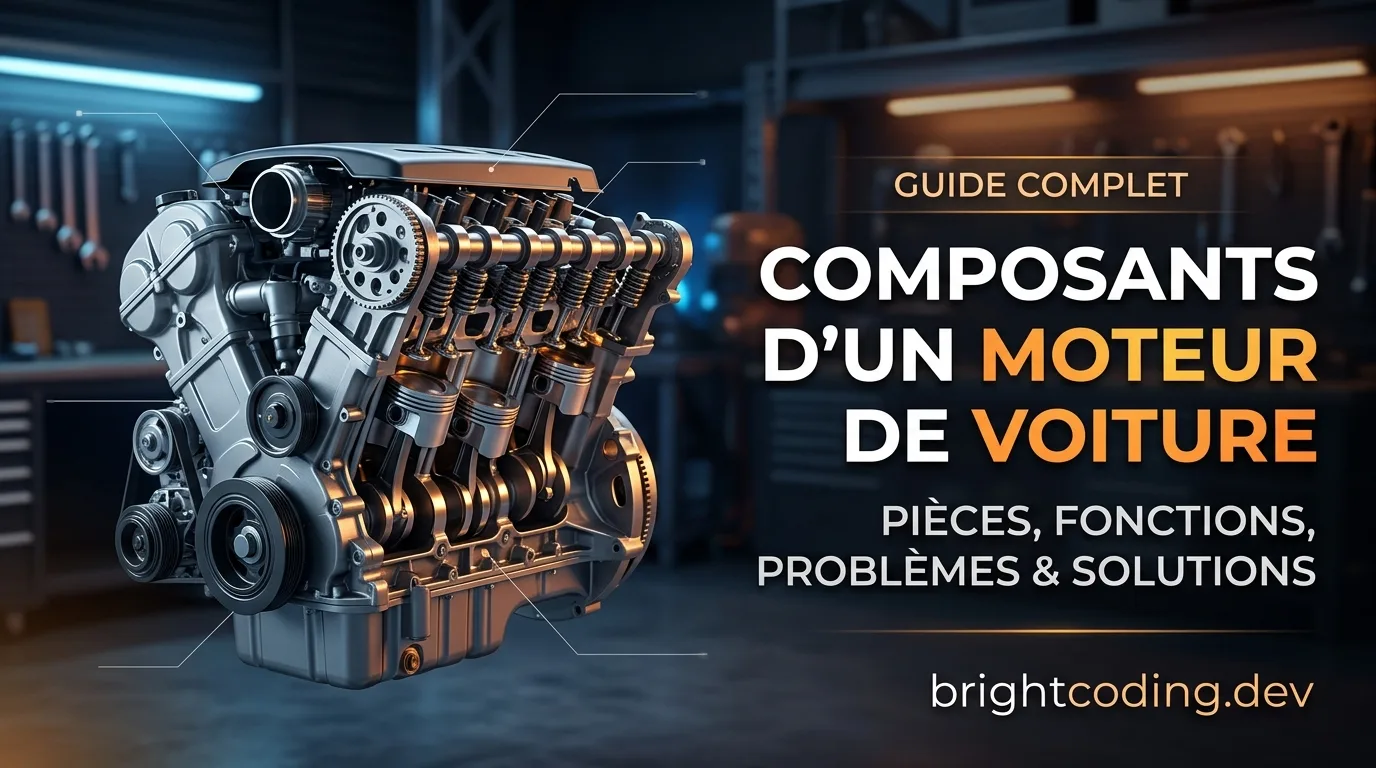
Composants d'un moteur de voiture : guide complet des pièces, fonctions, problèmes et solutions
Le moteur thermique est le cœur de la voiture. Il transforme le carburant en énergie mécanique grâce au cycle à quatre temps : admission, compression, combustion et échappement. Il est composé de nombreuses pièces essentielles comme le bloc moteur, la culasse, les pistons, le vilebrequin, les arbres à cames, les soupapes, ainsi que les systèmes d’admission, d’allumage, de lubrification et de refroidissement.
Read the article →
How Car Key Programming Works: The Complete Beginner's Guide
A car key used to be a piece of metal. Now it is a small computer that talks to your car, and when that conversation breaks, the car simply refuses to start. After reading this guide you will understand what key programming actually is, you will know when you can do it yourself with a scan tool and…
Read the article →