10 Signs It's Time to Replace Your Car Battery
Your battery rarely dies with a dramatic announcement. Usually it whispers first — a slow crank on a cold morning, lights that dim at idle, a clock that resets itself. This article walks through the ten signs that actually matter, answers the questions people ask most about car batteries, and tells…
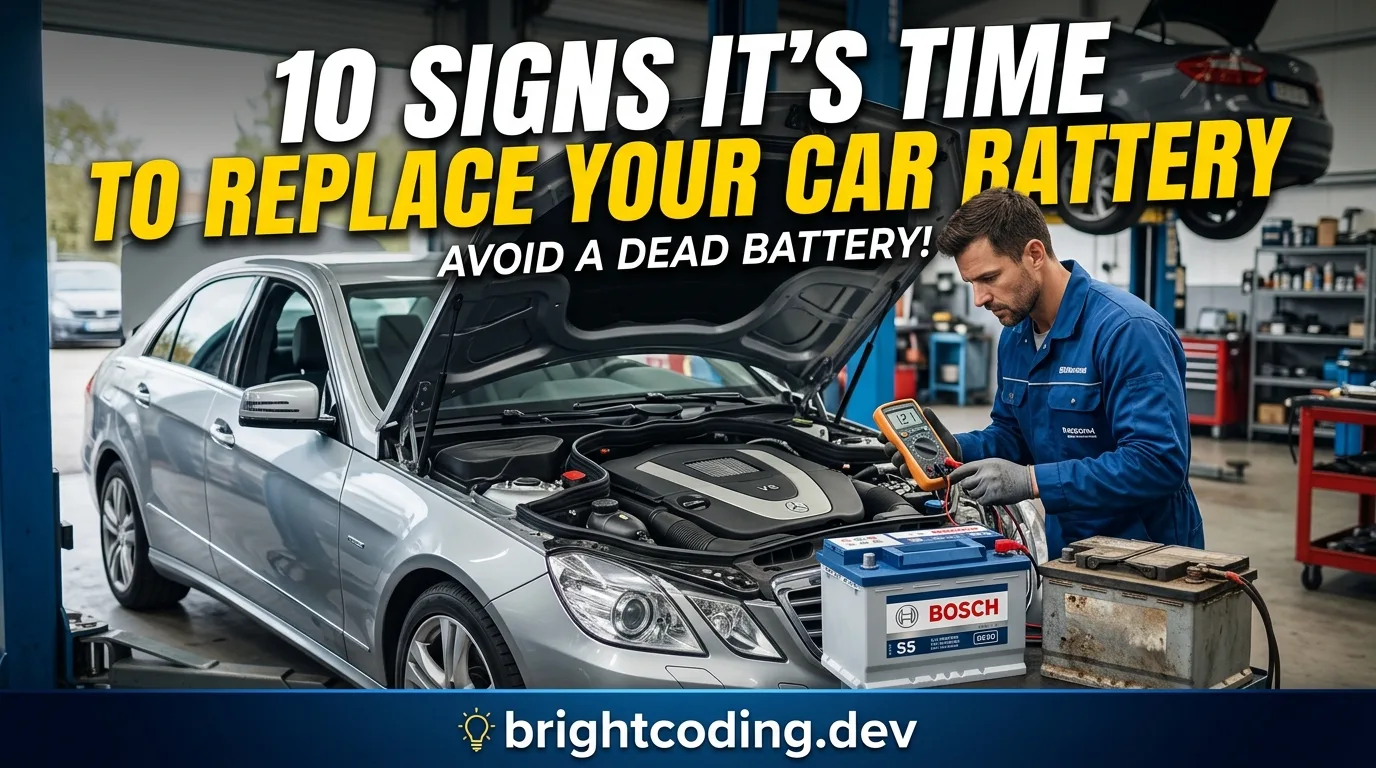
Your battery rarely dies with a dramatic announcement. Usually it whispers first — a slow crank on a cold morning, lights that dim at idle, a clock that resets itself. This article walks through the ten signs that actually matter, answers the questions people ask most about car batteries, and tells you when to keep driving and when to stop ignoring it.
Quick answers
- How do I know if my car battery needs replacing? A slow, labored crank is the most reliable early sign. Add dim lights at idle, a battery warning light, or a battery that's over 3–5 years old, and replacement is usually the smart call.
- What are the signs of a weak car battery? Slow engine cranking, dim headlights, clicking when you turn the key, a clock or radio that resets, and a swollen or smelly battery case.
- How long does a car battery last? Most last 3–5 years. Extreme heat shortens that; mild climates and gentle driving can stretch it a bit longer.
- Can a bad battery cause other problems? Yes. A weak battery stresses the alternator, can trigger random warning lights, and can cause misfires or rough running on modern cars.
- How do I test a car battery at home? A multimeter reading of about 12.6 volts at rest (engine off) and 13.5–14.5 volts with the engine running is a healthy sign. Below 12.4 volts at rest points to a weak or discharged battery.
How do I know if my car battery needs replacing?
The single best tell is the crank. If your engine used to fire up instantly and now turns over slowly — especially on the first cold start of the day — your battery is telling you something. Slow cranking happens because the battery can no longer deliver the burst of current the starter needs, and it usually gets worse over weeks, not hours.
That said, slow cranking isn't always the battery. A loose or corroded terminal, a tired starter, or a weak alternator can produce similar symptoms. If you want to sort out what's actually happening, the car symptom finder is a quick way to narrow things down before you spend money.
The other thing to watch is age. If your battery is 4 or 5 years old and you're starting to see any of the signs below, don't wait for a total failure. Batteries almost always die on a day you really need the car.
What are the signs of a weak car battery?
Here are the ten signs worth paying attention to, roughly in order of how often I see them:
- Slow engine cranking. The engine turns over sluggishly, especially in cold weather.
- Clicking sound when you turn the key. Often a classic "not enough juice to engage the starter" symptom.
- Dim headlights or interior lights at idle. Brightness that fades when you stop and returns when you rev is a giveaway.
- Battery warning light on the dash. Sometimes this is the alternator, sometimes the battery — don't assume.
- Electrical gremlins. The clock resets, the radio loses presets, seat memory forgets you, or random warning lights flash and vanish.
- A swollen or cracked battery case. Heat and internal damage can warp the case. This one is a hard stop — replace it.
- A rotten-egg smell. That's hydrogen sulfide from a battery being overcharged or failing internally. Ventilate and replace.
- Corrosion or white/blue crust on the terminals. Clean it first, but if it comes back fast, the battery is often on its way out.
- Frequent jump-starts. If you've jumped it twice in a month, stop pretending it's fine.
- Old age combined with any of the above. A 5-year-old battery showing even one symptom is usually done.
If you've got a check-engine light along with any of this, the free OBD code lookup can help you figure out whether the code is battery-related or pointing at something else entirely.
How long does a car battery last?
Three to five years is the honest range for most cars. Some last seven; plenty die at three. The big variable is heat — a battery cooking under the hood in a hot climate ages much faster than one in a mild one, even though cold weather is what usually exposes the weakness.
Driving habits matter too. Short trips that never let the alternator fully recharge the battery are brutal on it. If your daily drive is under ten minutes, you're slowly draining the battery every time, and you'll likely be replacing it closer to the three-year mark.
You can't predict the exact date a battery will fail, but you can get a rough idea. Most auto parts stores will load-test your battery for free in a few minutes. That test is far more useful than guessing from the calendar.
Can a bad battery cause other problems?
Yes, and this is where people get confused. A weak battery forces the alternator to work harder, which can shorten the alternator's life. On modern cars packed with electronics, low voltage can also trigger a whole parade of phantom issues: transmission hesitation, misfires, ABS lights, traction control warnings — symptoms that look expensive but disappear once the battery is replaced.
This is why a proper diagnosis matters before you throw parts at a problem. If you're getting codes that don't quite make sense, the OBD live-data tool lets you watch voltage and sensor readings in real time, which often catches a dying battery masquerading as something worse.
If you're not sure how to interpret what you're seeing, the AI mechanic assistant is a decent second opinion before you head to a shop.
How do I test a car battery at home?
You need a basic multimeter — a $20 one is fine. With the engine off and the headlights having been off for a while, touch the probes to the battery terminals:
- 12.6 volts or higher: healthy and charged.
- 12.4 volts: about 75% charged.
- 12.2 volts or lower: weak or discharged.
- Below 12 volts: probably needs replacing or a long charge.
Then start the engine and check again. You should see 13.5–14.5 volts, which means the alternator is charging. If the reading stays low with the engine running, the problem may be the charging system, not the battery.
For a more thorough look, a load tester (many parts stores lend or rent them) simulates the actual strain of starting and gives a much clearer verdict on a battery's remaining life. The free car tools section has a few calculators and references that pair well with basic electrical checks.
What does a clicking sound mean when I start the car?
A single loud click, followed by nothing, is usually the starter solenoid not getting enough current. That's often a weak battery or a bad connection. A rapid series of clicks — click-click-click-click — is the classic low-battery sound.
Before you buy a battery, clean the terminals with a wire brush and make sure they're tight. A bad ground or corroded cable can mimic a dead battery perfectly, and it's a five-minute fix. If cleaning doesn't change the click, the battery is the prime suspect.
Can cold weather kill a car battery?
Cold doesn't create the problem — it exposes it. A battery that's already weak produces less cranking power in freezing temperatures, right when the engine needs more of it. That's why so many batteries die on the first genuinely cold morning of the year.
Heat is actually the bigger long-term killer. Summer temperatures accelerate the internal chemical wear, and then winter arrives and the battery simply can't keep up. If your battery is more than three years old and you're heading into a cold season, a free load test is cheap insurance.
Should I replace the battery myself?
Absolutely, if you're comfortable with basic tools. It's usually a 10–20 minute job: disconnect the negative terminal first, remove the hold-down, swap the battery, reconnect negative last, and reset your clock and radio presets. Some cars need a computer relearn for the idle or window positions — check your owner's manual.
A few cautions. Modern cars with start-stop systems often need an AGM battery and a registration step so the charging system knows it's new. Skip that step and the new battery can be undercharged or overcharged. If your car has that setup, it's worth having a shop do it, or at least reading the procedure carefully in the step-by-step car guides before you start.
Budget-wise, a standard lead-acid battery typically runs somewhere in the $120–$250 range installed, and AGM batteries for start-stop cars often land higher — call it $180–$350. These are rough estimates; prices vary a lot by region, brand, and vehicle, so verify locally.
Bottom line
Slow cranking, dim lights at idle, electrical gremlins, and a battery past its fourth birthday — any two of those together usually means it's time. Test it with a multimeter or a free load test rather than guessing, clean the terminals before you spend money, and don't ignore a swollen or smelly battery. That one isn't a warning; it's a replacement order.
Related articles
How Often Should You Really Change Your Engine Oil?
The 3,000-mile oil change is one of the most successful marketing campaigns in automotive history. It's also mostly obsolete. By the end of this guide you'll know how to figure out the right interval for your car, your driving, and your oil — not the number some quick-lube poster taped to the wall.…
Read the article →
Free Car Diagnostics: The Best Methods to Try in 2026
Discover the best free car diagnostic methods of 2026, from AI-powered symptom checkers to live OBD scanners, and learn how to troubleshoot your vehicle without spending a dime at the dealership.
Read the article →Engine oil explained: viscosity, specs and myths
What the numbers on the bottle mean, why spec matters more than brand, and the common oil myths mechanics see every day.
Read the article →
The Best Way to Keep Your Car Cool During Extreme Summer Heat
Your steering wheel is hot enough to brand cattle, the air conditioning is blowing lukewarm air, and the temperature gauge is creeping past where it usually sits. If that sounds like your July commute, you are not imagining things. Extreme heat is genuinely hard on cars, and the ways to keep yours…
Read the article →
How to Save Money on Car Repairs Without Taking Risks
Here's the honest version up front: most common repairs land somewhere between $150 and $1,200 when you pay a shop, and a few big-ticket jobs (timing belts, clutches, head gaskets) can run past $2,000. That range is wide on purpose. Your make and model, where you live, and whether you walk into a d…
Read the article →
15 Easy Ways to Improve Your Car's Fuel Efficiency
The needle on my fuel gauge dropped a full eighth of a tank between my driveway and the grocery store six miles away. That's not right. I stood in the parking lot with my hand still on the pump handle from the day before, doing math in my head, and the math was bad. My aging sedan had been drinking…
Read the article →