The Simple Car Maintenance Checklist Every Driver Needs
Your car doesn't fail dramatically. It fails on a Tuesday, in a parking garage, when you're already late. The oil light you ignored for two weeks. The tire you kept meaning to check. The noise you turned the radio up to drown out.
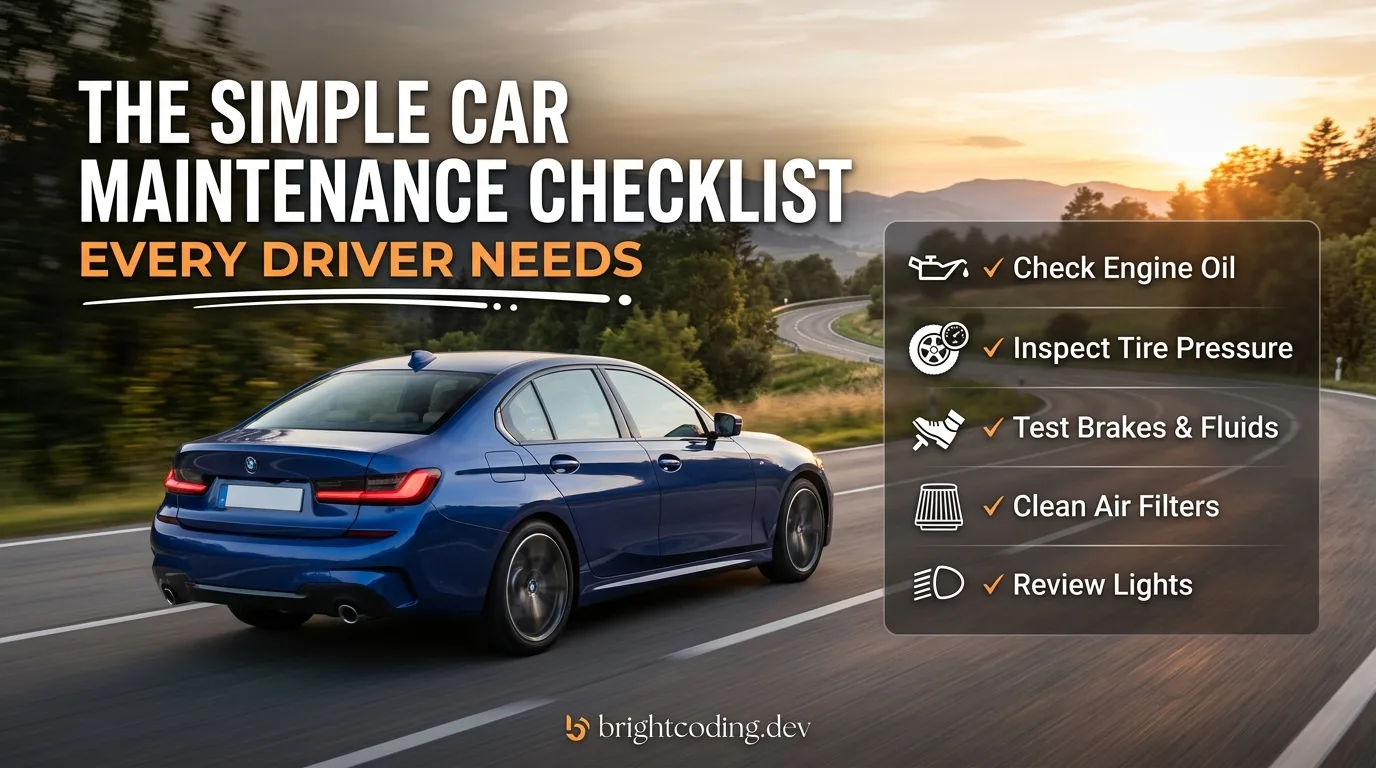
Your car doesn't fail dramatically. It fails on a Tuesday, in a parking garage, when you're already late. The oil light you ignored for two weeks. The tire you kept meaning to check. The noise you turned the radio up to drown out.
This isn't a list of things you should already know. It's the seven mistakes I see owners make over and over — and the cheap, boring habits that prevent almost all of them.
Why most people get this wrong
Car maintenance has a branding problem. It's sold as either a mysterious priesthood you shouldn't touch, or a boring chore you can indefinitely postpone. Both lead to the same place: neglected fluids, worn parts, and a repair bill that could have been a $12 jug of coolant.
The other problem is timing. Modern cars are quiet and forgiving, so nothing screams at you until something breaks. By then you're not doing maintenance — you're doing damage control.
The fix isn't becoming a mechanic. It's knowing the handful of checks that actually matter, doing them on a schedule, and reading the warning signs before they get expensive.
1 — Treating the oil light like a suggestion
Picture this: the oil pressure light flickers on at a stoplight, then goes away once you accelerate. You tell yourself it's a sensor. It's almost never a sensor.
That flicker usually means low oil pressure, and low pressure means metal parts are grinding without a proper film of oil between them. People ignore it because the car still drives fine — right up until it doesn't, and you're looking at an engine replacement instead of an oil change.
Avoid it: Check the dipstick the same day. If it's low, top it off and find out why it dropped. If the light stays on while the engine runs, stop driving and get it looked at.
2 — Ignoring the check engine light until inspection time
A steady check engine light is often something small — a loose gas cap, a failing oxygen sensor, a misfire that's costing you fuel economy every single mile. A flashing check engine light is different. That means active misfire, and you should stop driving.
The mistake is lumping both into "I'll deal with it later." Meanwhile you're burning extra fuel and masking a problem that's getting worse.
Avoid it: Pull the code yourself. A basic scanner is cheap, and you can run the code through a free OBD code lookup to see what it actually means before you panic or procrastinate. From there, live data tells you whether the sensor is genuinely misbehaving or just reporting a real fault elsewhere.
3 — Checking tire pressure by looking at the tire
You can't see 6 psi. A tire that's 20% under-inflated looks completely normal, and it's quietly costing you fuel, wearing unevenly, and running hotter on the highway.
People skip this because the tire "looks fine" and the gauge is in the glovebox somewhere. Then a sidewall bubbles on a hot day, or the tire wears out at 30,000 miles instead of 50,000.
Avoid it: Check pressure monthly, when the tires are cold, using the number on the driver's door jamb — not the max pressure molded into the sidewall. If you've changed wheel or tire sizes, a tire size comparison tool will show you how much your speedometer and clearance are now off.
4 — Waiting for the "maintenance light" to tell you everything
That little wrench icon is a reminder, not a diagnostic. It doesn't know your brake fluid is dark, your cabin filter is a petri dish, or your coolant is slowly disappearing through a pinhole.
Owners who only respond to dashboard prompts end up doing the minimum and missing the items that don't have a sensor — brake fluid, transmission fluid, power steering fluid, belts, hoses.
Avoid it: Keep a simple log. Date, mileage, what you did. When something feels off later, that log tells you whether it's new or something you've been ignoring for a year.
5 — Skipping the fluids nobody thinks about
Oil gets all the attention. Brake fluid absorbs moisture over time and can boil under hard braking. Coolant degrades and stops protecting against corrosion. Transmission fluid on many cars is "lifetime" — a word that means "until it isn't."
These aren't urgent until they are. Brake fluid that's gone bad doesn't warn you; it just fades when you need it most.
Avoid it: Follow the intervals in your owner's manual, and check fluid levels and color every few months. Dark, gritty, or low fluid is your cue to act, not top it off and forget it.
6 — Diagnosing by sound and hoping for the best
A new rattle, a clunk over bumps, a whine that rises with speed. Most drivers either crank the radio or start googling symptoms and convince themselves it's nothing.
That whine could be a wheel bearing that's about to seize. That clunk could be a worn sway bar link — cheap now, annoying later. Guessing wastes money on the wrong parts.
Avoid it: Describe what you hear and when you hear it. A symptom finder narrows it down by condition and location, and when you're stuck, an AI mechanic assistant can ask the follow-up questions you'd never think to ask yourself.
7 — Only opening the hood when something's already broken
Belts crack. Hoses get soft. Battery terminals corrode. None of this announces itself, and all of it is visible in thirty seconds with the hood up.
The people who avoid roadside breakdowns aren't luckier. They just look under the hood before something forces them to.
Avoid it: Once a month, pop the hood. Look for cracks, leaks, green crust on the battery, and fluid levels that have dropped. Five minutes, no tools required.
Do this instead
- Check tire pressure monthly, cold, against the door-jamb number.
- Pull and read codes the moment the check engine light comes on — steady or flashing.
- Keep a written log of dates, mileage, and what you did.
- Look at your fluids, not just your oil: brake, coolant, transmission, power steering.
- Investigate new noises instead of turning up the radio.
- Open the hood once a month and actually look.
- Follow your owner's manual's schedule — it beats any internet advice, including mine.
If you want to go deeper on any of this, the step-by-step car guides walk through the jobs most owners can handle themselves, and the free car tools cover the checks you'd otherwise pay someone to do.
FAQ
How often should I really check my oil? Once a month is plenty for most cars, plus before any long trip. If you're burning or leaking oil, check it weekly until you fix the cause.
My check engine light came on and the car drives fine. Can I wait? A steady light can usually wait a few days while you get the code read. A flashing light means stop driving now. Don't guess — read the code first.
Do I need to change "lifetime" transmission fluid? "Lifetime" is a marketing term, not a guarantee. Many mechanics recommend a fluid service well before the mileage most manuals imply. Ask a trusted shop what makes sense for your specific car.
Is it worth learning to do my own maintenance? For oil, filters, wipers, and fluid checks — yes. You'll save money and catch problems early. For brakes, timing belts, and anything involving the high-voltage system on a hybrid or EV, know your limits.
What's the single most overlooked item? Brake fluid. It has no dashboard warning, degrades silently, and matters most in the moment you need to stop hard.
The best maintenance checklist is the one you actually do — and the cheapest repair is always the one you caught early.
Related articles

The Best Way to Keep Your Car Cool During Extreme Summer Heat
Your steering wheel is hot enough to brand cattle, the air conditioning is blowing lukewarm air, and the temperature gauge is creeping past where it usually sits. If that sounds like your July commute, you are not imagining things. Extreme heat is genuinely hard on cars, and the ways to keep yours…
Read the article →
How to Save Money on Car Repairs Without Taking Risks
Here's the honest version up front: most common repairs land somewhere between $150 and $1,200 when you pay a shop, and a few big-ticket jobs (timing belts, clutches, head gaskets) can run past $2,000. That range is wide on purpose. Your make and model, where you live, and whether you walk into a d…
Read the article →
15 Easy Ways to Improve Your Car's Fuel Efficiency
The needle on my fuel gauge dropped a full eighth of a tank between my driveway and the grocery store six miles away. That's not right. I stood in the parking lot with my hand still on the pump handle from the day before, doing math in my head, and the math was bad. My aging sedan had been drinking…
Read the article →
What Happens If You Ignore Your Check Engine Light?
That amber engine icon is the most ignored warning in motoring. It comes on, nothing explodes, so you keep driving. A week later it's still there. A month later you've stopped seeing it.
Read the article →
10 Dashboard Warning Lights You Should Never Ignore
Your dashboard isn't trying to annoy you. It's the only part of the car that talks to you in plain language — and it's often the cheapest warning you'll ever get. Ignore the wrong one and a $150 repair becomes a $2,000 repair, or a breakdown on the shoulder of a highway at 11 p.m.
Read the article →
20 Hidden Features in Your Car You Probably Never Use
Most cars built in the last fifteen years are quietly packing a couple dozen conveniences the owner's manual buries on page 147. This article answers the questions people actually type into Google about those features — what they are, how to turn them on, and which ones are worth the trouble — so y…
Read the article →