How to Protect Your Engine During Short Trips
Short trips are brutal on an engine, and most people never realize it. If your daily routine is a five-minute drive to the store, the school run, or a commute under ten minutes, your oil never gets hot enough to do its job properly. After reading this, you'll know exactly how to reduce that damage:…

Short trips are brutal on an engine, and most people never realize it. If your daily routine is a five-minute drive to the store, the school run, or a commute under ten minutes, your oil never gets hot enough to do its job properly. After reading this, you'll know exactly how to reduce that damage: what to change, how often, and which habits actually matter. Set aside about 20 minutes to read and plan, plus whatever time the small jobs take.
What you need before you start
- Your owner's manual (the single most useful document you own)
- A notebook or phone note to track your driving patterns and service dates
- A tire pressure gauge
- Jumper cables or a portable jump starter
- Basic hand tools if you plan to check or change your own oil and filters
- A code reader or access to a free OBD code lookup at /obd if a warning light shows up
- Spare oil of the correct grade for your car, topped up between changes
You don't need all of this today. Even tracking your trips and checking your oil level once a week puts you ahead of most drivers.
Step 1: Understand why short trips hurt your engine
Every cold start dumps extra fuel into the cylinders, and some of that fuel sneaks past the piston rings into the oil pan. On a long drive, the engine gets hot enough to boil that fuel and moisture back out through the crankcase ventilation system. On a short trip, it doesn't. Over months, your oil gets diluted, acidic, and full of water.
That's the core problem. Everything below is about either getting the engine hotter or compensating for the fact that you can't.
Practical tip: If most of your trips are under 10 minutes, treat your car as a "severe service" vehicle. Most owner's manuals list a shorter oil change interval for exactly this use case. Look it up, don't guess.
Step 2: Check your oil level and condition weekly
Pull the dipstick when the engine is cold and the car is on flat ground. Wipe it, reinsert it, pull it again, and read the level. Then look at the color and texture. Fresh oil is amber and translucent. Oil that's milky, gritty, or smells strongly of fuel is a warning sign.
Why it matters: Short-trip driving is the fastest way to turn good oil into bad oil. Catching dilution early is cheaper than catching a worn bearing later.
Time: Two minutes. Do it every Sunday while you're thinking about the week ahead.
Step 3: Shorten your oil change interval
If the manual says 10,000 miles, that number assumes normal driving. Short trips are not normal driving. Many manufacturers list a separate severe-service interval, often 5,000 to 7,500 miles, but check your specific manual because this varies a lot by engine and oil type.
Why it matters: Diluted oil loses its ability to lubricate and protect metal surfaces. The cost of an extra oil change per year is trivial next to an engine rebuild.
Cost: An oil and filter change at a shop typically runs from roughly $60 to $150 depending on your car and oil type. Doing it yourself with a filter and the correct oil usually costs less. Prices vary by region, so confirm locally.
Tip: Use the oil grade your manual specifies. Don't "upgrade" to a thicker oil hoping it helps. It usually doesn't, and it can hurt cold-start flow, which is exactly what short trips punish.
Step 4: Take the long way home once a week
This is the simplest fix on the list. Once a week, drive your car for at least 20 to 30 minutes at highway speed. That's long enough to fully warm the oil and burn off the fuel and moisture that accumulated.
Why it matters: You're not just driving. You're giving the engine a chance to clean itself out through normal heat cycles and crankcase ventilation.
Tip: Combine it with an errand you already have to run. A 25-minute drive to a store farther away beats a 5-minute trip to the closest one.
Step 5: Don't idle to "warm up"
Idling warms the coolant, not the oil. The engine sits there running rich, dumping more fuel into the cylinders, and the oil stays cold. Modern engines are designed to be driven gently from a cold start.
Why it matters: Long idles make the dilution problem worse, not better, and they waste fuel.
Tip: Start the car, buckle up, and drive gently for the first few minutes. Keep the revs moderate until the temperature gauge starts moving. That's the real warm-up.
Step 6: Watch your battery, it suffers too
Short trips never give the alternator enough time to fully recharge the battery after a start. Do that every day for months and you'll be shopping for a new battery earlier than you should.
Why it matters: A weak battery stresses the starter and the charging system, and it can leave you stranded in a parking lot.
Safety note: When jump-starting, connect positive to positive first and negative to a solid metal ground on the dead car, not to the negative battery terminal. Never lean over the battery while connecting. Batteries can vent explosive gas. Check your manual for your specific car's jump-start procedure.
Tip: If your car cranks slowly on cold mornings, get the battery and charging system tested. Many auto parts stores do this free.
Step 7: Keep the air filter and spark plugs in good shape
A clogged air filter and worn spark plugs make an already inefficient combustion process worse. Short trips already run rich. Don't add to it.
Why it matters: Clean air and a strong spark mean better combustion, less unburned fuel, and less contamination in your oil.
Time and cost: An air filter is often a 10-minute job and usually costs somewhere between $15 and $40. Spark plugs vary widely by engine, from a quick job to a half-day project. Check your manual for intervals.
Step 8: Let the engine breathe, don't baby it forever
Once the engine is warm, don't be afraid to use some throttle now and then. Gentle driving is right when cold. But an engine that never sees any load can build up carbon deposits over time.
Why it matters: Some spirited acceleration after warm-up helps keep the intake and combustion chambers cleaner than constant low-rpm puttering.
Tip: This is not an excuse to redline a cold engine. Warm first, then drive it properly.
Step 9: Deal with warning lights immediately
That check engine light is not decoration. On a short-trip car, it might be telling you about a misfire, a failing oxygen sensor, or a rich-running condition, all of which make oil dilution worse.
Why it matters: Ignoring a small problem on a short-trip car turns it into an expensive problem faster than on a highway-driven car.
Tip: Pull the code, then look it up. You can use the free OBD code lookup at /obd to understand what your car is telling you before you decide whether to book a shop visit.
Step 10: Consider a block heater in cold climates
If you live somewhere with real winters, a block heater or oil pan heater keeps the engine warmer overnight. A warmer start means less fuel dilution and less wear on the first few minutes of running.
Why it matters: Cold starts are the worst part of short-trip driving. Anything that softens that first minute pays off.
Cost: A block heater install varies widely, often from around $100 to $300 installed depending on the car and your region. Confirm locally.
Pro tips
- Track your trips for one week. You'll probably be surprised how many are under five minutes, and that number tells you how aggressive to be with maintenance.
- Change your oil based on miles and time. If you drive very little, change it at least once a year even if you haven't hit the mileage. Oil degrades sitting in a cold engine.
- Park facing out when you can. It's a small thing, but fewer cold-start maneuvers in tight spots is easier on everything.
- Keep a log. A simple note in your phone of every oil change, filter, and battery test makes future decisions obvious instead of a guessing game.
- If you want to understand what a symptom is actually telling you, the car symptom finder at /symptom is a fast way to narrow it down before you spend money.
- Use your owner's manual as the final word. Every engine is different, and the manual knows yours better than any generic advice, including this article.
Common pitfalls
Thinking "low mileage" means "low maintenance." It's the opposite. A car that does 3,000 short-trip miles a year often needs more attention than one that does 15,000 highway miles. Don't skip service because the odometer looks low.
Idling to warm up then driving hard. You warmed the coolant, not the oil, and then you hammered a cold engine. Warm up by driving gently, then drive normally.
Only topping off oil and never changing it. Topping off keeps the level right, but it doesn't remove the fuel and moisture that built up. The oil still needs to come out.
Ignoring a slow-cranking battery until it dies. Batteries on short-trip cars fail earlier. Test them before winter, not during a snowstorm.
Assuming a check engine light is "probably nothing." On a short-trip car, that light is more likely to matter. Read the code with the free OBD code lookup at /obd and act on it.
Useful resources
- Your owner's manual, for oil grade, service intervals, and jump-start procedure
- The free OBD code lookup at /obd for reading and understanding trouble codes
- The step-by-step car guides at /guides for hands-on maintenance jobs
- The mechanical encyclopedia at /encyclopedia for how engine systems actually work
- The AutoTools blog at /blog for ongoing maintenance and repair topics
FAQ
How short is "short" for a trip? There's no universal number, but anything under about 10 minutes, or under roughly 5 miles, is generally considered a short trip for engine wear purposes. The key factor is whether the oil reaches full operating temperature, which usually takes longer than the drive itself.
Can I just drive longer once a month instead of every week? Weekly is better, but even once every couple of weeks helps. The longer you go between full warm-ups, the more fuel and moisture accumulate in the oil.
Does synthetic oil solve the short-trip problem? It helps, because synthetics resist breakdown and dilution better than conventional oil, but it doesn't eliminate the issue. You still need to change it on a short-trip schedule.
Will a check engine light from short trips go away on its own? Sometimes a code clears after a long drive, especially if it was triggered by a temporary rich condition. But if it comes back, get it diagnosed. Don't assume it's harmless.
Is it worth using a fuel additive for short trips? Some additives claim to help with fuel system cleanliness, but results vary and quality matters. Follow your manual's recommendations first, and be skeptical of anything promising a miracle fix.
One last thing
Short-trip engine care isn't complicated. It's mostly about acknowledging that your driving style is hard on the oil, the battery, and the combustion process, and adjusting your maintenance to match. Do the weekly oil check, change the oil more often, take the long way home once a week, and don't ignore warning signs. That routine alone will keep most engines healthy for a very long time. Your car isn't asking for much. Just a little attention.
Ready to act on what you just read? Decode that warning light with the free OBD code lookup, run the matching car tools to check the numbers yourself, or browse more practical car articles for ideas.
Related articles

15 Common Driving Mistakes That Increase Accident Risk
Most crashes do not start with a dramatic event. They start with a decision you have made a hundred times without thinking: rolling a stop sign, tailgating the guy who cut you off, fiddling with the radio on the highway. Nothing happens 999 times, so the habit feels safe. That is exactly what makes…
Read the article →
10 Parking Mistakes That Can Damage Your Car
You park a dozen times a day. That's exactly why it goes wrong. Nobody thinks about parking until a mirror is hanging by a wire or a wheel bearing starts humming at highway speed.
Read the article →
How to Drive Safely on Snow and Ice
Snow driving is mostly a set of small decisions made before you ever touch the gas. Get those right and the road stops being scary.
Read the article →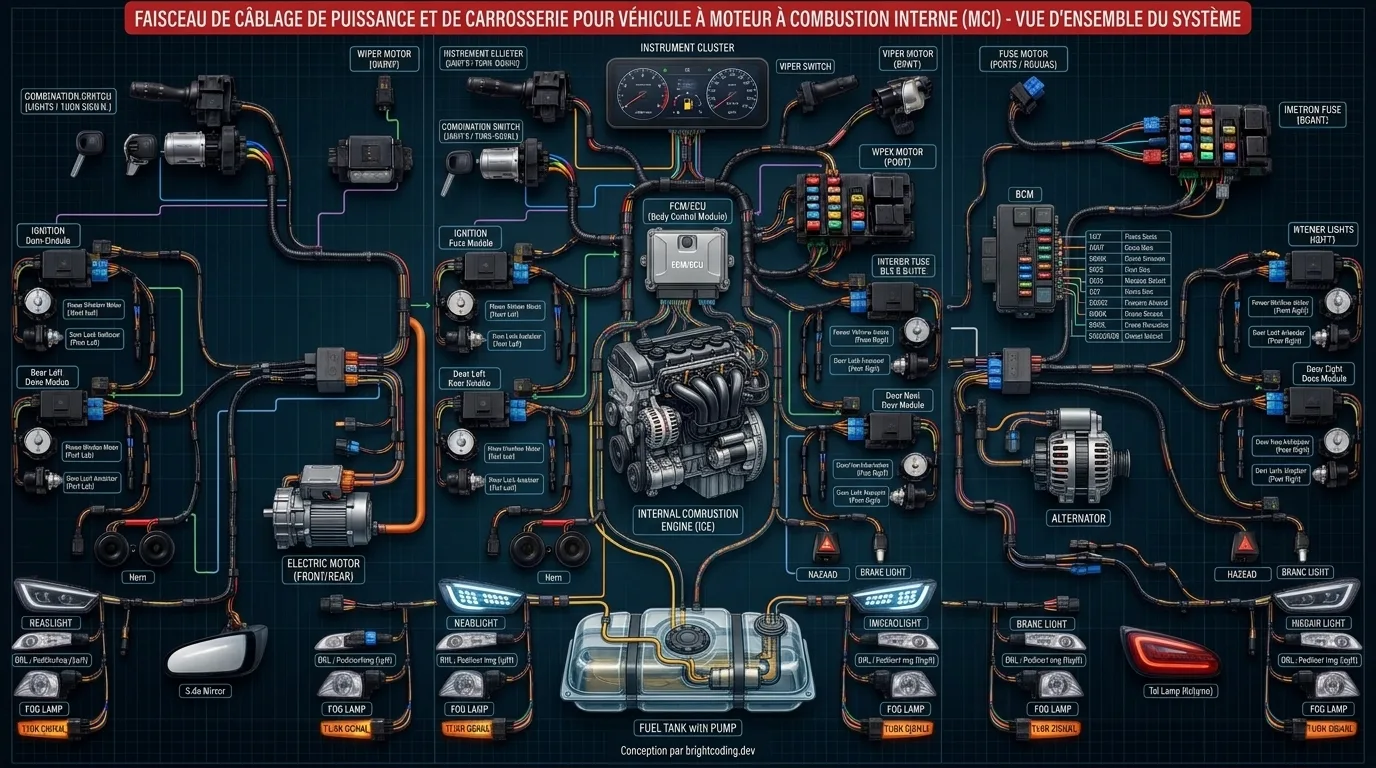
Comprendre le faisceau électrique d’une voiture à moteur thermique : alimentation, ECU, fusibles, BCM et équipements électriques
Une voiture moderne ne dépend pas uniquement du moteur, de la batterie et de l’alternateur. Elle utilise un réseau complexe de fils, de connecteurs, de fusibles, de relais et de calculateurs pour faire fonctionner le moteur et les nombreux équipements électriques. Ce guide permet de comprendre simplement les principaux éléments représentés sur le schéma et la manière dont l’énergie électrique et les signaux circulent dans le véhicule.
Read the article →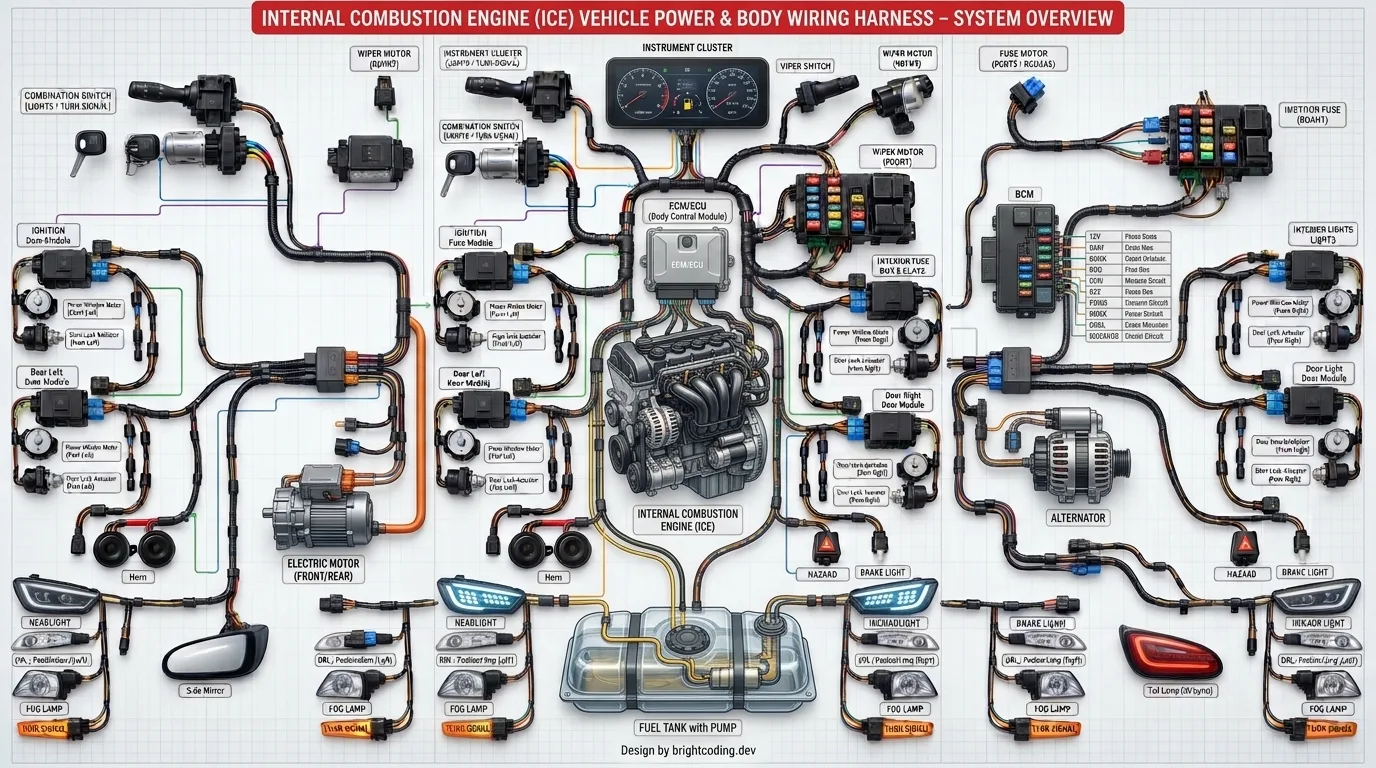
Internal Combustion Engine Vehicle Wiring Harness Explained: A Complete Guide to Power, Control Modules, Fuses and Body Electronics
A modern vehicle depends on much more than an engine and a battery. Behind the dashboard and throughout the engine bay is a complex network of wires, connectors, fuses, relays, control modules and electrical components working together. This guide explains the main parts shown in a vehicle wiring harness overview and how electrical power and control signals travel through the car.
Read the article →
Why Hard Braking Can Cost You More Than You Think
You stab the pedal, the nose dives, and you stop just in time. Feels like good driving, right? That single moment of panic braking sends a bill to a dozen parts you never think about, and it keeps charging interest long after you've driven away.
Read the article →