20 Hidden Features in Your Car You Probably Never Use
Most cars built in the last fifteen years are quietly packing a couple dozen conveniences the owner's manual buries on page 147. This article answers the questions people actually type into Google about those features — what they are, how to turn them on, and which ones are worth the trouble — so y…
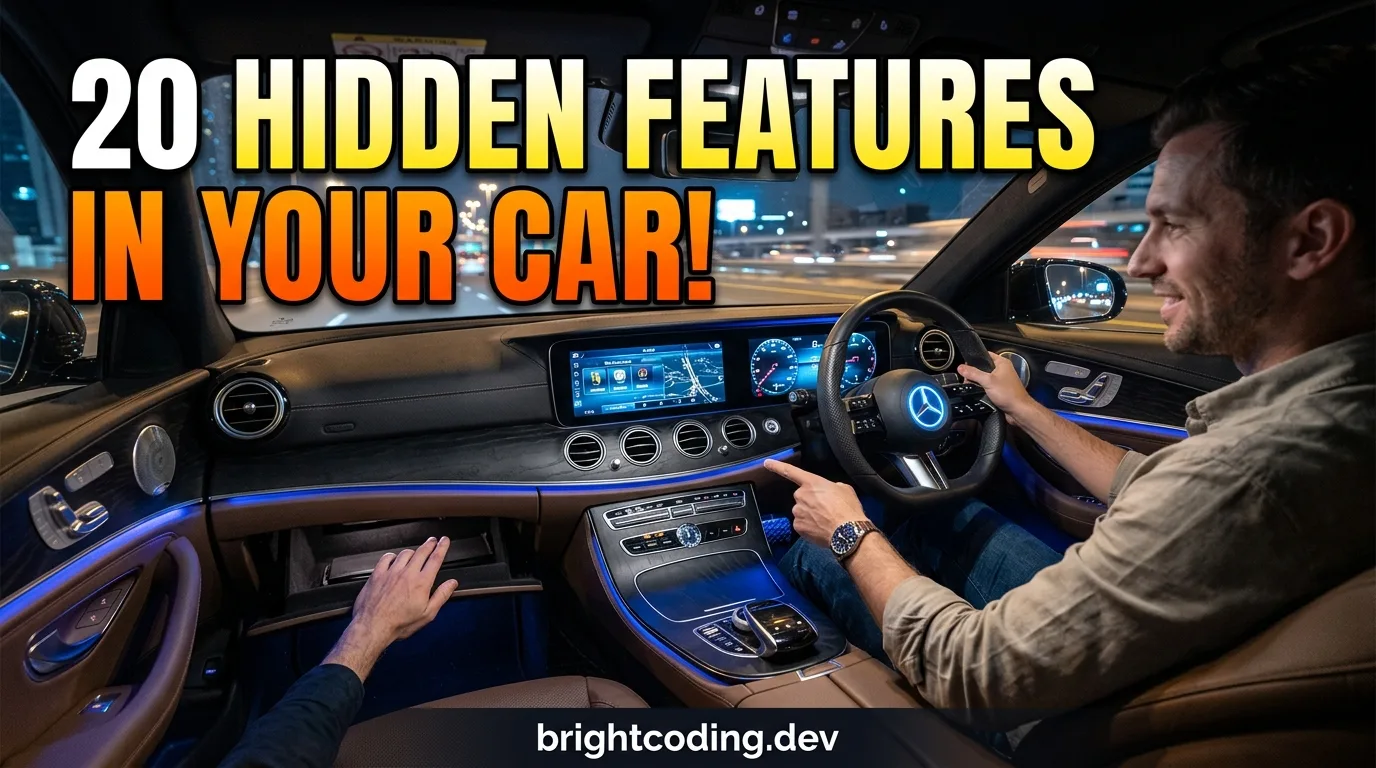
Most cars built in the last fifteen years are quietly packing a couple dozen conveniences the owner's manual buries on page 147. This article answers the questions people actually type into Google about those features — what they are, how to turn them on, and which ones are worth the trouble — so you can stop discovering them by accident in a parking lot.
Quick answers
- What are the most commonly overlooked car features? The ones you can't see: auto-locking doors, a hidden valet mode, a physical key release inside the fob, and a hold-to-roll-down-windows trick on the remote.
- How do I find hidden features on my own car? Read the index at the back of your owner's manual, not the chapters. That's where the "if equipped" features are listed. You can also search your exact trim level online, since base models often strip features the manual still describes.
- Do hidden car features actually matter? Some are gimmicks, but a handful — the fuel door release, the child safety lock, the emergency trunk pull — matter a lot the one time you need them.
- Can I unlock hidden features with a scan tool? Sometimes. On many VW, Audi, BMW, and Ford models, dealers or independent shops can enable features like auto-locking, needle sweep, or coming-home lights through coding.
- Why doesn't my car have the feature my friend's does? Trim level and model year. The same nameplate can lose three features between the base and mid-level trims, and again between model years.
What are the most commonly overlooked car features?
The pattern is consistent: features that don't have a dedicated button get forgotten. Auto-locking doors, a valet mode you have to trigger through the infotainment menu, a fuel door release tucked under the dash — they exist, they work, and the average owner never touches them. That's not a design failure so much as a documentation failure. The manual tells you the feature exists; it just doesn't tell you how much you'll want it the day you need it.
If you've ever stood at a gas pump wondering where the fuel door button is, you already know what I mean.
How do I find hidden features on my own car?
Start with the index at the back of your owner's manual — not the table of contents, the index. Look up words like "automatic," "remote," "memory," and "release." That's where the oddball features live. If you don't have the paper manual, most manufacturers host PDFs by year and trim on their owner sites.
Then narrow it down by your actual trim. A 2019 base-model sedan and a 2019 loaded one share a manual but not a feature list. Searching "2019 [your car] [your trim] hidden features" on a forum will get you further than the manual will, because owners have already done the digging.
One more thing: if a feature involves the engine, transmission, or emissions system, don't guess. A quick check with the free OBD code lookup will tell you whether the car is complaining about anything before you start poking at settings.
Do hidden car features actually matter?
Some are genuinely useful. The emergency trunk release inside the trunk lid has saved lives. The child safety lock on the rear doors is a two-minute job that prevents a very bad afternoon. The physical key hidden inside your key fob has rescued more people at more parking lots than any roadside app.
Others are closer to party tricks. A "needle sweep" on startup is fun the first week. A "coming home" light delay is nice if you park on a dark street. There's no harm in them, but they're not the reason to buy the car.
The honest test: if you had to explain the feature to a friend in one sentence and they'd say "oh, that's smart," it's worth learning. If they'd shrug, skip it.
Can I unlock hidden features with a scan tool?
Often, yes — and this is where things get interesting for DIYers. Manufacturers build features into the software that they only enable on certain trims or in certain markets. With the right tool and a bit of nerve, you can sometimes turn them on yourself.
On many Volkswagen, Audi, and BMW models, this is called coding. On Ford and some GM trucks, it's a "as-built" configuration change. On Toyotas, it's usually a dealer-only procedure. The tools range from a $20 Bluetooth dongle paired with a phone app to a $300 handheld programmer.
A few warnings. Coding can brick modules if you don't back up first. It can void a warranty claim if the dealer decides the change caused the problem. And on some cars, the feature you want is genuinely not supported — the hardware isn't there, regardless of what a forum post claims.
If you're going to try it, do it on a car you can afford to have towed. And if something feels off after the change — rough idle, warning lights, weird shifting — pull the codes and get a real diagnosis rather than guessing. You can use the OBD live-data tool to watch what the sensors are actually doing in real time.
Why doesn't my car have the feature my friend's does?
Trim level, model year, and market. That's almost always the answer. Automakers share a platform across many trims and change the feature list every year, sometimes mid-year. A feature that was standard on a 2018 mid-trim can become optional on the 2019 equivalent, or disappear entirely if the chip supply got tight.
This is why two people with the "same" car can have very different experiences. If you're chasing a specific feature and your car doesn't have it, check the window sticker or a VIN decoder before you spend money trying to enable it. The hardware has to be there first.
The 20 features, in roughly the order you'll want them
I'll keep the list tight and skip the obvious ones (cruise control, Bluetooth pairing). Each entry is something a real owner has asked me about.
1. The physical key inside your key fob. Pop the fob open or slide a hidden tab and there's a metal key inside. It unlocks the driver's door when the fob battery dies, and on some cars it also disables the passenger airbag or opens the trunk.
2. Remote window roll-down. On many cars, holding the unlock button on the fob rolls all windows down. Some models also roll them up with the lock button. This is one of the easiest features to check — just hold the button for five seconds and watch.
3. Auto-locking doors. Many cars can be set to lock all doors once you shift out of park or hit a certain speed. It's usually a menu setting or a sequence of button presses. Worth turning on if you drive in a city.
4. The child safety lock on rear doors. Open the rear door, look at the edge, and you'll find a small switch. Flip it and the door can only be opened from outside. It's mechanical, not electronic, and it's been there since the 1980s.
5. The emergency trunk release. Every car sold in the US since 2002 has a glow-in-the-dark pull handle inside the trunk. If you've never opened your trunk from the inside, do it once so you know where it is.
6. The fuel door release you can't find. On some cars it's a lever on the floor by the driver's seat. On others it's a button on the door panel. On a few, you just push the door itself. If you're stuck at a pump, check the owner's manual index under "fuel."
7. The hidden compartment in the console or under the seat. Many cars have a small stash spot — sometimes a false bottom in the center console, sometimes a slot under the passenger seat. It's usually for a wallet or registration, not a gun safe.
8. The sunglasses holder that isn't a sunglasses holder. That overhead flip-down thing is sometimes a conversation mirror, sometimes an eyeglass holder, and sometimes a garage door remote pocket. Look at what's molded into the plastic.
9. The sun visor extension. Most sun visors slide out on their rod or flip down a second panel. If the sun is at that specific angle that blinds you at 5pm, this is the fix.
10. The rearview mirror dimmer tab. On older cars, the little tab under the mirror flips it to a night setting. On newer cars, it's automatic — but the manual override still exists on many models.
11. The valet mode. Whether it's a keypad code on the infotainment, a physical key slot in the glovebox, or a trunk lockout, valet mode limits speed, locks the trunk, and hides your home address from the nav. It's usually buried in settings.
12. The parking brake release you didn't know existed. If your car has an electronic parking brake, there's often a manual release hidden under the console or behind a trim panel for emergencies. Check the manual before you need it.
13. The tilt-and-telescope steering wheel lever. It's usually a lever under the column that unlocks both adjustments at once. A surprising number of drivers have only ever moved the seat.
14. The seat memory buttons you've never pressed. If your car has memory seats, they also remember mirror positions and sometimes steering wheel position. Set two profiles — one for you, one for your partner — and stop adjusting mirrors every morning.
15. The "follow me home" headlights. Turn the car off, flash the high beams, and the headlights stay on for 30 seconds while you walk to your door. Standard on many European cars, hiding in the settings on others.
16. The one-touch lane change signal. Tap the turn signal stalk (don't push it all the way) and the blinker flashes three times. Most cars made after 2010 do this. It's the single most underused feature on this list.
17. The automatic recirculation button. On cars with climate control, there's usually a setting that switches the cabin to recirculated air when it detects exhaust or bad air outside. Great in traffic tunnels.
18. The rear wiper washer jet. If you have a rear wiper, you almost certainly have a rear washer too. Push the stalk forward (or twist the end) and it sprays. Most people forget it exists until winter.
19. The 12V socket that stays on with the ignition off. Some cars keep the accessory socket live after you turn the car off. Others cut power. You can test yours with a phone charger in 30 seconds.
20. The diagnostic mode in your instrument cluster. On many cars, holding a specific button combination while turning the key shows you a hidden menu with battery voltage, coolant temp, and error codes. Search your model and "instrument cluster test mode" — but be careful, some menus let you change things you shouldn't.
A few more questions people ask after reading a list like this
How do I know if my car has a feature before I buy it?
Check the window sticker, which lists every factory option, or run the VIN through a decoder. If you're buying used, ask the seller to demonstrate the specific feature — if they don't know how, you'll save yourself a surprise later. For anything engine- or transmission-related, a pre-purchase scan with the free car tools will catch problems a test drive won't.
Are there features I should turn off?
Yes. Auto start-stop is the big one — it saves a little fuel but wears the starter and battery faster, and many drivers disable it. Lane-keeping assist and automatic emergency braking are worth leaving on, even if they're annoying, because they've genuinely reduced crashes. Adaptive cruise control is a personal call; some people love it, some find it unpredictable in traffic.
If a warning light comes on after you toggle something, resist the urge to ignore it. Look up the code with the OBD code lookup and figure out what the car is actually telling you.
Do hidden features vary by country?
Constantly. European cars often have features that US models lack (matrix headlights, for example, were restricted here for years). Japanese domestic market cars have features we never see. And some features that are standard in the US — like the emergency trunk release — aren't required everywhere. If you import a car, don't assume it works the same way.
Bottom line
You probably already own most of these features. The trick is finding which ones your specific car actually has, which takes ten minutes with the owner's manual index and a flashlight. Start with the four that matter most — the key in the fob, the trunk release, the child locks, and the lane-change blinker — and work backward from there. The rest you can discover on a rainy afternoon when you have nothing better to do.
Related articles

The Best Way to Keep Your Car Cool During Extreme Summer Heat
Your steering wheel is hot enough to brand cattle, the air conditioning is blowing lukewarm air, and the temperature gauge is creeping past where it usually sits. If that sounds like your July commute, you are not imagining things. Extreme heat is genuinely hard on cars, and the ways to keep yours…
Read the article →
How to Save Money on Car Repairs Without Taking Risks
Here's the honest version up front: most common repairs land somewhere between $150 and $1,200 when you pay a shop, and a few big-ticket jobs (timing belts, clutches, head gaskets) can run past $2,000. That range is wide on purpose. Your make and model, where you live, and whether you walk into a d…
Read the article →
15 Easy Ways to Improve Your Car's Fuel Efficiency
The needle on my fuel gauge dropped a full eighth of a tank between my driveway and the grocery store six miles away. That's not right. I stood in the parking lot with my hand still on the pump handle from the day before, doing math in my head, and the math was bad. My aging sedan had been drinking…
Read the article →
What Happens If You Ignore Your Check Engine Light?
That amber engine icon is the most ignored warning in motoring. It comes on, nothing explodes, so you keep driving. A week later it's still there. A month later you've stopped seeing it.
Read the article →
10 Dashboard Warning Lights You Should Never Ignore
Your dashboard isn't trying to annoy you. It's the only part of the car that talks to you in plain language — and it's often the cheapest warning you'll ever get. Ignore the wrong one and a $150 repair becomes a $2,000 repair, or a breakdown on the shoulder of a highway at 11 p.m.
Read the article →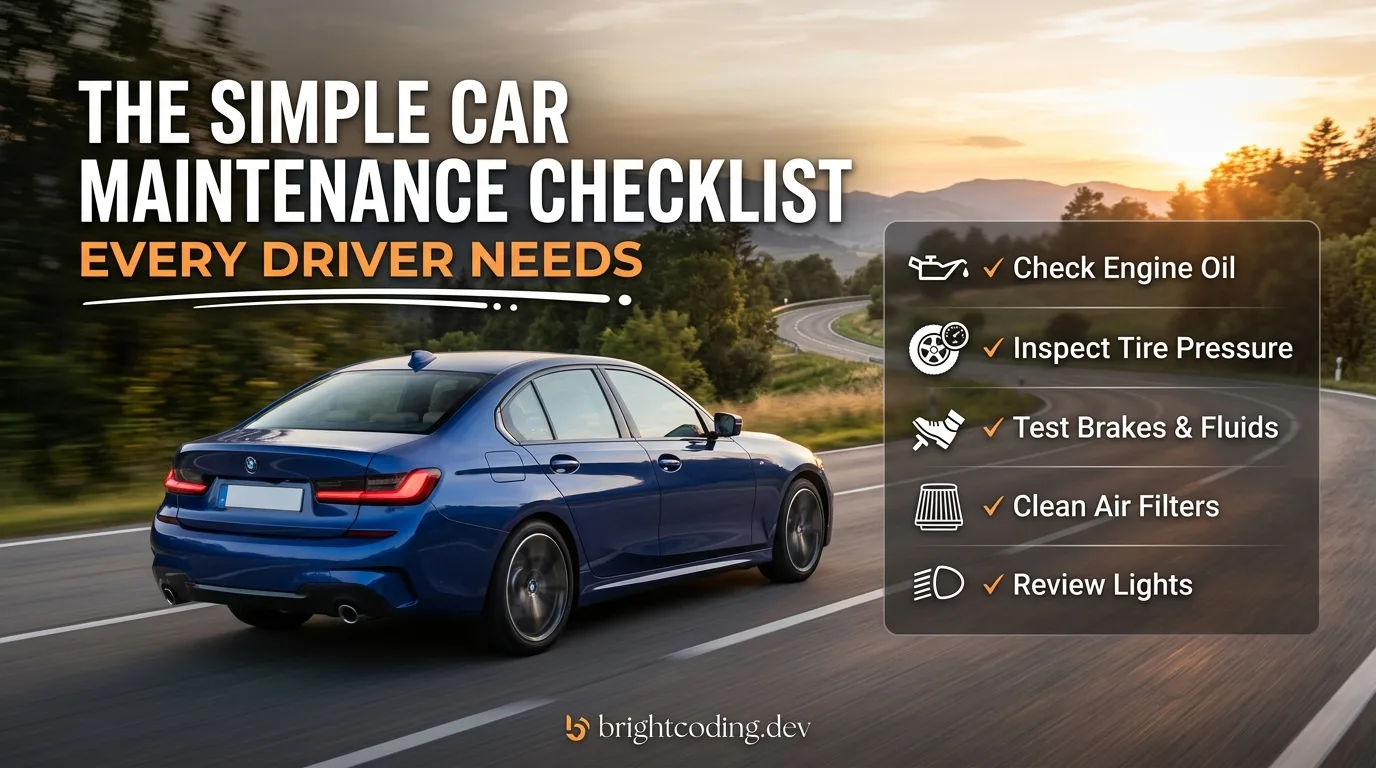
The Simple Car Maintenance Checklist Every Driver Needs
Your car doesn't fail dramatically. It fails on a Tuesday, in a parking garage, when you're already late. The oil light you ignored for two weeks. The tire you kept meaning to check. The noise you turned the radio up to drown out.
Read the article →