15 Easy Ways to Improve Your Car's Fuel Efficiency
The needle on my fuel gauge dropped a full eighth of a tank between my driveway and the grocery store six miles away. That's not right. I stood in the parking lot with my hand still on the pump handle from the day before, doing math in my head, and the math was bad. My aging sedan had been drinking…
The needle on my fuel gauge dropped a full eighth of a tank between my driveway and the grocery store six miles away. That's not right. I stood in the parking lot with my hand still on the pump handle from the day before, doing math in my head, and the math was bad. My aging sedan had been drinking fuel for weeks and I'd been pretending not to notice.
That was the moment I stopped guessing and started actually checking things. What follows is what I found, what I fixed, and what I wasted money on. Some of it is boring. A couple of things genuinely surprised me.
The backstory
I drive about 12,000 miles a year, mostly short trips — school run, hardware store, the kind of stop-and-go driving that's brutal on fuel economy. I'd been averaging around 24 mpg when the car was newer. Lately I was lucky to see 19. No check engine light, no weird noises, nothing dramatic. Just a car quietly getting thirstier.
I'd love to tell you I diagnosed it in one heroic afternoon. I didn't. I chased a few dead ends first.
The easy stuff I should have done months earlier
Before you spend a dime, do the free things. I'm serious. I ignored my tire pressures for probably four months because bending down at a gas station is annoying. When I finally checked, two tires were about six PSI low. That alone is worth a measurable chunk of fuel — low rolling resistance gone, engine working harder to push the same car.
I topped them up to the door-jamb spec (not the max on the sidewall — those are different numbers and people mix them up constantly). If you're not sure how tire size and pressure relate, there's a tire size comparison tool that helps you sanity-check what you're running before you assume anything.
The other free win: take the junk out of your trunk. I had a case of bottled water, a bag of road salt from last winter, and a folding chair that had been living back there since summer. Probably 60 pounds of nothing. Weight costs fuel, especially in a small car.
The part where I actually looked at data
Here's where I stopped being lazy. I plugged a cheap Bluetooth OBD adapter into the port under my dash and opened the live-data tool to watch what the engine was actually doing while I drove.
That changed everything. My long-term fuel trims were way off — the engine was adding fuel because it thought the mixture was lean. That's a classic sign of a vacuum leak or a dirty mass airflow sensor, and it explained the mileage drop without ever throwing a code.
I pulled the MAF sensor, which took about fifteen minutes and one special torx bit I had to buy for roughly $8. The sensor element was coated in a fine grey film. I cleaned it with MAF-specific spray — not brake cleaner, not carb cleaner, don't do that — let it dry, and put it back. Fuel trims came back into a normal range within a couple of drive cycles.
If your car is throwing a light, run the code first with the free OBD code lookup before you start replacing parts. I've thrown money at the wrong sensor more than once because I skipped that step.
The maintenance items that quietly cost you money
A few things I did over the next month, in roughly the order they paid off:
Spark plugs. Mine were past due by maybe 15,000 miles. Worn plugs mean weaker spark and worse combustion. A set of standard plugs ran me around $30–$60 depending on the engine, and I did them myself in under an hour. If you've never done it, the step-by-step car guides walk through the basics so you don't cross-thread anything.
Air filter. Mine looked like it had been through a dust storm. A new one is usually $15–$30 and takes five minutes. A clogged filter makes the engine work harder on every single intake stroke.
Oxygen sensor. This one hurt. The upstream O2 sensor was reading lazy — not dead, just slow. A new one was roughly $60–$120 for the part on my car, and the job fought me because it was seized. If you're not comfortable with a breaker bar and penetrating oil, this is a reasonable one to farm out.
Tire rotation and alignment. A car pulling slightly to one side is dragging its tires down the road. An alignment is usually $80–$150 and can pay for itself in tire life alone.
The driving habits nobody wants to hear about
I hate this section because it's the one where I'm the problem.
Coasting up to red lights instead of racing to them and braking hard? Real savings. Keeping steady throttle on the highway instead of surging and lifting? Real savings. Idling in a parking lot with the AC blasting while I wait for someone? That's just burning fuel for nothing.
The single biggest change was my right foot. I started treating the accelerator like it costs money to press — because it does. I gained back roughly 2–3 mpg just from that, and I didn't have to buy anything.
One caveat: don't overdo the "hypermiling" stuff. Drafting trucks, shutting the engine off at every stop, running tires at max pressure — that's how you save two dollars and wear out a transmission or lose control in the rain. Not worth it.
Honest pros & cons
What actually worked:
- Free stuff first (tires, weight, driving habits) gave the biggest bang for zero dollars
- Cleaning the MAF sensor fixed a real problem for the price of a can of spray
- Watching live data meant I stopped guessing and stopped buying the wrong parts
What didn't help or cost more than it was worth:
- That "fuel saver" magnet thing a guy at the parts counter sold me. It did nothing. I knew better.
- Premium fuel in a car that doesn't call for it — just more money per gallon for no gain
- Chasing mileage numbers in winter. Cold weather, winter blend fuel, and short trips will tank your economy no matter what you do. Don't diagnose a problem that's actually just January.
What it actually cost
| Item | Approximate cost |
|---|---|
| Tire pressure gauge | $5–$15 |
| Bluetooth OBD adapter | $20–$40 |
| MAF sensor cleaner | $8–$15 |
| Spark plugs (set) | $30–$60 |
| Engine air filter | $15–$30 |
| Upstream O2 sensor | $60–$120 |
| Alignment | $80–$150 |
| The useless fuel magnet | $25 (don't) |
Total for me landed around $250–$350 spread over a couple of months. Verify prices for your specific car — they vary a lot by make and engine.
What I would do differently
- Check the free things first, every time. Tires, weight, driving style. I spent mental energy worrying about sensors before I'd even topped up my tires.
- Watch live data before buying parts. The live-data tool would have saved me from a wrong guess if I'd used it a month earlier.
- Don't trust the parts counter upsell. If someone hands you a product with no data behind it and a great story, walk away.
- Log your mileage every fill-up. I started writing down gallons and odometer readings in a notes app. It's the only way to know if a change actually helped or if you're just hoping.
- Separate seasonal effects from real problems. Winter fuel economy is worse. That's physics, not a failing sensor.
Quick practical tips
- Check tire pressure monthly, when tires are cold
- Clean or replace your air filter at every oil change if you drive in dusty conditions
- Fix the cheapest, easiest thing first and re-measure before moving on
- If your fuel trims are off with no code, suspect a vacuum leak or dirty MAF before anything expensive
- Track your actual mpg — feelings lie, math doesn't
FAQ
Will premium gas improve my fuel economy? Only if your engine is designed to take advantage of higher octane. For most cars, it just costs more per gallon with no measurable gain. Check your owner's manual.
How much can I really save? Realistically, a few mpg from fixing a genuine problem plus better habits. Anyone promising a 30% jump with a bolt-on gadget is selling you something.
Does AC really hurt fuel economy? Yes, especially in stop-and-go traffic. At highway speeds, AC is usually more efficient than open windows creating drag. It's a trade-off, not a rule.
My mileage dropped suddenly. Where do I start? Scan for codes with the OBD code lookup, then check tire pressure and look for a dragging brake or a fuel smell. Sudden drops usually mean a real fault, not a habit.
Fixing my mileage wasn't one clever trick. It was a stack of small, boring things I'd been avoiding — and a reminder that the cheapest repair is usually the one you do before you buy a part.
Ready to act on what you just read? Decode that warning light with the free OBD code lookup, run the matching car tools to check the numbers yourself, or browse more practical car articles for ideas.
Related articles

The Best Way to Keep Your Car Cool During Extreme Summer Heat
Your steering wheel is hot enough to brand cattle, the air conditioning is blowing lukewarm air, and the temperature gauge is creeping past where it usually sits. If that sounds like your July commute, you are not imagining things. Extreme heat is genuinely hard on cars, and the ways to keep yours…
Read the article →
How to Save Money on Car Repairs Without Taking Risks
Here's the honest version up front: most common repairs land somewhere between $150 and $1,200 when you pay a shop, and a few big-ticket jobs (timing belts, clutches, head gaskets) can run past $2,000. That range is wide on purpose. Your make and model, where you live, and whether you walk into a d…
Read the article →
What Happens If You Ignore Your Check Engine Light?
That amber engine icon is the most ignored warning in motoring. It comes on, nothing explodes, so you keep driving. A week later it's still there. A month later you've stopped seeing it.
Read the article →
10 Dashboard Warning Lights You Should Never Ignore
Your dashboard isn't trying to annoy you. It's the only part of the car that talks to you in plain language — and it's often the cheapest warning you'll ever get. Ignore the wrong one and a $150 repair becomes a $2,000 repair, or a breakdown on the shoulder of a highway at 11 p.m.
Read the article →
20 Hidden Features in Your Car You Probably Never Use
Most cars built in the last fifteen years are quietly packing a couple dozen conveniences the owner's manual buries on page 147. This article answers the questions people actually type into Google about those features — what they are, how to turn them on, and which ones are worth the trouble — so y…
Read the article →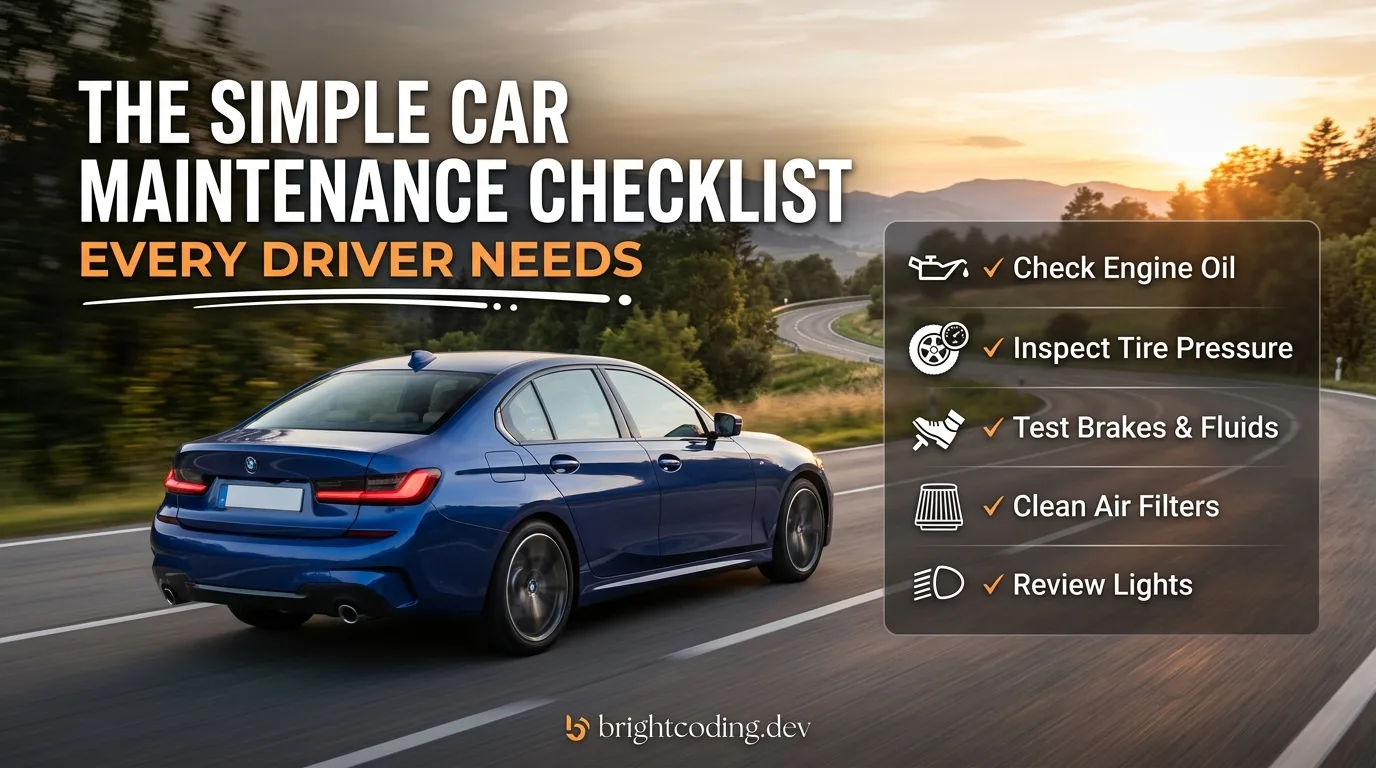
The Simple Car Maintenance Checklist Every Driver Needs
Your car doesn't fail dramatically. It fails on a Tuesday, in a parking garage, when you're already late. The oil light you ignored for two weeks. The tire you kept meaning to check. The noise you turned the radio up to drown out.
Read the article →