How to Read Car Error Codes Yourself (No Mechanic Needed)
Your check engine light isn't a mystery — it's a message. Learn how to read car error codes yourself with a $20 tool, save hundreds on diagnostics, and finally understand what your vehicle is trying to tell you.
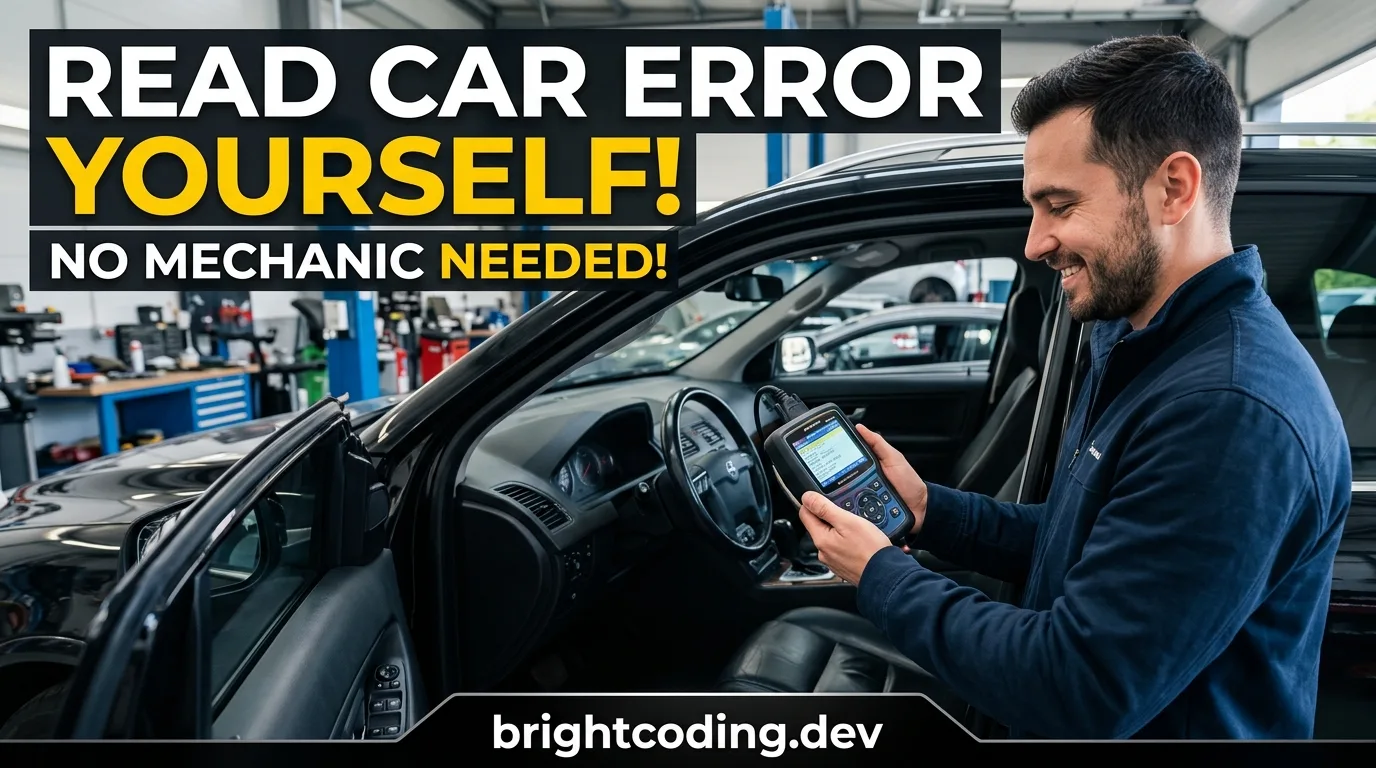
The Dashboard Light That Doesn't Have to Ruin Your Weekend
It always happens at the worst possible moment.
You're merging onto the interstate, coffee still hot in the cupholder, weekend plans locked in. Then it appears. That little amber engine icon glowing from your instrument cluster like a warning from the automotive gods. Your stomach drops. The mental math begins instantly: How much is this going to cost? Can I make it to Monday? Should I even keep driving?
For decades, that light was a mechanic's secret handshake — a signal that your car was speaking a language you couldn't understand, and the translation would cost you. But here's what most drivers still don't realize: your car has been trying to tell you exactly what's wrong the entire time. And with the right approach, you can listen.
The Mystery Hiding in Plain Sight
The real question isn't whether something is broken. It's whether you need to pay someone $100 just to tell you what your car already knows.
Modern vehicles — essentially rolling computers with 30 to 100 onboard microprocessors — generate diagnostic trouble codes (DTCs) every time a sensor detects something outside normal parameters. These codes are standardized. They're specific. And in most cases, they're accessible through a port located right under your steering wheel.
This is where the story gets interesting. That panic-inducing check engine light? It's rarely the catastrophe your imagination conjures. Sometimes it's a loose gas cap. Sometimes it's a failing oxygen sensor. Occasionally, it's something that genuinely needs immediate attention. But the point is this: you can know the difference before you ever talk to a shop.
How We Got Here
To understand why this matters, you need to know what changed.
Before 1996, every automaker used proprietary diagnostic systems. A Ford required Ford-specific equipment. A Toyota needed Toyota tools. Mechanics hoarded knowledge like medieval guilds, and drivers were entirely dependent on their interpretation.
Then came OBD-II — On-Board Diagnostics, second generation — mandated for all vehicles sold in the United States (and adopted globally soon after). Suddenly, every car spoke the same basic language. A standardized 16-pin connector appeared beneath the dash. A universal set of codes emerged. The P0xxx series for powertrain issues. The B0xxx for body systems. The C0xxx for chassis. The U0xxx for network communications.
The information was democratized in theory. But in practice? Most drivers still don't know the port exists, let alone how to use it.
What Actually Happens When That Light Comes On
When your check engine light illuminates, your vehicle's engine control module (ECM) has detected a fault and stored a corresponding code. Think of it as your car leaving a breadcrumb trail.
Here's the part that surprises most people: retrieving that code takes about 60 seconds and costs anywhere from $0 to $30, depending on your approach.
Option one: Many auto parts retailers will scan your codes for free. It's a genuine service, though you're often standing in a parking lot while someone reads a screen and hands you a printout of possible causes — a list that can range from "tighten fuel cap" to "replace catalytic converter" without much nuance.
Option two — and this is where things get genuinely empowering: You do it yourself. A basic Bluetooth OBD-II adapter plugs into that port under your dash, pairs with your phone, and displays the exact code in real time. No mechanic. No appointment. No diagnostic fee.
For those who want to go deeper, tools like the OBD-II Live Scanner let you monitor live data — RPM, coolant temperature, vehicle speed, mass airflow readings — turning your phone into a portable dynamometer. You can watch your engine's vital signs as you drive, spotting irregularities before they trigger a warning light at all.
The Turning Point: When Knowledge Beats Fear
The most valuable shift isn't financial, though saving $80 to $150 per diagnostic visit adds up fast. It's psychological.
Consider Sarah, a marketing director in Denver whose 2018 CR-V threw a P0301 code — cylinder one misfire detected. The dealership quoted her $400 for diagnostics plus potential coil and plug replacement. Instead, she spent $22 on an OBD-II reader, confirmed the code, watched a 10-minute video on spark plug access for her engine, and replaced the ignition coil herself in a parking lot during her lunch break. Total cost: $47 for the part. Total time: 35 minutes.
Or take Marcus, a rideshare driver in Atlanta who noticed his fuel economy had dropped 15 percent. No warning light yet, but his Live OBD PID Data tool showed his oxygen sensor readings fluctuating erratically. He replaced the upstream O2 sensor proactively for $65. A shop would have charged $200 for the same part plus labor — if they had even caught it before the light came on and his catalytic converter suffered damage.
These aren't gearhead fantasies. They're what happens when drivers stop treating the check engine light like a black box and start treating it like information.
What the Codes Actually Mean (and What They Don't)
Here's where nuance matters. A code tells you what sensor detected an anomaly. It doesn't always tell you the root cause.
A P0420 — catalyst system efficiency below threshold — might mean your catalytic converter is failing. Or it might mean a failing oxygen sensor is sending bad data. Or an exhaust leak is letting air in downstream. The code is the starting line, not the finish.
This is why context matters. How long has the light been on? Did it appear suddenly or gradually? Are there drivability symptoms — rough idle, hesitation, reduced power? Is the light steady or flashing? (A flashing check engine light means active misfire and potential catalytic converter damage. That one, you don't drive on.)
For drivers who want structured guidance without the intimidation factor, the Interactive Car Diagnostic tool walks through symptom-based troubleshooting step by step. You describe what you're experiencing — strange noise, warning light, performance issue — and it narrows down the likely culprits with the methodical logic of an experienced technician.
The Bigger Picture: Your Car, Your Data
We're entering an era where vehicle data ownership is becoming a genuine consumer rights issue. Newer cars transmit diagnostic information directly to manufacturers and dealerships. Some automakers are building subscription models around features that used to be standard. The more you understand your own vehicle's baseline health, the less vulnerable you are to upsells, unnecessary services, and opaque pricing.
Knowing how to read your own error codes isn't just about saving money on one repair. It's about maintaining autonomy in a relationship that has historically been deeply asymmetric. The average driver knows almost nothing about their $40,000 machine. The average service writer knows everything. Closing that gap even slightly changes the dynamic entirely.
There's also a practical dimension for anyone who drives used cars, manages a household fleet, or simply wants to avoid being stranded. A $25 Bluetooth adapter and a free app turn your phone into a pre-purchase inspection tool. Scan the codes before you buy. Check for pending codes — faults that haven't triggered the light yet but are brewing. Review freeze-frame data to see exactly what conditions existed when a fault occurred.
For those building real competency, the Mechanic Training modules offer structured lessons that progress from fundamental systems to advanced diagnostics. It's the difference between being able to read a code and being able to interpret what it actually means for your vehicle.
What You Should Remember
- Every car sold since 1996 has an OBD-II port, usually located beneath the steering column. You don't need special permission to access it.
- A check engine light is information, not a sentence. Many triggers are inexpensive and simple to address.
- A basic Bluetooth OBD-II adapter ($15–$30) and a free app will read codes, clear them, and monitor live data from most vehicles.
- Codes indicate symptoms detected by sensors. They suggest where to look, but intelligent diagnosis requires context and sometimes additional testing.
- A flashing check engine light is different from a steady one. It's an active misfire warning. Pull over and stop driving.
- Understanding your codes before visiting a shop leads to better conversations, fairer pricing, and fewer unnecessary repairs.
FAQ
Do I need an expensive scan tool to read error codes?
No. A basic Bluetooth OBD-II adapter paired with your smartphone handles code reading and clearing for most common situations. Professional-grade tools offer bidirectional control and manufacturer-specific codes, but for the average driver, a $20 adapter is sufficient to start.
Can I damage my car by reading the codes myself?
Absolutely not. Reading codes is a passive process — you're only accessing information the car has already stored. Clearing codes won't harm anything, though you should note that erasing a code doesn't fix the underlying problem. If the fault persists, the light will return.
What's the difference between a generic code and a manufacturer-specific code?
Generic OBD-II codes (P0xxx, B0xxx, etc.) apply to all vehicles and cover common powertrain, body, and chassis issues. Manufacturer-specific codes (often P1xxx or similar) provide deeper detail about particular systems in your make and model. Many free apps read both, but some basic readers only show generic codes.
My check engine light turned off by itself. Should I still be concerned?
If the light went off after a few drive cycles, the system may have detected that a temporary condition resolved itself — like a loose gas cap that you retightened. However, the code is often still stored in memory. A quick scan can confirm whether anything is pending or if the issue truly cleared.
Where can I look up what my specific code means?
You can search by code number using the OBD-II Code Lookup tool, which breaks down thousands of diagnostic trouble codes with likely causes, affected systems, and typical repair approaches. For more complex situations, the AI Mechanic Assistant can help interpret codes in the context of your specific symptoms and vehicle details.
Related articles

The Best Way to Keep Your Car Cool During Extreme Summer Heat
Your steering wheel is hot enough to brand cattle, the air conditioning is blowing lukewarm air, and the temperature gauge is creeping past where it usually sits. If that sounds like your July commute, you are not imagining things. Extreme heat is genuinely hard on cars, and the ways to keep yours…
Read the article →
How to Save Money on Car Repairs Without Taking Risks
Here's the honest version up front: most common repairs land somewhere between $150 and $1,200 when you pay a shop, and a few big-ticket jobs (timing belts, clutches, head gaskets) can run past $2,000. That range is wide on purpose. Your make and model, where you live, and whether you walk into a d…
Read the article →
15 Easy Ways to Improve Your Car's Fuel Efficiency
The needle on my fuel gauge dropped a full eighth of a tank between my driveway and the grocery store six miles away. That's not right. I stood in the parking lot with my hand still on the pump handle from the day before, doing math in my head, and the math was bad. My aging sedan had been drinking…
Read the article →
What Happens If You Ignore Your Check Engine Light?
That amber engine icon is the most ignored warning in motoring. It comes on, nothing explodes, so you keep driving. A week later it's still there. A month later you've stopped seeing it.
Read the article →
10 Dashboard Warning Lights You Should Never Ignore
Your dashboard isn't trying to annoy you. It's the only part of the car that talks to you in plain language — and it's often the cheapest warning you'll ever get. Ignore the wrong one and a $150 repair becomes a $2,000 repair, or a breakdown on the shoulder of a highway at 11 p.m.
Read the article →
20 Hidden Features in Your Car You Probably Never Use
Most cars built in the last fifteen years are quietly packing a couple dozen conveniences the owner's manual buries on page 147. This article answers the questions people actually type into Google about those features — what they are, how to turn them on, and which ones are worth the trouble — so y…
Read the article →