How to Know When Your Tires Need to Be Replaced
You can check your own tires in about 15 minutes with a coin, a pressure gauge and a flashlight. By the end of this guide you will know how to read tread depth, spot the damage that means "replace now," decode the numbers on your sidewall, and judge whether that slow leak is a cheap fix or a new-ti…
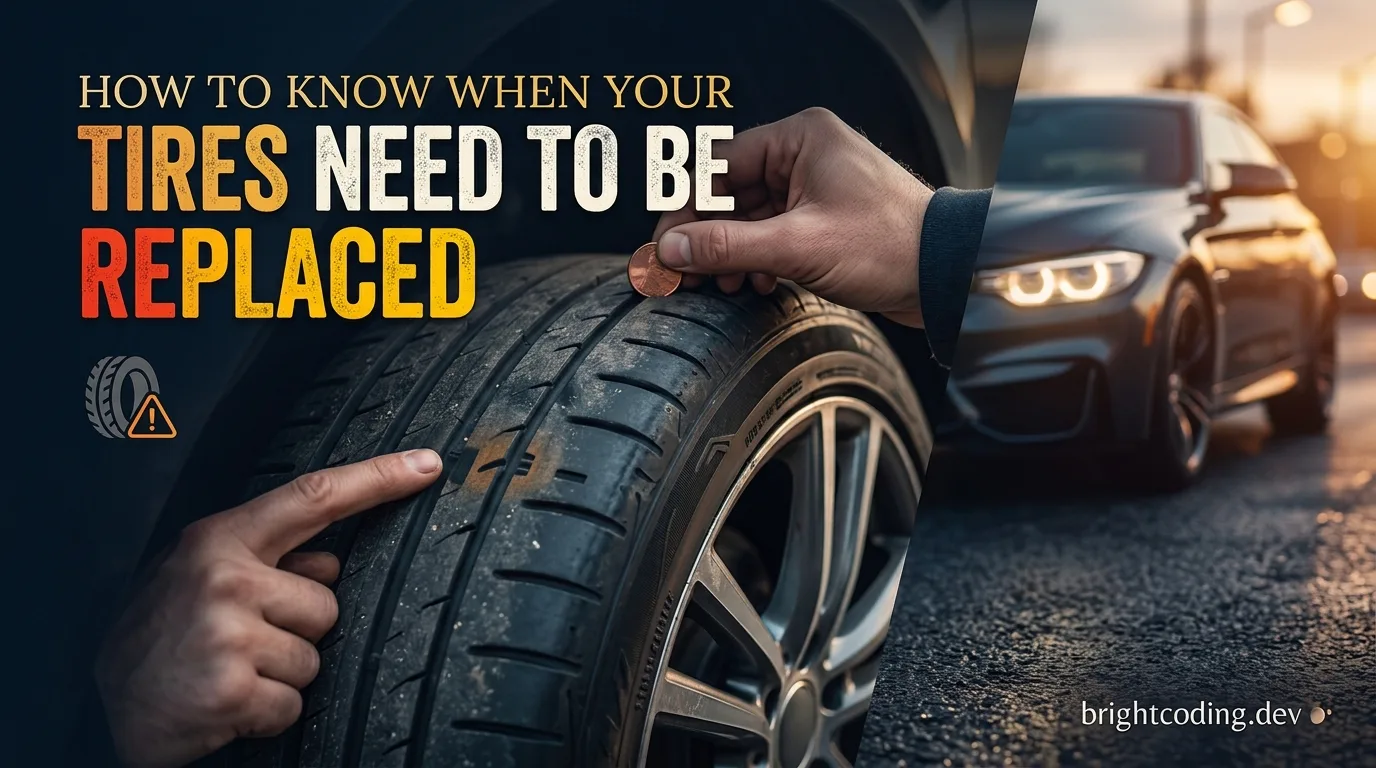
You can check your own tires in about 15 minutes with a coin, a pressure gauge and a flashlight. By the end of this guide you will know how to read tread depth, spot the damage that means "replace now," decode the numbers on your sidewall, and judge whether that slow leak is a cheap fix or a new-tire situation.
No lift, no special skills. Just your hands, your eyes and a little patience.
What you need before you start
- A tire pressure gauge (a cheap pencil gauge works fine)
- A tread depth gauge, or a US quarter and a penny
- A bright flashlight or your phone light
- A pair of work gloves and something to kneel on
- Paper and a pen, or your phone's notes app, to record what you find
- Your owner's manual or the tire placard inside the driver's door jamb for the correct pressure and tire size
You do not need to remove the wheels. Everything here can be done with the car parked.
Step 1: Park somewhere safe and flat
Do this in a driveway, a quiet parking lot, or the shoulder of a low-traffic road. Set the parking brake, put the car in Park (or first gear if it is a manual), and switch the engine off.
If you are anywhere near moving traffic, turn on your hazards. A tire check takes 15 minutes and you do not want to spend it watching your back.
Once you are parked, walk around the car once and just look. Do you see a tire that is visibly softer than the others, a bulge, or a nail head catching the light? Make a mental note of which corner.
Tip: Do this check once a month, and always before a long highway drive. Tire problems rarely announce themselves quietly.
Step 2: Measure tread depth with a coin
Tread depth is the single best predictor of whether a tire is still safe in the rain. New tires start around 10/32 inch (about 8 mm) of tread. The legal minimum in most US states is 2/32 inch, but that number is a floor, not a target.
The quarter test: insert a US quarter into a tread groove with Washington's head pointing down. If the top of his head is visible, you are at or below 4/32 inch. That is when wet grip starts falling off a cliff.
The penny test: do the same with a penny and Lincoln's head. If you can see the top of his head, you are at or below 2/32 inch. That is legally worn out in most places, and genuinely dangerous in the rain.
A tread depth gauge gives you an exact number and costs very little. It is worth owning if you plan to keep this car a while.
Why it matters: A tire at 2/32 inch has roughly half the wet stopping distance of a new tire. On a wet highway that is the difference between stopping and not stopping.
Tip: Check three spots per tire: both outer edges and the center. Uneven wear tells you something is wrong with alignment or pressure, which we will get to.
Step 3: Check the wear indicator bars
Every tire has small raised bars molded into the bottom of the main grooves. They sit at 2/32 inch. When the tread around them has worn down flush with the bar, the tire is done. No coin needed.
Run your finger along a groove and feel for the bumps. If the tread is level with them, start shopping. If you can feel them poking up but the tread still sits above them, you have a little time left.
Tip: These bars only exist in the main circumferential grooves, not the small shoulder grooves. If you cannot find them on the edge, look toward the center of the tread.
Step 4: Look for uneven wear patterns
Even tread is a healthy tire. Uneven tread is a symptom, and replacing the tire without fixing the cause just wears out the new one the same way.
- Worn on both outer edges: chronic underinflation. Check for a slow leak and check your pressure monthly.
- Worn down the center: chronic overinflation. Less common, but it happens.
- Worn on one edge only: alignment is off. Get an alignment with the new tires or you will be back here soon.
- Feathered or scalloped blocks: worn suspension parts or bad shocks. Worth having a shop look at.
- One flat spot: usually a locked brake or a car that sat for months. Sometimes it smooths out, sometimes it does not.
If you see cupping or a wobble, an alignment shop can tell you in minutes whether it is a $100 alignment or a $600 suspension job. Get a quote before you commit.
Tip: If uneven wear shows up on one tire only, suspect that corner, not the whole car. A bent wheel or a bad ball joint can do it.
Step 5: Check the sidewalls for cracks, bulges and cuts
Tread depth gets all the attention, but sidewall damage is the more urgent problem.
Run your hand around the sidewall of each tire, feeling for bumps, soft spots or splits. Then look at the sidewall rubber itself. Fine hairline crazing on an old tire is a warning sign of age. A bulge the size of a thumbnail is a structural failure waiting to happen.
Safety warning: If you find a bulge, a deep cut that shows cords, or a bubble in the sidewall, do not drive on that tire at highway speed. A sidewall blowout at 70 mph is one of the most dangerous things that can happen in a car. Swap on the spare or call for a tow.
Tip: Check the inner sidewall too, the side facing the car. You will need to crouch and use the flashlight. That is exactly where damage hides, because that is the side you never look at.
Step 6: Read the DOT date code on the sidewall
Tires age even when they are not driven. Rubber hardens, grip drops, and cracks form. Most tire makers and safety experts suggest replacing tires around six to ten years old regardless of tread, though you should check your owner's manual and the tire maker's guidance for your specific tire.
Find the letters "DOT" on the sidewall, followed by a string of characters. The last four digits are the date code: the first two are the week of manufacture, the last two are the year. So "2319" means the 23rd week of 2019.
If your tires are older than about six years, start budgeting for a set even if they look fine. If they are pushing ten, replace them. Age cracks plus hard rubber equals poor wet grip, and that is exactly when you need it.
Cost note (approximate): A set of four mid-range all-season tires for a common sedan usually runs somewhere in the $400 to $800 range installed, depending on size, brand and your area. Performance, truck and SUV tires run higher. Get two or three quotes.
Tip: The date code is often only on one side of the tire. If you cannot find it, look on the inner sidewall.
Step 7: Check pressure and look for leaks
Set your gauge to the pressure on the door jamb placard, not the number molded on the tire sidewall. The sidewall number is the tire's maximum, not what your car wants.
Check all four tires and the spare. A tire that is consistently 5 psi low has a slow leak, and slow leaks do not fix themselves. A soapy water spray bottle over the valve stem, the bead and the tread will often show you bubbles where the air is escaping.
Why it matters: Chronically low pressure is the number one cause of premature tire wear and one of the leading contributors to blowouts. It also kills your fuel economy.
Tip: If you find a screw or nail in the tread, do not pull it out. A tire shop can often patch a puncture in the tread area for a modest fee (often $20 to $40, approximate). Punctures in the sidewall or shoulder usually mean a new tire.
Step 8: Take a short test drive and feel for symptoms
On a quiet road, pay attention to what the car is telling you.
- A shimmy or vibration through the steering wheel at speed: wheel balance or a bent wheel.
- A pull to one side: alignment or a tire with different pressure.
- A droning or humming noise that changes with speed: often a worn or cupped tire.
- A vibration you feel in the seat more than the wheel: usually a rear tire or rear drivetrain issue.
If the car pulls or shakes, and you also have a warning light on, a quick scan can rule out a related system before you start spending money. The free OBD code lookup will decode whatever your car is complaining about in plain English, and the car symptom finder is a good place to check whether the noise you are hearing matches a known pattern.
Step 9: Decide, then act
By now you have four pieces of information: tread depth, wear pattern, sidewall condition, and age. Here is how to weigh them.
Replace now if any of these are true:
- Tread is at or below 2/32 inch anywhere on the tire
- You found a bulge, cut to the cords, or sidewall crack deep enough to worry about
- The tire is over ten years old
- A puncture is in the sidewall or shoulder
Replace soon if:
- Tread is at 4/32 inch or below and you drive in rain or snow
- The tires are six to ten years old
- Wear is uneven and you have not yet fixed the alignment or pressure issue
Watch and re-check if the tread is healthy, the sidewalls are clean and the tires are young. Check again in a month.
When you do buy, replace in pairs at minimum, and ideally all four at once on an AWD car. Mixing a new tire with three worn ones on AWD can stress the drivetrain, and a mismatched pair on the same axle hurts handling. If you are changing sizes or just comparing what fits, the tire size comparison tool will show you the diameter and speedometer difference before you commit.
Pro tips
- Keep a tread depth gauge in the glovebox. Two dollars of plastic removes all the guessing. You will actually use it if it is right there.
- Rotate your tires at every other oil change. Even wear is the cheapest way to get more miles out of a set. It takes 20 minutes at home with a jack and stands, or most shops do it cheaply during an oil service.
- Mark the valve stems with a dot of paint. It makes it obvious at a glance if a tire has rotated or if a shop put them back in the wrong place.
- Buy tires in sets of four when there is a rebate. Tire rebates are common and the savings on four often beat the savings on two.
- Store your winter or summer set flat, out of sunlight, in bags. UV and ozone age rubber faster than miles do.
- Check pressure when the tires are cold. Driving heats them up and adds several psi, so a reading right after a highway run will lie to you.
Common pitfalls
Trusting the penny test alone. The penny shows you 2/32 inch, which is already too late for safe wet driving. Use the quarter test to catch problems at 4/32 inch while you still have margin.
Replacing tires without fixing the alignment. If a tire wore out on one edge and you bolt on a new one, the new tire will do the same thing. Alignment is a small cost next to a ruined set.
Ignoring the spare. A ten-year-old spare that has never been used is still a ten-year-old tire. Check its pressure and its date code, or you will find out the hard way on the shoulder of a highway.
Pulling the nail out yourself. That is often what turns a repairable puncture into a tire that will not hold air. Leave it in and drive (gently) to a shop.
Buying the cheapest tires you can find. Tires are the only thing touching the road. The difference between a budget tire and a decent one shows up in wet braking distance, and that is not the place to save $200. If you want a second opinion on whether a noise or vibration is tire-related or something else, the AI mechanic assistant can help you sort symptom from cause before you spend anything.
Useful resources
- Your owner's manual and the tire placard on the driver's door jamb for correct pressure and size
- The NHTSA website for tire safety information and recall lookups
- Tire Rack and Discount Tire websites for tire size and load rating explanations
- The Rubber Manufacturers Association for tire care and age guidance
- The AutoTools guides section for step-by-step walkthroughs on related maintenance jobs
- The AutoTools blog and expert car tips for more short, practical maintenance reads
- The mechanical encyclopedia if you want to understand what a tire's load index and speed rating actually mean
- The mechanic quiz if you want to test what you just learned
FAQ
How often should I check my tires? Once a month for pressure, and a full tread and sidewall check every three months or before any long trip. It takes 15 minutes and it is the highest-value car maintenance you can do.
Can I replace just one tire? Usually not, unless the other three are nearly new. On AWD cars especially, mismatched tire diameters can damage the drivetrain. Replace in pairs at minimum, and check your owner's manual for what the manufacturer recommends.
My tires have plenty of tread but they are eight years old. Do I really need new ones? Probably yes, or very soon. Rubber hardens and cracks with age, and wet grip drops even if the tread looks fine. Check your owner's manual and the tire maker's guidance, but most sources suggest replacing around six to ten years.
How do I know if a puncture can be repaired? If it is in the tread area, away from the shoulder and sidewall, and the hole is small, a shop can usually patch it. Anything in the sidewall, or a hole that is too large or too close to the edge, means a new tire. Let the shop decide.
Is it worth buying used tires? Rarely. You are buying someone else's unknown history, and you cannot verify how the tire was treated. The savings are small next to the risk, especially on a car you drive daily.
A last word
You do not need to be a mechanic to know when your tires are done. You need a coin, a gauge, a flashlight and 15 minutes. Do this check today, and you will drive away knowing exactly where you stand, which is a much better feeling than wondering.
Related articles

What Does It Mean When Your Car Won't Start?
You turn the key or push the button, and nothing. Or worse, that awful click-click-click. Your stomach drops because you know this is going to cost you time, money, or both.
Read the article →
Why Is My Car Shaking? 8 Common Causes Explained
Your coffee is sitting in the cupholder, and it looks like it's trying to escape. Maybe the steering wheel vibrates at highway speed. Maybe the whole cabin shudders when you brake. Either way, a shaking car is one of those problems you can feel in your teeth, and it never fixes itself.
Read the article →
10 Car Noises You Should Never Ignore
Your car talks to you constantly. Most of the time it's mumbling, and you tune it out like a radio ad. Then one day it screams, and you're staring at a repair bill that could have been a $40 part three months ago.
Read the article →
Composants d'un moteur de voiture : guide complet des pièces, fonctions, problèmes et solutions
Le moteur thermique est le cœur de la voiture. Il transforme le carburant en énergie mécanique grâce au cycle à quatre temps : admission, compression, combustion et échappement. Il est composé de nombreuses pièces essentielles comme le bloc moteur, la culasse, les pistons, le vilebrequin, les arbres à cames, les soupapes, ainsi que les systèmes d’admission, d’allumage, de lubrification et de refroidissement.
Read the article →
Car Engine Components Explained: The Complete Guide to Parts, Functions, Problems, and Solutions
Your car’s engine is a complex system of parts working together to turn fuel into motion. This complete guide breaks down every major car engine component from the engine block, cylinder head, and DOHC valvetrain to pistons, crankshaft, timing system, fuel delivery, ignition, exhaust, lubrication, and cooling. You’ll also learn common engine problems, warning signs you should never ignore, diagnostic steps, and maintenance tips to keep your engine running reliably
Read the article →
How Car Key Programming Works: The Complete Beginner's Guide
A car key used to be a piece of metal. Now it is a small computer that talks to your car, and when that conversation breaks, the car simply refuses to start. After reading this guide you will understand what key programming actually is, you will know when you can do it yourself with a scan tool and…
Read the article →