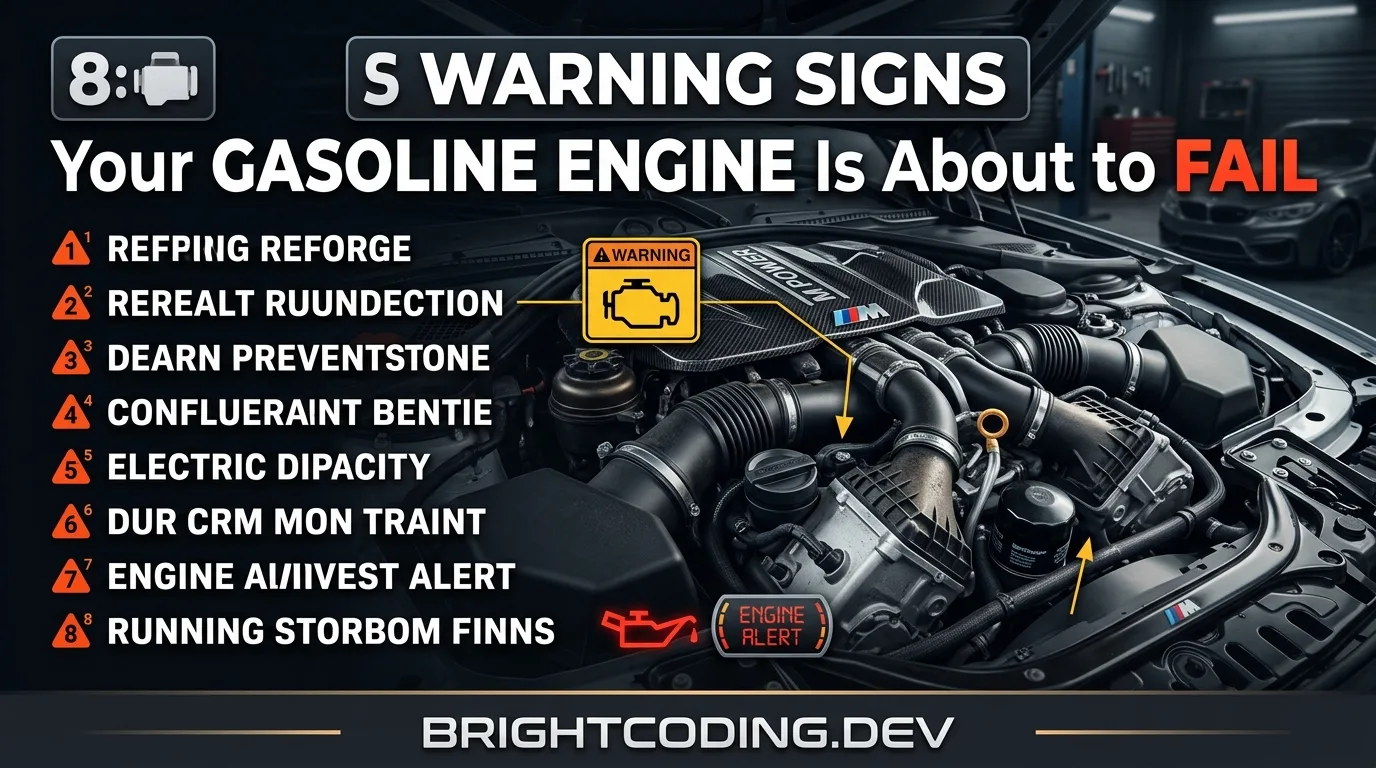
8 Warning Signs Your Gasoline Engine Is About to Fail
Most engine failures don't happen out of nowhere. They send postcards first. A rattle here, a puff of smoke there, a check engine light you decide to ignore until inspection time.
Most engine failures don't happen out of nowhere. They send postcards first. A rattle here, a puff of smoke there, a check engine light you decide to ignore until inspection time.
The problem is that the early signs are easy to explain away. A little noise? Old car. A little oil use? They all do that. Then one morning you're on the shoulder of a highway watching a tow truck back toward you, and the repair quote has an extra zero on it.
This article walks through eight signs that separate "keep driving, just watch it" from "stop the car now." Read it once and you'll know which is which.
Why most people get this wrong
Engines fail slowly, then all at once. The symptoms that matter most are usually the ones that feel minor, which is exactly why they get ignored.
There's also a trust problem. A flashing light or a new noise can mean anything from a loose gas cap to a spun bearing, and most drivers don't have a frame of reference for the difference. So they default to hoping.
That hope is expensive. A $40 sensor ignored becomes a $400 repair, and a $400 repair ignored becomes a $4,000 engine. The signs below are ordered roughly by how badly they want your attention.
1 - A check engine light that flashes instead of staying on
A steady check engine light is annoying. A flashing one is an emergency.
If the light blinks while you're driving, the engine computer is telling you it's detecting a misfire severe enough to dump raw fuel into the exhaust. That fuel can torch your catalytic converter in minutes, and a converter costs more than most people expect.
Pull over when it's safe, shut the engine off, and get the codes read before you drive another mile. You can look them up free with an OBD code lookup so you know whether you're dealing with a coil pack or something worse before you call anyone.
2 - Blue smoke from the tailpipe
Blue smoke means oil is burning inside the engine. That's different from the white steam of a cold morning or the black puff of a rich fuel mix.
A small amount at startup that clears up can be worn valve guides or seals. Blue smoke that follows you down the road, especially under acceleration, points to worn rings or a failing PCV system. The first is a nuisance. The second is the engine eating itself.
Check your oil level weekly and note how fast it drops. If you're adding a quart every few hundred miles, get a compression or leak-down test before it gets worse.
3 - A knocking or ticking that gets louder with RPM
Ticking at idle that fades once the engine warms up is often just lifters. A deep knock that matches engine speed and gets louder when you rev is a different animal, and it usually means worn rod bearings.
People ignore this one because the car still drives fine. It does, right up until it doesn't. A rod that lets go doesn't warn you twice, and it tends to take the block with it.
If a knock shows up suddenly after an oil change, stop driving and check that the filter and drain plug are tight and the oil level is correct. If everything checks out and the knock stays, park it and get it diagnosed.
4 - Coolant disappearing with no visible leak
You top off the overflow tank, and a week later it's low again. No puddle in the driveway. No sweet smell under the hood.
That coolant is going somewhere, and the two likely places are a head gasket or an internal crack. Both mean coolant is mixing with combustion gases or leaking into a cylinder, and neither fixes itself.
Look for milky oil on the dipstick or bubbles in the radiator with the cap off and the engine running. Our symptom finder is a quick way to cross-check what you're seeing against common failure patterns before you start pulling parts.
5 - Overheating that comes back after you fix the obvious stuff
A single overheat from a bad thermostat is a bad afternoon. Repeated overheating after you've replaced the thermostat, water pump, and hoses is a different story.
That pattern often means exhaust gases are pushing into the cooling system through a failed head gasket, pressurizing it and forcing coolant out. The gauge climbs, you add coolant, it behaves for a day, and then it happens again.
Don't keep dumping in coolant and hoping. A combustion leak test at a shop is cheap compared to warping a head or cracking a block.
6 - Oil that looks like a milkshake
Pull the dipstick and see tan, frothy sludge instead of amber oil, and you have coolant mixing with your oil.
This is the same head gasket failure showing up in a different place, and it's worse for your bearings than any of the symptoms above. Coolant doesn't lubricate. It destroys the film that keeps metal off metal.
Short trips in cold weather can cause a little condensation under the oil cap, which looks similar but clears up once the engine gets fully warm. If the dipstick itself is milky, that's not condensation. Stop driving.
7 - A sudden loss of power or rough running that won't clear
If your car starts bucking, idling rough, and refusing to accelerate, you're past the "watch it" stage.
This can be ignition, fuel delivery, or a mechanical failure, and the difference matters. A misfire from a bad coil is a cheap fix. The same symptoms from low compression are not.
This is where live data earns its keep. Watching fuel trims, misfire counters, and sensor readings in real time tells you whether the problem is spark, fuel, or air. Our OBD live-data tool walks through what to watch so you're not guessing at parts.
8 - Metal shavings in the oil or on the drain plug
Some fine gray paste on a magnetic drain plug is normal wear. Chunks, flakes, or a glittery sheen in the oil are not.
Metal in the oil means something inside the engine is grinding itself apart. Bearings, cam lobes, cylinder walls, it could be any of them, and the fix is almost always major.
Cut open the oil filter at your next change and look at the pleats. If you find metal there, don't start the car again until a mechanic has seen it. You might save the block. You almost certainly won't save it by driving it to the shop yourself.
Do this instead
Check your oil and coolant at least every other fill-up. It takes two minutes and catches most of the problems above while they're still cheap.
Listen to your car. New noises deserve attention, not a louder radio.
Read the codes instead of clearing them. A code that comes back is telling you something. Use the free car tools to decode it and the step-by-step car guides when you're ready to actually fix it.
Keep a small log of symptoms: when they happen, how often, what makes them worse. That log is worth more to a mechanic than any description you'll give over the phone.
Finally, when something scares you, stop. A tow is cheaper than an engine. Every time.
FAQ
Can an engine fail without any warning signs? Rarely. Sudden failures usually trace back to a sign that was there and dismissed. Timing belt snaps on interference engines are the big exception, which is why the service interval in your owner's manual matters.
Is a check engine light always serious? No. A loose gas cap can trigger one. The rule is simple: flashing means stop now, steady means get it read soon.
How much does it cost to diagnose an engine problem? A basic scan is often free at parts stores. A proper diagnostic at a shop typically runs somewhere in the $100 to $200 range, more if they need to do compression or leak-down testing. Prices vary by region, so call ahead.
Can I keep driving with a slight knock? You can. You shouldn't. A knock that's bearing-related can go from annoying to catastrophic in a short drive, and the difference in repair cost is enormous.
What's the single best habit to catch engine problems early? Checking fluids weekly and reading your codes instead of ignoring them. Neither costs money, and both buy you time.
The engine tells you it's dying long before it does. Your only job is to listen before the tow truck does it for you.
Related articles
Stop Throwing Parts at Your Car: The 4-Step Sensor Diagnostic Method That Actually Works
A fault code points to a circuit or behavior—not automatically a failed sensor. This practical guide covers the 8 engine sensors every DIYer and technician should understand, plus the 4-step test process that prevents expensive parts-swapping and misdiagnosis.
Read the article →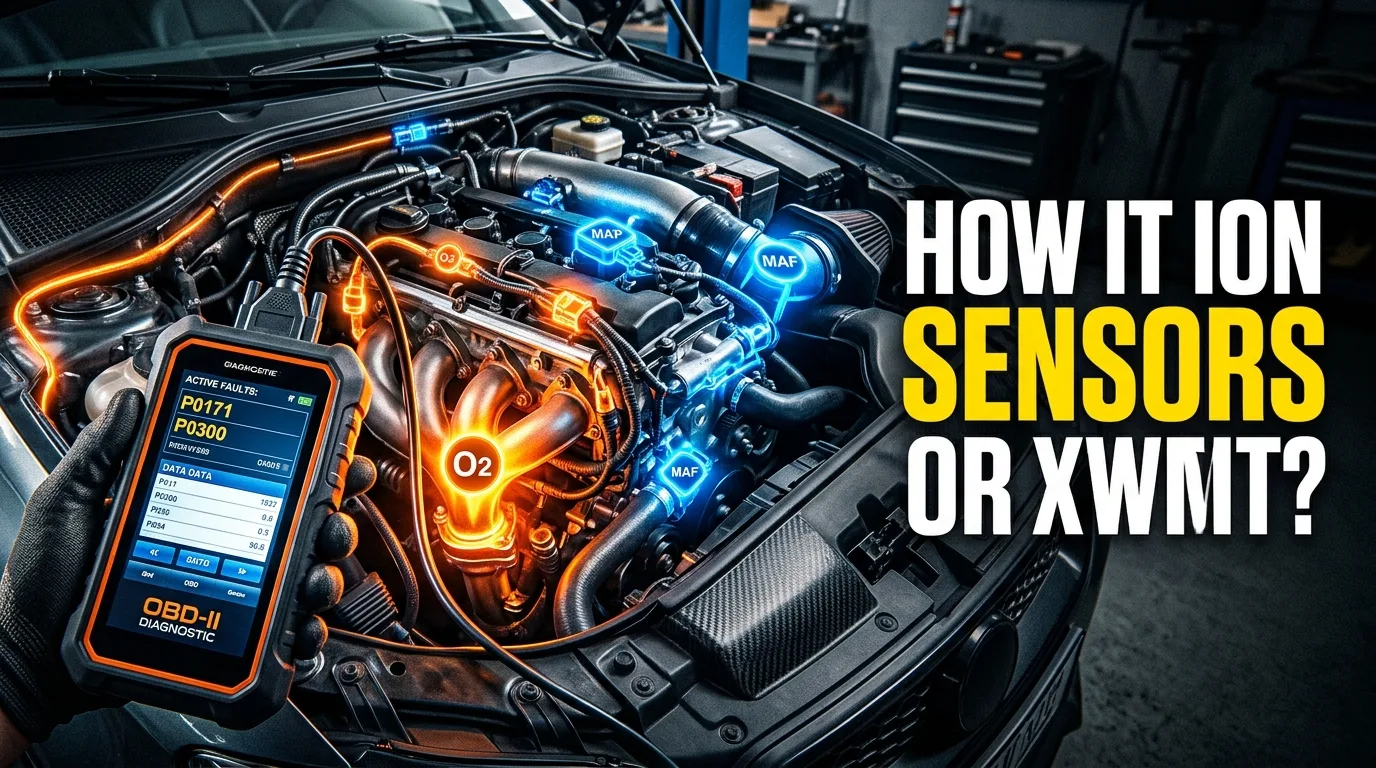
The Ultimate Guide to Engine Sensors: 40+ Types, Functions, and Failure Symptoms (Gasoline & Diesel)
Engine sensors control performance, fuel economy & emissions. Learn 40+ sensor types, failure symptoms, testing methods, and OBD-II codes for gas & diesel engines.
Read the article →
How to Reduce Diesel Fuel Consumption: 10 Practical Tips
Diesel isn't cheap, and if you run a van, a pickup or a small fleet, fuel is probably your single biggest running cost. The good news: most diesel vehicles are burning more than they need to, and a lot of that waste is fixable in an afternoon.
Read the article →
10 Hidden Features in Your Car That Dealerships Rarely Explain
Most of the useful stuff in your car is buried in the owner's manual, and nobody reads the owner's manual. Not the salesperson, not the service advisor, and probably not you. That is fine. I am going to walk you through the features that actually change how you live with a car, the ones that make y…
Read the article →
Diesel Engine: 10 Mistakes Drivers Make Without Knowing It
Diesel engines are tough, and that toughness fools people. A petrol car will often complain loudly when you treat it badly. A diesel just keeps going, quietly accumulating damage until the day it doesn't. That gap between "running fine" and "facing a four-figure repair bill" is where most owners lo…
Read the article →
10 Signs Your Petrol or Diesel Engine Is Starting to Fail
Your engine rarely dies without warning. It whispers first, then talks, then screams. Most drivers only start listening at the screaming stage, which is when the repair bill has already tripled.
Read the article →