What to Do If Your Car Starts Hydroplaning
The steering went light first. That's the part I remember, not the noise or the spray, but the sudden nothing in my hands, like the wheel had been disconnected from everything underneath it. I was doing maybe 55 on the interstate, second lane, wipers on high, and the car just stopped answering.
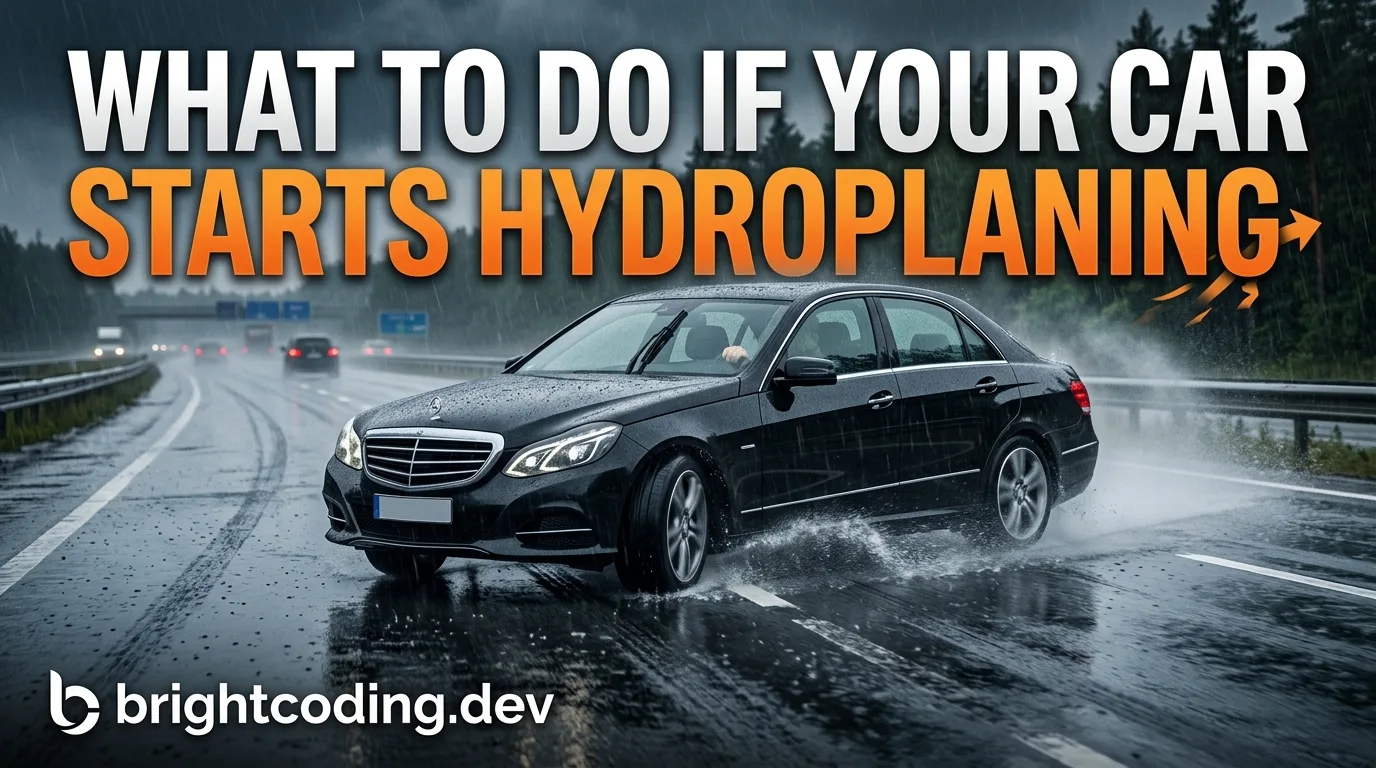
The steering went light first. That's the part I remember, not the noise or the spray, but the sudden nothing in my hands, like the wheel had been disconnected from everything underneath it. I was doing maybe 55 on the interstate, second lane, wipers on high, and the car just stopped answering.
I did the wrong thing. I lifted off the gas and tapped the brake, gently, because "gently" felt smart. The rear stepped out about a foot and the whole car wandered toward the left lane like it had its own plans. A pickup went past me on the right and threw another sheet of water across the windshield. For maybe two seconds I was a passenger in my own car.
Then the tires found the road again, the wheel went heavy, and I was just a guy in the slow lane with his heart going.
The backstory
I've changed my own oil since I was 19 and I've done brakes, struts and one truly miserable water pump on a driveway in February. So I'm not helpless around cars. But driving in heavy rain is a skill I'd never really practiced, and I'd been running the same tires for a bit over four years. Not bald. Not great either. Tread was down to about 4/32 on a tread depth gauge, which is above the legal limit in most states but well below where wet grip starts falling off a cliff.
That's the boring setup. The interesting part is that hydroplaning isn't really a driver-error problem, it's a physics problem. Water builds up in front of the tire faster than the grooves can push it out, and once the tire is riding on a film of water, your steering and brakes are basically opinions. Nothing you do with your hands matters until the tire touches pavement again.
What I actually did, in order
The wrong reflex, and what to do instead
Braking was my instinct and it was the wrong one. Braking shifts weight forward, which unloads the rear tires and makes the back end want to come around. On a front-wheel-drive car in a straight-ish hydroplane, that's how you end up sideways.
What you want, and what I now do without thinking: ease off the gas. Not a hard lift, just let the pedal come up. Keep the wheel pointed where you want to go, and hold it there. Don't steer into the slide and don't correct, because there's no grip to correct with and you'll just be out of position when the tires hook up again. The car will straighten itself out. It always feels like it won't.
If you absolutely have to slow down and you're already past the water, gentle pressure only. If you have anti-lock brakes, the pedal will pulse and that's fine. On a car without ABS, you're better off doing nothing at all and waiting it out.
The tires were the real story
A week later I was at a tire shop with a tread depth gauge in my pocket, feeling slightly ridiculous. The tech measured all four and confirmed what I already knew: 4/32 front, 5/32 rear, uneven wear across the front from an alignment that was probably off.
Here's the honest version of the tire math. New tires are the single biggest thing you can do for wet grip, and they're also the most expensive. A set of four decent all-seasons for a mid-size sedan runs roughly $500 to $900 installed, depending on size and brand. Cheap no-name tires can be under $400 for the set, and on wet pavement you can feel the difference. If you want to compare what a different size would do to your speedometer and clearance, the tire size comparison tool is genuinely useful before you buy.
I went with a mid-tier all-season set and paid about $680 mounted and balanced, plus $110 for an alignment. That's more than I wanted to spend in a month where the water heater also died.
Why tire pressure matters more than people think
Two weeks after the new tires went on, I checked pressures cold and found one front at 28 psi when the door sticker said 33. Underinflation lets the tire squirm and changes the shape of the contact patch, which is exactly the wrong thing in standing water. Overinflation is its own problem, a smaller contact patch and harsher wear.
Check them cold, meaning before you've driven more than a mile or so, because driving heats them up and the numbers lie. A decent digital gauge is ten or fifteen bucks and lives in my glovebox now. If you want a running list of cheap tools that actually earn their space, the free car tools page has a sensible starting set.
Slowing down is free, and it's the actual fix
The thing nobody wants to hear: the speed at which your specific car hydroplanes depends on tire tread, tire pressure, water depth and pavement texture, and it can be surprisingly low. Some sources put it in the 45 to 55 mph range for worn tires in standing water. I'm not going to hand you a number and pretend it's universal, because it isn't. But the principle holds. Every 10 mph you drop cuts the water your tires have to clear by a lot.
Now in real rain I run 5 to 10 under the limit and I stay out of the left lane, where water pools against the median. I follow the tire tracks of the car ahead when I can see them, because that pavement is already partly squeegeed. And I turn off cruise control, which I used to leave on out of laziness. Cruise control will happily keep feeding throttle while your drive wheels are floating, and that's the last thing you want.
The dashboard light that made me paranoid
A few days after the scare, my check engine light came on. Almost certainly unrelated, probably a loose gas cap or an old O2 sensor, but I'd just had a near-miss and suddenly every light felt like a prophecy. I pulled the codes with a cheap Bluetooth dongle and looked them up in the free OBD code lookup, which told me it was an evaporative emissions code and not an emergency.
That's a habit worth having regardless. If you want to watch fuel trims and sensor behavior live while you drive, the OBD live-data tool does that, though honestly for a rain-related scare you won't need it.
Honest pros and cons
Buying good tires early, before they're technically worn out:
- You get wet grip back immediately, and you feel it the first time it rains.
- Resale and ride quality usually improve with fresh rubber.
- It's a lot of money for something invisible when it's working.
Running your tires down to the legal limit to squeeze out the last miles:
- You save a few hundred dollars right now.
- You're driving around with a real, measurable reduction in wet grip, every single rainy day.
- The legal limit is a floor set by law, not a safety target, and it's worth remembering that.
What it actually cost
| Item | Approximate cost |
|---|---|
| Set of four mid-tier all-season tires, mounted and balanced | $500 to $900 |
| Four-wheel alignment | $90 to $150 |
| Digital tire pressure gauge | $10 to $25 |
| Bluetooth OBD dongle (optional, for code reading) | $20 to $60 |
| Tread depth gauge | $5 to $15 |
| Total, in my case | roughly $850 |
Prices vary a lot by tire size and region, so treat these as ballpark figures and get a couple of quotes.
What I would do differently
-
I'd have replaced the tires at 5/32 instead of waiting for 4/32. The last couple of 32nds are where wet performance falls off fastest, and I got maybe three extra months out of them for a scare I'd rather not repeat.
-
I'd have practiced the recovery in an empty wet parking lot before I needed it. Ten minutes of deliberately driving through puddles at low speed would have taught my hands the right reflex instead of the brake reflex.
-
I'd have checked my alignment when I noticed uneven front wear, not after. Uneven wear means you're wasting part of the tire you paid for.
-
I'd have turned cruise control off the moment the rain got heavy, not after the incident. It's a one-second habit and it removes a whole failure mode.
-
I'd have slowed down sooner. Every time I've had a close call in rain, the honest answer is that I was going faster than the conditions deserved.
Quick practical tips
- Ease off the gas, hold the wheel steady, and wait. Don't brake, don't jerk the wheel.
- Turn cruise control off in any meaningful rain.
- Replace tires before the wear bars, ideally around 4/32 to 5/32 for wet climates.
- Check pressures cold, monthly, including the spare.
- Stay out of the left lane and follow existing tire tracks when you can see them.
- If your car starts behaving oddly in the dry too, read the codes before you guess. The symptom finder can point you in a direction, and the step-by-step guides walk through the common fixes.
FAQ
Does hydroplaning damage anything? Usually no. The tires and the car come out of it fine. What gets damaged is your confidence and, occasionally, your car if you hit something while the tires were floating. If you do make contact with a curb or barrier, get the alignment checked.
Can I hydroplane with brand new tires? Yes. Deep water at speed can float almost anything, and wide tires with shallow tread patterns are actually worse at clearing water than narrow ones. New tires lower your risk a lot, but they don't make you immune.
Is it better to steer into the slide or hold straight? In most hydroplaning situations, hold the wheel steady and let the car settle. Steering into a slide is a technique for dry or low-grip cornering where your tires still have some bite. While you're actually floating, inputs mostly make things worse.
How do I know if my tires are worn enough to matter? Get a tread depth gauge, they cost a few dollars. Measure in the main grooves across the tire, not just the outer edge. Below 4/32 in a wet climate, start shopping. Below 2/32, you're past the wear bars and you're taking a real risk.
I still think about that two seconds on the interstate, and I still catch myself lifting off the gas a little early when the rain gets serious. That's probably the whole lesson: the car will find the road again on its own, and your job is just to not make it worse in the meantime.
Related articles
How to Reverse Park Perfectly Every Time
Reverse parking is the one driving skill almost nobody practises after they pass their test. That is why it feels hard. The good news: it is a geometry problem, not a talent contest. Once you know where to put your car and when to turn the wheel, the manoeuvre repeats itself the same way every time.
Read the article →
10 Things You Should Check Before a Long Road Trip
The smell hit me somewhere west of the last exit with a gas station. Sweet, a little sharp, like syrup left on a hot stove. I had the windows down at 70 mph and still caught it, which meant it was coming from me, not the truck in front.
Read the article →
15 Common Driving Mistakes That Increase Accident Risk
Most crashes do not start with a dramatic event. They start with a decision you have made a hundred times without thinking: rolling a stop sign, tailgating the guy who cut you off, fiddling with the radio on the highway. Nothing happens 999 times, so the habit feels safe. That is exactly what makes…
Read the article →
How to Protect Your Engine During Short Trips
Short trips are brutal on an engine, and most people never realize it. If your daily routine is a five-minute drive to the store, the school run, or a commute under ten minutes, your oil never gets hot enough to do its job properly. After reading this, you'll know exactly how to reduce that damage:…
Read the article →
10 Parking Mistakes That Can Damage Your Car
You park a dozen times a day. That's exactly why it goes wrong. Nobody thinks about parking until a mirror is hanging by a wire or a wheel bearing starts humming at highway speed.
Read the article →
How to Drive Safely on Snow and Ice
Snow driving is mostly a set of small decisions made before you ever touch the gas. Get those right and the road stops being scary.
Read the article →