What Happens If You Drive With Low Tire Pressure?
Your car feels a little vague on the highway. Maybe the steering wanders, or there's a faint thrumming you can't quite place. You meant to check the tires last month. You didn't. Now you're wondering whether it's actually a big deal or just one of those things you can ignore until the weekend.
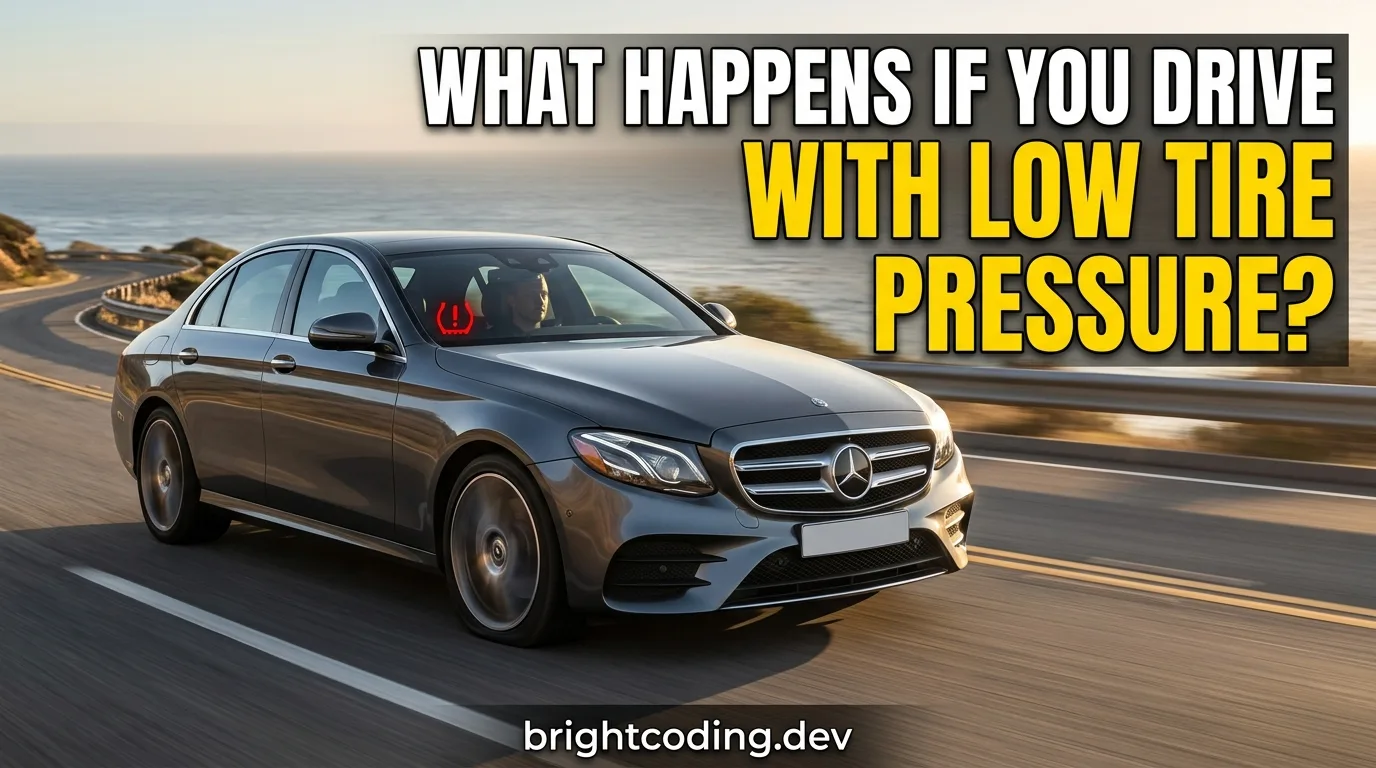
Your car feels a little vague on the highway. Maybe the steering wanders, or there's a faint thrumming you can't quite place. You meant to check the tires last month. You didn't. Now you're wondering whether it's actually a big deal or just one of those things you can ignore until the weekend.
Short answer: it's a bigger deal than most people think, and the damage often happens before you notice anything at all. Driving with low tire pressure costs you fuel, chews through tires, and in the worst cases it can end with you fighting the steering wheel at 70 mph. The good news is that the fix is cheap, fast, and you can do most of it in your own driveway. Let's go through what's actually happening, what it's costing you, and what to do about it today.
What low tire pressure actually does to your car
A tire is a flexible air chamber that carries the entire weight of your vehicle. When it's underinflated, the shape of the contact patch changes. Instead of sitting flat and even on the road, the tire squashes down and the sidewalls bulge outward. That bulge is where the trouble starts.
The sidewall flexes far more than it was designed to, and that flexing generates heat. Heat is the enemy of rubber. It accelerates wear, weakens the internal cords, and in severe cases it causes the tire to fail outright. A tire that's 25 percent underinflated can run dramatically hotter than a properly inflated one, and that heat builds every mile you drive.
You'll feel the effects before you see them. Steering gets heavier or vaguer. Braking distances stretch. The car may pull to one side if only one tire is low. And your fuel economy quietly drops because the engine is working against more rolling resistance.
How low is too low?
There's no single number, because it depends on your car. A typical passenger car runs somewhere in the 30 to 35 psi range, but trucks, SUVs, and EVs vary widely. The correct figure for your vehicle is printed on a sticker in the driver's door jamb, not on the tire sidewall. The sidewall number is the maximum the tire can safely hold, not what your car needs.
As a rough guide: a few psi below spec is worth fixing soon. Ten psi low is a genuine safety concern. Twenty psi low means you should not be driving on it at all except to the nearest air pump, slowly.
Why tires lose pressure in the first place
Tires aren't perfectly sealed. Air escapes slowly through the rubber itself, through the valve stem, and past the bead where the tire meets the rim. A healthy tire can lose one or two psi per month just sitting there. Cold weather makes it worse: pressure drops roughly one psi for every 10°F drop in ambient temperature. That's why your tire warning light tends to come on the first cold morning of autumn.
Then there are the less innocent causes. A nail or screw creates a slow leak that can take weeks to show. A damaged valve stem hisses quietly. A bent or corroded rim lets air escape at the bead. And if you had tires mounted recently, a poor seal can leak from day one.
If your pressure warning light keeps returning after you've topped up, you have a leak, not a mystery. That's when a proper diagnosis pays off. You can start by checking for a stored code with a free OBD code lookup, and if the car is throwing a TPMS-related fault, our guide on reading live sensor data walks through what those numbers mean.
Your options when pressure is low
Top it up yourself
This is the answer 95 percent of the time. Find the recommended pressure on the door jamb sticker, drive to a gas station or use a home compressor, and inflate to spec. Check each tire individually, including the spare if you have one. A decent tire pressure gauge costs very little and lives in your glovebox forever.
The advantage is obvious: it's nearly free and takes ten minutes. The disadvantage is that topping up doesn't fix a leak. If you're back to low pressure in a week, you've got a puncture or a bad seal that needs attention.
Find and fix the leak
If a tire keeps losing air, a tire shop can dunk it in water and spot the bubbles in seconds. A simple puncture in the tread can often be patched from the inside for a modest fee, usually somewhere in the range of what you'd pay for a tank of fuel. A sidewall puncture or a damaged bead is usually not repairable, and you'll be looking at a replacement.
Don't rely on a can of sealant goo as a permanent fix. It's fine as a roadside emergency measure to get you to a shop, but it can gum up the inside of the tire and the TPMS sensor, and many shops charge extra to deal with the mess.
Replace the tire or the sensor
If a tire is worn unevenly from months of low pressure, no amount of air will bring it back. Cupped or feathered tread wears faster and noisier, and it compromises grip. The same goes for a TPMS sensor with a dead battery, which typically lasts around a decade. A new sensor needs to be programmed to the car, which is a shop job on most vehicles.
If you're shopping for replacements, it's worth checking that the new size matches your originals before you buy. Our tire size comparison tool lets you see how a different size changes your speedometer and clearance.
Which option fits your situation
If your light came on this morning and the tires look fine, you're almost certainly dealing with a temperature drop. Top up to spec and move on.
If you're a commuter who checks pressure monthly and it's holding steady, keep doing what you're doing. That's the whole game.
If one tire keeps going soft, stop topping it up and get it inspected. You're throwing money at a problem that will keep coming back until someone finds the leak.
If multiple tires are losing pressure at once, suspect the valve stems or the rims, especially on an older car. And if you're not sure whether the issue is tires or something else entirely, our car symptom finder can help you narrow down what you're actually feeling from behind the wheel.
Step-by-step action plan
- Check pressures cold. Tire pressure should be measured before you've driven more than a mile or two. Driving heats the air and inflates the reading, which hides a real problem.
- Find your spec. Look at the driver's door jamb sticker or the owner's manual. Ignore the number molded into the tire sidewall.
- Measure each tire. Use a quality gauge. Don't trust the one built into a cheap gas station pump.
- Inflate to spec, not to "looks about right." Overinflation wears the center of the tread and reduces grip just like underinflation does.
- Recheck after a week. If any tire has dropped noticeably, you have a leak.
- Get a persistent leak inspected. A tire shop will find it in minutes.
- Reset your TPMS light if your car requires it. Many do this automatically after a few miles of driving; some need a manual reset button or a scan tool.
Safety note: never crawl under a car supported only by a jack, and never attempt to repair a sidewall. If you're inflating a tire that looks visibly flat or has obvious damage, have it inspected before you drive on it at speed.
Mistakes that cost people money
- Trusting the sidewall number. That's the tire's maximum, not your car's recommendation. Use the door jamb.
- Checking pressure when the tires are hot. You'll get an inflated reading and miss a real loss.
- Ignoring a slow leak. A cheap patch today beats a blowout on the interstate tomorrow.
- Overinflating "to be safe." More air is not better. It wears the center tread and cuts your contact patch.
- Using sealant as a permanent repair. It's an emergency tool, not a fix.
- Skipping the spare. A flat spare is useless when you need it most.
- Waiting for the light. By the time the warning triggers, you may already be 25 percent low.
The bottom line
Low tire pressure is one of the cheapest problems to fix and one of the most expensive to ignore. It quietly steals fuel, wears out tires early, and turns a routine drive into a handling risk. The single most important habit you can build is a monthly pressure check with a real gauge, done cold, set to the number on your door jamb. That one habit will save you more money than almost any other maintenance task on your car.
If you want to go deeper on diagnosing odd noises, vibrations, or warning lights that show up alongside tire trouble, browse the step-by-step car guides or ask a specific question through our AI mechanic assistant. And for the full library of owner-focused maintenance advice, the AutoTools blog is a good place to keep reading.
FAQ
Can I drive with a tire that's 10 psi low?
You can, but you shouldn't make a habit of it. At 10 psi below spec you're generating extra heat, wearing the tire faster, and losing fuel economy. Top it up as soon as you can, and if it drops again, find the leak.
Will low tire pressure damage my car?
Yes. The tires wear unevenly and can fail, and the extra rolling resistance makes the engine and drivetrain work harder. Prolonged underinflation can also stress suspension components over time.
How often should I check my tire pressure?
Once a month, plus before any long trip. Check when the tires are cold. If you live somewhere with big temperature swings, check more often in fall and spring.
Why does my tire pressure light come on when it gets cold?
Air contracts as it cools. A drop of 20°F can pull a few psi out of your tires, which is often enough to trip the warning. It's normal, but it still means you should top up.
Can I just add air and keep driving if I have a slow leak?
You can for a while, but you're gambling. A slow leak can turn into a fast one without warning. Get it inspected so you know what you're dealing with.
Related articles
How to Check Your Tire Pressure the Right Way
Checking your tire pressure takes about ten minutes once you know what you are doing, and it is the single cheapest piece of car maintenance you can perform. Get it right and you will feel it in the steering, the fuel gauge, and the life of your tires. Get it wrong and you are either driving on und…
Read the article →
10 Tire Mistakes That Reduce Fuel Economy and Safety
Your tires are the only four things connecting two tons of metal to the road, and they quietly decide how much fuel you burn and whether you stop in time. Most owners ignore them until something feels wrong, and by then the damage is already done to their wallet or their safety.
Read the article →
12 Reasons Your Check Engine Light Might Be On
The light came on at 6:42 on a Tuesday morning, halfway through a left turn onto the highway ramp, and I did what everyone does: I stared at it like it had personally insulted my family.
Read the article →
How to Know When Your Tires Need to Be Replaced
You can check your own tires in about 15 minutes with a coin, a pressure gauge and a flashlight. By the end of this guide you will know how to read tread depth, spot the damage that means "replace now," decode the numbers on your sidewall, and judge whether that slow leak is a cheap fix or a new-ti…
Read the article →
What Does It Mean When Your Car Won't Start?
You turn the key or push the button, and nothing. Or worse, that awful click-click-click. Your stomach drops because you know this is going to cost you time, money, or both.
Read the article →
Why Is My Car Shaking? 8 Common Causes Explained
Your coffee is sitting in the cupholder, and it looks like it's trying to escape. Maybe the steering wheel vibrates at highway speed. Maybe the whole cabin shudders when you brake. Either way, a shaking car is one of those problems you can feel in your teeth, and it never fixes itself.
Read the article →