How to Check Your Tire Pressure the Right Way
Checking your tire pressure takes about ten minutes once you know what you are doing, and it is the single cheapest piece of car maintenance you can perform. Get it right and you will feel it in the steering, the fuel gauge, and the life of your tires. Get it wrong and you are either driving on und…
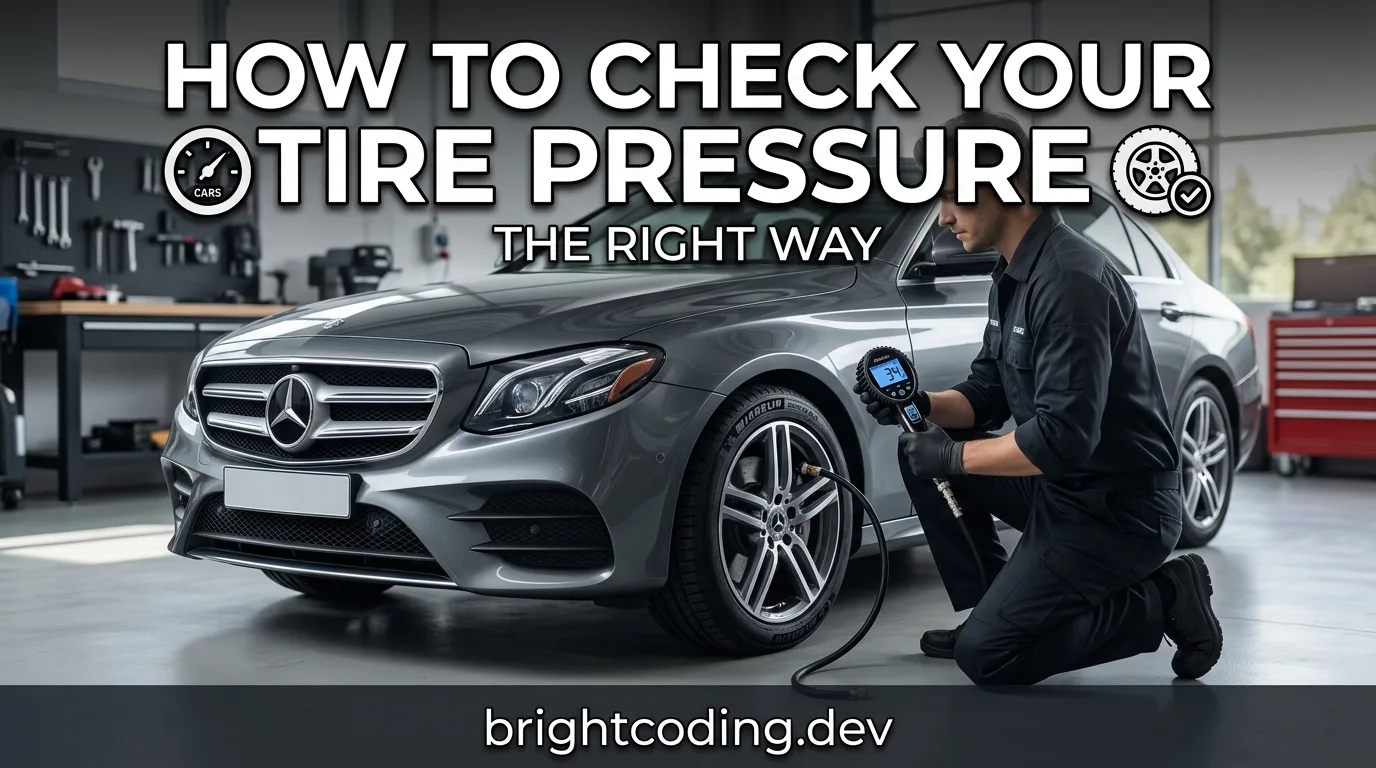
Checking your tire pressure takes about ten minutes once you know what you are doing, and it is the single cheapest piece of car maintenance you can perform. Get it right and you will feel it in the steering, the fuel gauge, and the life of your tires. Get it wrong and you are either driving on underinflated rubber that overheats on the highway, or overinflated tires that wear out in the center and skip across wet roads.
By the end of this guide you will know how to find the correct pressure for your specific car, measure it accurately with a cheap gauge, add or release air, and spot the difference between a slow leak and normal pressure loss. This is a driveway job, not a shop job. Let's do it properly.
What you need before you start
- A tire pressure gauge. A basic stick or digital gauge costs very little and is far more accurate than the sensor on most gas station pumps. Keep one in the glovebox. An inexpensive digital gauge is fine, but a cheap one that reads in 1 PSI increments is worth the few extra dollars.
- An air source. Either a gas station compressor or a small 12V inflator you keep in the trunk. If you have a portable inflator with a built-in gauge, still verify with your handheld gauge. The two rarely agree.
- Your owner's manual, or the driver's door jamb sticker. This is where the real numbers live.
- A valve stem cap, or four. They are cheap and they keep grit out of the valve. If yours are missing, replace them.
- A flashlight if you are checking at night or in a dim garage.
You do not need a torque wrench, a jack, or anything under the car for a basic pressure check. Those come in later if you find a problem.
Step 1: Find the correct pressure for your car, not the tire
Do not use the number molded into the tire sidewall. That maximum-pressure figure is what the tire can safely hold at its limit, not what your car wants. The correct specification is on the driver's door jamb sticker, inside the fuel filler flap, or in the owner's manual.
It will usually list two numbers: a normal load pressure and a higher pressure for a fully loaded car with luggage. It may also list different pressures for front and rear. Use the normal-load figure for everyday driving.
One important exception: if your car has a space-saver spare, the pressure for that is usually much higher than the road tires, often printed right on the spare itself. Check it too while you are at it.
Step 2: Check the tires cold
"Cold" means the car has been sitting for at least three hours, or you have driven less than a mile or two at low speed. Driving heats the air inside the tire and raises the pressure reading by several PSI. If you check a hot tire and set it to the cold spec, you will actually be running underinflated.
If you must check hot, expect the reading to be higher. Tire engineers commonly suggest adding roughly 4 PSI above the cold spec as a hot-fill target, but check your owner's manual rather than trusting a number from the internet. The cold reading is the one that matters.
Step 3: Remove the valve cap and press the gauge on straight
Unscrew the valve cap and keep it somewhere you will not lose it, like your pocket. Push the gauge onto the valve stem firmly and squarely. You will hear a short hiss of escaping air. That is normal. Press until the hiss stops and the gauge gives you a reading.
If you get no reading, you are not seated properly. If you get a wildly low reading and hear continuous hissing, the gauge is not on straight. Pull it off and try again.
A quick tip: check all four tires before you add any air. Write the numbers down. This gives you a baseline and tells you whether one tire is the odd one out.
Step 4: Compare each reading to the spec and top up as needed
Add air in short bursts and re-check after each one. It is much easier to add air than to remove it. If you overshoot, press the small metal pin in the center of the valve stem with the tip of your gauge or a fingernail to bleed air out, then re-check.
If you are using a gas station compressor, the gauge on the hose is often inaccurate. Use it to get close, then confirm with your own gauge. Do not walk away trusting the machine.
Note that tires naturally lose a small amount of pressure over time, often around 1 PSI per month in cool weather, and more when temperatures drop sharply. A sudden 10 PSI drop on one tire is not normal loss. That is a leak, and you should read on.
Step 5: Look for the reason if one tire keeps dropping
If the same tire is low every time you check, you have a slow leak. Common causes are a nail or screw in the tread, a leaking valve stem, a corroded wheel bead, or a damaged valve core. Run your hand around the tread and sidewall (carefully, in case of a screw) and look for anything embedded. A spray bottle of soapy water brushed onto the valve stem and bead will bubble if air is escaping there.
If you find a puncture in the tread, a reputable tire shop can usually plug or patch it for a modest fee, often less than the cost of a new tire. A sidewall puncture or bulge is not repairable. That tire needs replacing. If your car has a tire pressure monitoring system (TPMS) light on, that is a separate system from your manual check, and it can be triggered by a failing sensor as well as low pressure. If a warning light is nagging you and you want to understand what the car is telling you, the free OBD code lookup at /obd can help you decode the fault.
Safety: before you go any further
Everything above is done with the car parked and the engine off. If you are going to jack the car up to inspect a tire or rotate wheels, do it on flat, solid ground, set the parking brake, and use proper jack stands. Never work under a car supported only by a jack. That is how people get hurt.
If you are checking pressures on a car that has just been driven hard, be aware that brake discs and drums get very hot. Do not touch them. Let things cool before you put your hands near the wheels.
Step 6: Reset or relearn the TPMS if needed
Many cars need you to re-set the tire pressure monitoring system after you adjust pressures. Some do it automatically after a few minutes of driving. Others need a button press, or a specific relearn procedure listed in the owner's manual. If your light stays on after you have set all four tires correctly, consult the manual before assuming a sensor has failed.
If you want to watch live data from your car while you drive, including things like wheel speed and other sensor readings, the OBD live-data tool at /tools/obd-live-data is a good place to start. It will not read tire pressure directly on most cars, but it helps you understand what your vehicle is reporting.
Step 7: Re-check after a big temperature swing
Tire pressure tracks ambient temperature. A cold snap of 20 degrees Fahrenheit can knock several PSI off your tires overnight. This is why the TPMS light often comes on the first cold morning of the season. Check and adjust after the first real cold snap, and again when a heat wave hits, since pressure rises with heat too.
Pro tip: check pressures the same way every time. Same gauge, same conditions, same order of tires. Consistency is what catches a slow leak before it becomes a flat on the highway.
Pro tips
- Buy two gauges. Keep one in the car and one in the garage. When a reading looks odd, compare. If they disagree by more than a pound or two, one is lying to you.
- Check the spare. A flat spare is useless. Check it every few months. It is the tire everyone forgets until they need it.
- Watch the sidewall for cracking. Pressure is only half the story. UV and age degrade rubber. If the sidewalls are cracked or the tires are old, pressure checks will not save them.
- Use a tread depth gauge or a coin. Low pressure causes uneven wear. If the outer edges of a tire are worn more than the center, you have been running underinflated. The free car tools at /tools include handy references to keep in your glovebox routine.
- Do it monthly, not annually. Once a month takes ten minutes. A blowout at speed does not. If you want a broader maintenance rhythm, the step-by-step car guides at /guides walk you through the rest of the basics.
- Learn your car's personality. Some cars are fussy about a 2 PSI difference. Others barely notice. After a few checks, you will know what yours likes.
Common pitfalls
Using the sidewall number. This is the most common mistake. The sidewall shows the tire's maximum, not your car's recommended pressure. Use the door jamb sticker or manual.
Checking when hot. A hot tire reads high. If you set it to the cold spec while hot, you will be underinflated. Check cold, or use the hot-fill rule in your manual.
Trusting the gas station gauge. Those hoses get dropped, kicked, and frozen. They drift. Always confirm with your own gauge.
Ignoring one tire that keeps dropping. If you keep topping up the same tire, you have a leak. Find it now, before it strands you. If you are not sure what is causing a warning light or odd behavior, the AI mechanic assistant at /tools/ai-assistant can help you think through the symptoms in plain language.
Forgetting the valve caps. Dirt and moisture get into the valve core without a cap. The core leaks, and you blame the tire. Replace missing caps.
Useful resources
- Your owner's manual, or the door jamb sticker. This is the only source that matters for your specific car.
- A reputable tire shop for free or low-cost pressure checks and puncture repairs.
- The mechanical encyclopedia at /encyclopedia if you want to understand how a tire, wheel, and TPMS system actually work together.
- The car symptom finder at /symptom when a warning light or odd noise has you guessing.
- The AutoTools blog at /blog for more plain-English maintenance walkthroughs.
FAQ
How often should I check my tire pressure? Once a month is the standard advice, plus before any long road trip and after a big temperature swing. It takes about ten minutes.
Can I check my tires when they are hot? Yes, but the reading will be higher than the true cold pressure. If you must fill hot, use the hot-fill guidance in your owner's manual rather than the cold spec.
Why does my TPMS light come on when my tires are fine? Cold weather, a failing sensor, or a slow leak can all trigger it. Check pressures manually first. If they are correct, the sensor may need attention.
Should I use nitrogen instead of air? Nitrogen loses pressure more slowly and is less affected by temperature, but it is not a magic fix. Regular air from a compressor is fine for most drivers. Just check your pressures regularly either way.
What pressure should I use for a heavy load? Your door jamb sticker or manual will list a higher pressure for a fully loaded car. Use that figure when you are carrying a lot of weight or towing.
One last thing
Checking your tire pressure is the kind of small habit that quietly saves you money and keeps you safe. Ten minutes a month. A cheap gauge in the glovebox. That is the whole secret. Do it today, and you will wonder why you ever put it off.
If you want to go deeper into car maintenance and understand what your vehicle is telling you, the expert car tips at /tips and the mechanic quiz at /quiz are good next stops. Get out there and check those tires.
Ready to act on what you just read? Decode that warning light with the free OBD code lookup, run the matching car tools to check the numbers yourself, or browse more practical car articles for ideas.
Related articles
What Happens If You Drive With Low Tire Pressure?
Your car feels a little vague on the highway. Maybe the steering wanders, or there's a faint thrumming you can't quite place. You meant to check the tires last month. You didn't. Now you're wondering whether it's actually a big deal or just one of those things you can ignore until the weekend.
Read the article →
10 Tire Mistakes That Reduce Fuel Economy and Safety
Your tires are the only four things connecting two tons of metal to the road, and they quietly decide how much fuel you burn and whether you stop in time. Most owners ignore them until something feels wrong, and by then the damage is already done to their wallet or their safety.
Read the article →
12 Reasons Your Check Engine Light Might Be On
The light came on at 6:42 on a Tuesday morning, halfway through a left turn onto the highway ramp, and I did what everyone does: I stared at it like it had personally insulted my family.
Read the article →
How to Know When Your Tires Need to Be Replaced
You can check your own tires in about 15 minutes with a coin, a pressure gauge and a flashlight. By the end of this guide you will know how to read tread depth, spot the damage that means "replace now," decode the numbers on your sidewall, and judge whether that slow leak is a cheap fix or a new-ti…
Read the article →
What Does It Mean When Your Car Won't Start?
You turn the key or push the button, and nothing. Or worse, that awful click-click-click. Your stomach drops because you know this is going to cost you time, money, or both.
Read the article →
Why Is My Car Shaking? 8 Common Causes Explained
Your coffee is sitting in the cupholder, and it looks like it's trying to escape. Maybe the steering wheel vibrates at highway speed. Maybe the whole cabin shudders when you brake. Either way, a shaking car is one of those problems you can feel in your teeth, and it never fixes itself.
Read the article →