5 Warning Signs Your Car Needs a Diagnostic Check Right Now
Your car sends signals before major failures strike. From blinking dashboard lights to strange new sounds, here are five warning signs that demand a diagnostic check—and how free tools can save you thousands.
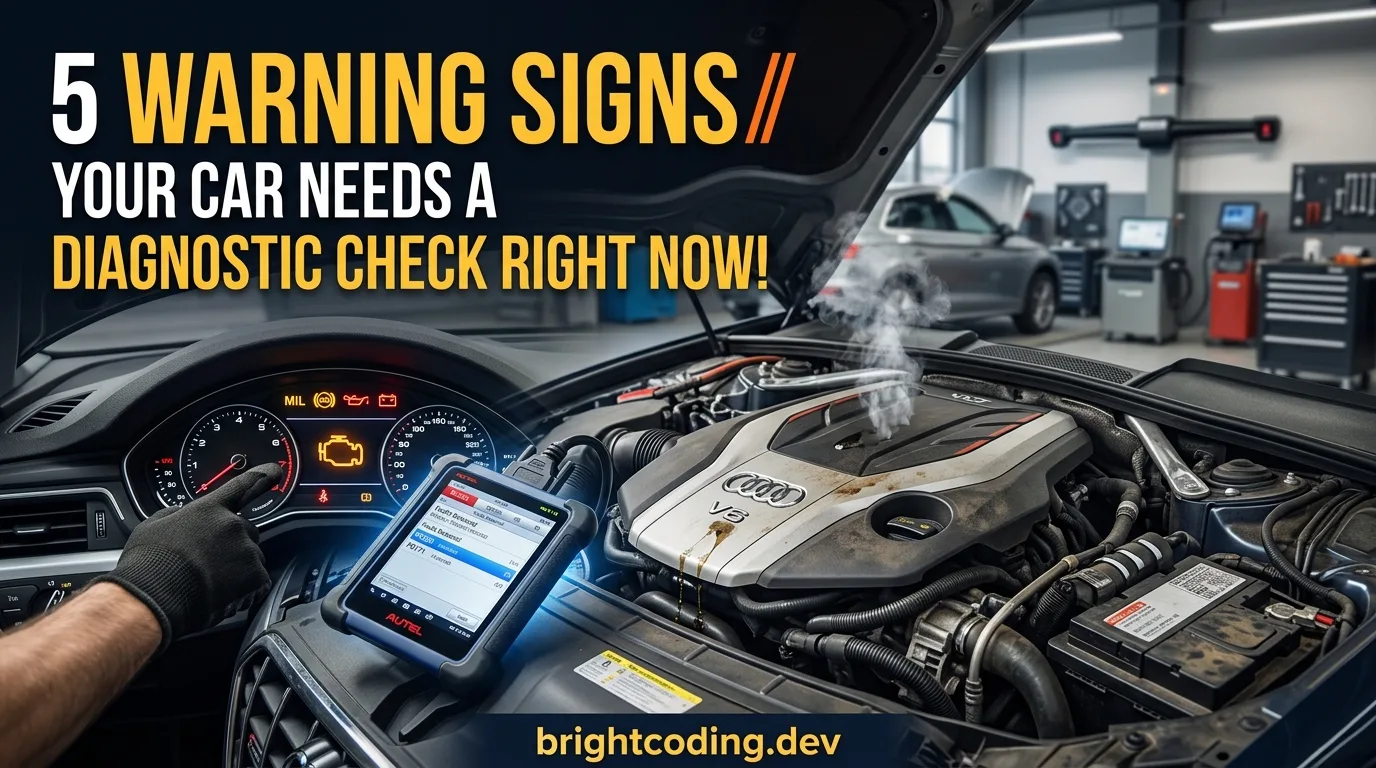
The Dashboard That Cried Wolf—Until It Didn't
Maya Chen was running late for a client meeting in downtown Austin when her 2019 Honda CR-V did something it had never done before. The check engine light flickered on, then off, then on again—like a faulty streetlamp at dusk. She tapped the dash. She turned the radio down, as if silence might fix it. It didn't. She drove the remaining twelve miles telling herself it was probably nothing. Three days later, she was staring at a $2,400 repair bill for a catalytic converter that had been failing in slow motion, sending silent damage through her exhaust system.
Here's the part that stings: her mechanic said a $45 diagnostic scan would have caught it early. The warning signs were there. She just didn't know how to read them.
Most drivers treat their cars like refrigerators—silent, reliable appliances that only demand attention when something goes catastrophically wrong. But modern vehicles are closer to rolling computers, generating thousands of data points per second. When something shifts, your car is often trying to tell you. The question is whether you're listening.
The Big Question: Is Your Car Trying to Warn You?
Every day, millions of drivers ignore subtle signals because they seem too small to matter. A faint rattle. A slightly rough idle. A light that comes and goes. These aren't quirks. They're data. And in the world of automotive repair, early data is the difference between a $120 sensor replacement and a $3,000 engine rebuild.
So what should you actually worry about? When does "probably fine" become "get it checked today"? And how do you separate expensive imagination from genuine mechanical distress?
The answers matter more than ever. With average vehicle ages hitting a record 12.5 years in the United States, more people are driving cars deep into their mechanical lifespans. Maintenance isn't optional anymore—it's survival.
The Backstory: Why Cars Whisper Before They Scream
For decades, diagnosing car trouble required intuition. Mechanics listened to engines, smelled fluids, felt vibrations. Today, your vehicle's onboard computer—formally called the Engine Control Module, or ECM—monitors everything from oxygen levels in your exhaust to the precise timing of your fuel injectors. When something drifts outside factory parameters, the ECM logs a diagnostic trouble code, or DTC.
These codes are the foundation of modern automotive diagnostics. A technician plugs in a scan tool—often an OBD-II reader—and the car essentially reports what's wrong. Some codes indicate imminent failure. Others flag conditions that could become serious. The problem? Not every issue triggers the check engine light immediately. Some problems simmer. And by the time the light stays on, damage may already be spreading.
This is where driver awareness becomes your first line of defense. You don't need to be a mechanic. You just need to recognize when your car's behavior has changed.
What Happened: The Five Warning Signs You Can't Ignore
1. The Check Engine Light Is Blinking—or Behaving Strangely
A steady check engine light usually means something needs attention soon. A blinking check engine light means something needs attention now. That rapid flash typically indicates an active misfire—raw fuel is entering your catalytic converter, where it can overheat and destroy a component that often costs $1,000 to $2,500 to replace.
But what about the light that appears for a day, vanishes for a week, then returns? Intermittent codes are some of the most dangerous because they lull drivers into complacency. The problem hasn't gone away. The conditions simply haven't aligned to trigger it again.
If your light is doing anything other than staying quietly off, your car has something to say. Tools like the Interactive Car Diagnostic at AutoTools can help you narrow down likely causes before you ever reach a shop. You answer guided questions about symptoms, and the tool points you toward the most probable culprits—no mechanical degree required.
2. Your Car Has Developed a New Sound
Cars have acoustic personalities. You know your engine's idle note, your exhaust's hum, your suspension's thud over potholes. When that soundtrack changes, pay attention.
A high-pitched whine under the hood often signals a failing belt or bearing. A rhythmic clicking that speeds up with acceleration could mean a valve train issue or exhaust leak. Knocking from deep in the engine—especially under load—is the sound of detonation, and it can destroy pistons if ignored.
Then there's the sound you can't quite place. The one that only happens at 45 miles per hour, or when the AC is running, or on cold mornings. These are the sounds that drive owners to distraction because they're impossible to describe to a mechanic.
This is where technology can bridge the gap. The Sound Diagnostic Assistant lets you record your engine noise and matches it against likely causes. Instead of saying "it kind of rattles, but only sometimes," you can present a recording and a structured analysis. That specificity saves diagnostic time—and diagnostic money.
3. Performance Has Dropped Without Explanation
Your car used to leap off the line at green lights. Now it hesitates. The highway merge that felt effortless last month now requires planning and prayer. Fuel economy has slipped from 28 miles per gallon to 23, and you haven't changed your driving habits.
Performance degradation is often gradual, which makes it insidious. You adapt without realizing. But the underlying causes are rarely benign. Clogged fuel injectors, failing mass airflow sensors, restricted catalytic converters, or ignition coil degradation can all sap power while hiding behind vague symptoms.
The financial math is worth considering. A diagnostic scan might cost $40 to $100 at a shop, or nothing if you use a basic Bluetooth OBD-II reader at home. Replacing a mass airflow sensor runs $150 to $400. Driving with a failing one for months can foul your spark plugs, damage your catalytic converter, and drop your fuel economy by 15 to 25 percent. The cost of ignoring the problem compounds faster than credit card interest.
For drivers who want to understand what their car's computer is actually seeing, Live OBD PID Data provides real-time engine metrics—RPM, coolant temperature, mass airflow readings, engine load, battery voltage—displayed as live charts. Watching these values while you drive can reveal patterns no dashboard light will show you.
4. You Smell Something That Doesn't Belong
Your nose is an underrated diagnostic tool. Burning oil often means a leak dripping onto hot exhaust components—a fire risk as much as a mechanical one. A sweet, syrupy odor points to coolant leaking somewhere in the system, potentially from a failing head gasket. The smell of rotten eggs usually means your catalytic converter is struggling to process exhaust gases, often because it's overheating or contaminated.
Gasoline odors inside the cabin are especially urgent. They can indicate a fuel leak in lines, injectors, or the tank itself. This isn't a next-week problem. This is a pull-over-and-call-a-tow-truck problem.
Fluid leaks leave visual evidence, but not always where you park. Small leaks may burn off on hot engine surfaces before reaching the ground. Your nose catches what your eyes miss.
5. The Steering, Braking, or Handling Feels Different
Modern cars isolate drivers from road feel more than ever, which makes any change in steering weight, brake pedal response, or cornering behavior significant. A brake pedal that sinks lower than usual could indicate air in the brake lines or master cylinder failure. Steering that suddenly feels loose or wanders on the highway might mean worn tie rods, failing ball joints, or alignment issues that are eating your tires alive.
Vibration under braking—especially through the steering wheel—usually signals warped brake rotors. It's not immediately dangerous, but it strains suspension components and extends stopping distances. Vibration at highway speeds that smooths out when you let off the gas? That's often a driveshaft or CV joint issue, and at 70 miles per hour, you don't want to discover its limits the hard way.
The Photo Diagnostic Assistant offers a practical approach here. You photograph your brake pads, rotors, tires, or fluid leaks, and the tool walks you through an inspection checklist. It's not a replacement for a professional evaluation, but it gives you vocabulary and visual references to have an informed conversation with your mechanic.
The Turning Point: Diagnostics Have Gone Democratized
Here's what has changed in the last five years, and why it matters for your wallet.
Professional-grade diagnostic equipment used to cost thousands of dollars and live exclusively in dealership service bays. Today, a competent Bluetooth OBD-II adapter costs $20 to $60. Paired with the right software, it can read the same codes a shop sees. Free platforms like AutoTools have aggregated calculators, code lookups, and guided diagnostics into mobile-friendly toolkits that require no account, no subscription, and no mechanical background.
This democratization doesn't mean you should replace your mechanic with an app. It means you can arrive at the shop informed. You can distinguish between a $150 oxygen sensor and a $1,500 catalytic converter. You can catch problems in the window where they're still cheap to fix.
The average American spends roughly $1,200 per year on car maintenance and repairs, according to industry data. Drivers who ignore early warning signs until catastrophic failure often spend two to three times that. The diagnostic mindset—treating small changes as data rather than annoyances—is the single most effective way to bend that curve downward.
What It Means: The Shop vs. The Driveway
There are two schools of thought emerging among car owners, and both have merit.
The traditional approach says: leave diagnostics to professionals. They have the training, the lifts, the scopes, and the liability insurance. This is still true for complex issues involving internal engine components, transmission rebuilds, or electrical gremlins that require circuit-by-circuit tracing.
The emerging approach says: use accessible tools to monitor your own vehicle, understand baseline behavior, and catch deviations early. This doesn't replace the shop. It extends your awareness into the weeks between services.
The smartest drivers do both. They use free resources like the OBD-II Code Lookup to understand what a code means before panicking. They run through the Maintenance Checklist before long trips. They know that a P0301 code means "cylinder one misfire" and that it could be a spark plug, a coil, a fuel injector, or a compression issue—but at least they know where the conversation starts.
The Bigger Picture: Older Cars, Tighter Budgets, Smarter Ownership
Economic pressure has extended vehicle lifecycles across every income bracket. New car payments averaging $725 per month have pushed buyers toward keeping what they have. The result is a fleet of older vehicles that need more attentive care, not less.
This shift has created a parallel demand for transparent, accessible automotive information. Drivers want to understand what they're paying for. They want to know whether a recommended repair is urgent or elective. They want to avoid the anxiety of sitting in a waiting room, wondering if they're being sold unnecessary work.
Diagnostic transparency is becoming a form of consumer protection. When you can verify a code independently, research likely causes, and understand ballpark repair costs, you enter the service bay as a participant rather than a target.
Platforms like AutoTools represent this shift—offering 42+ free calculators, 208+ OBD code explanations, and guided diagnostics without extracting your email address or selling your data. The business model is straightforward: useful tools funded by non-intrusive advertising. For drivers who remember the era of paywalled repair manuals and $100 dealership diagnostic fees, this openness feels almost radical.
What Readers Should Remember
- A blinking check engine light is an emergency. A steady one is a conversation. Either way, your car is talking. Listen.
- New sounds, smells, or sensations are data. Your baseline matters. Any deviation deserves attention, even if it seems minor.
- Diagnostics are cheaper than repairs. A $40 scan today can prevent a $2,400 repair next month. The math is unforgiving.
- Free tools exist. You don't need to be a mechanic to understand what your car is reporting. Guided diagnostics, OBD code lookups, and live data readers have removed the expertise barrier.
- Performance degradation is a symptom, not a personality change. If your car feels different, something has changed. Assume mechanical cause before writing it off.
FAQ
How much does a car diagnostic check typically cost?
At a repair shop or dealership, expect $40 to $120 for a basic OBD-II scan. Some shops waive this fee if you proceed with the repair. For home diagnostics, a Bluetooth OBD-II adapter costs $20 to $60, and platforms like AutoTools provide free code lookups and guided troubleshooting.
Can I drive with the check engine light on?
A steady light usually means you can drive short distances, but you should schedule diagnostics within a few days. A blinking light means active misfire and potential catalytic converter damage—reduce speed, avoid heavy acceleration, and get to a shop immediately.
What if my check engine light turns off by itself?
An intermittent light suggests an intermittent problem. The issue hasn't resolved; the conditions simply haven't triggered the sensor threshold. These are worth investigating because intermittent electrical or sensor issues often worsen unpredictably.
Are free online diagnostic tools accurate?
Quality varies, but established platforms like AutoTools provide educational guidance based on symptom patterns and factory diagnostic logic. They're excellent starting points. Final diagnosis should always be confirmed by physical inspection and professional measurement.
How do I know if a mechanic's recommended repair is actually necessary?
Get the specific diagnostic code. Research it independently. Ask the mechanic to explain how they verified the failure—did they use live data, physical inspection, or component testing? A trustworthy shop welcomes informed questions.
Related articles

12 Winter Car Tips That Could Save You From Getting Stranded
Cold weather exposes every weak point in a car at once. A battery that cranks fine in July can quit at 10°F, summer tires turn into hockey pucks, and a half-empty gas tank can leave you stranded in a ditch. This article answers the winter questions people actually search for, then goes deeper on ea…
Read the article →
The Best Way to Keep Your Car Cool During Extreme Summer Heat
Your steering wheel is hot enough to brand cattle, the air conditioning is blowing lukewarm air, and the temperature gauge is creeping past where it usually sits. If that sounds like your July commute, you are not imagining things. Extreme heat is genuinely hard on cars, and the ways to keep yours…
Read the article →
How to Save Money on Car Repairs Without Taking Risks
Here's the honest version up front: most common repairs land somewhere between $150 and $1,200 when you pay a shop, and a few big-ticket jobs (timing belts, clutches, head gaskets) can run past $2,000. That range is wide on purpose. Your make and model, where you live, and whether you walk into a d…
Read the article →
15 Easy Ways to Improve Your Car's Fuel Efficiency
The needle on my fuel gauge dropped a full eighth of a tank between my driveway and the grocery store six miles away. That's not right. I stood in the parking lot with my hand still on the pump handle from the day before, doing math in my head, and the math was bad. My aging sedan had been drinking…
Read the article →
What Happens If You Ignore Your Check Engine Light?
That amber engine icon is the most ignored warning in motoring. It comes on, nothing explodes, so you keep driving. A week later it's still there. A month later you've stopped seeing it.
Read the article →
10 Dashboard Warning Lights You Should Never Ignore
Your dashboard isn't trying to annoy you. It's the only part of the car that talks to you in plain language — and it's often the cheapest warning you'll ever get. Ignore the wrong one and a $150 repair becomes a $2,000 repair, or a breakdown on the shoulder of a highway at 11 p.m.
Read the article →