10 Tire Mistakes That Reduce Fuel Economy and Safety
Your tires are the only four things connecting two tons of metal to the road, and they quietly decide how much fuel you burn and whether you stop in time. Most owners ignore them until something feels wrong, and by then the damage is already done to their wallet or their safety.
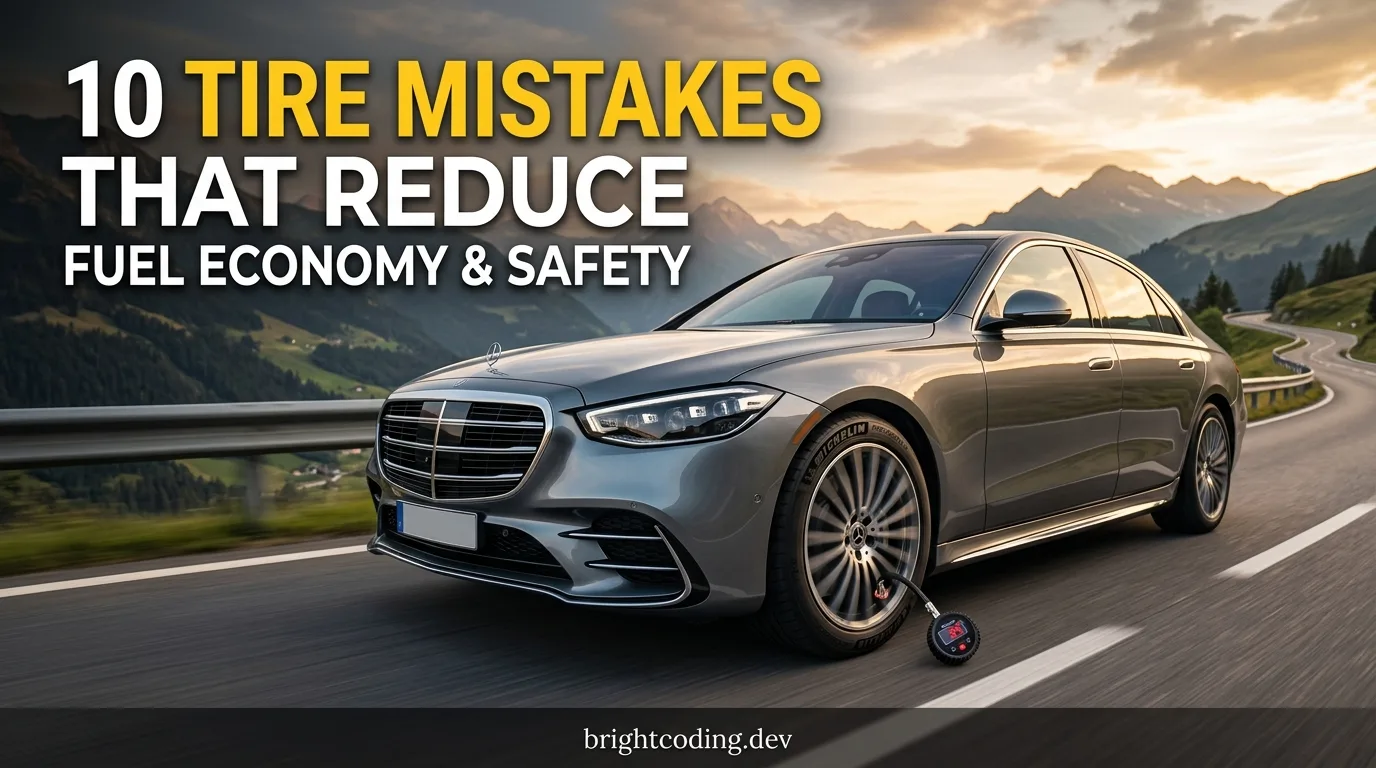
Your tires are the only four things connecting two tons of metal to the road, and they quietly decide how much fuel you burn and whether you stop in time. Most owners ignore them until something feels wrong, and by then the damage is already done to their wallet or their safety.
This isn't a lecture about checking pressure once a month. It's the stuff that actually goes wrong, why smart people keep doing it, and what it costs you.
Why most people get this wrong
Tires are boring until they aren't. They don't flash a warning light when they're a little soft, a little worn, or a little mismatched. The car still drives. So you keep driving.
Dealerships and tire shops have their own incentives too. Some push rotations you don't need, others skip the pressure check entirely and hand you the keys. You assume the pros handled it. Often they didn't.
Then there's the internet. Half the advice out there is from someone who read a forum post in 2009 and repeats it like gospel. The basics haven't changed much, but the details matter more than people admit. Let's fix that.
1 - Running the wrong pressure because the sidewall said so
You look at the tire, see "MAX 44 PSI," and pump it to 40 because it's close enough. That number is the tire's limit, not your car's recommendation. Your owner's manual or the sticker in the driver's door jamb has the real target, and it's often in the low 30s.
People make this mistake because the sidewall number is right there and the door sticker is hidden under grime. Overinflating wears the center of the tread and makes the ride harsh. Underinflating wears the edges, kills fuel economy, and builds heat that can cause a blowout on a hot highway.
Check the door jamb, not the tire. If the sticker is gone, look up your model or ask a shop to confirm the spec.
2 - Chasing "eco" pressure numbers
Some drivers hear that higher pressure means better fuel economy and start running 5 PSI over spec. Technically, less rolling resistance does save a little fuel. Realistically, you're trading pennies for uneven wear and a skittish feel in the rain.
The gain is small, maybe a fraction of a mile per gallon in most cases, and it vanishes the moment your tires wear out early. Stay within a couple PSI of the manufacturer's number. That's the sweet spot, not a conspiracy.
3 - Ignoring pressure because the tire "looks fine"
A tire can be 25 percent low and still look normal to the eye. This is the single most common thing I see. People trust their eyes instead of a gauge.
Low pressure increases rolling resistance, which means the engine works harder for every mile. It also generates heat, and heat is what destroys tires from the inside. A slow leak from a nail or a bad valve stem can drop you several PSI a week without any obvious symptom.
Buy a decent gauge and use it when the tires are cold, before you've driven more than a mile or two. If one tire keeps losing air, get it checked rather than topping it up forever.
4 - Checking pressure when the tires are hot
You pull into a gas station after a 40 minute drive and the gauge reads 38 when the spec says 33. So you bleed air out. Bad move.
Driving heats the air inside the tire and raises the pressure. If you set it hot, you'll be underinflated once things cool down. Set pressures cold, in the morning or after the car has sat for a few hours.
If you must add air on a hot tire, add a little and recheck cold later. Don't dump air out based on a hot reading.
5 - Skipping rotations until the wear pattern screams
Front tires on most cars wear faster than the rears because they steer and take more of the braking load. Skip rotations and you end up with two worn tires and two decent ones, which is both a handling problem and a money problem.
People skip it because it's an extra trip and it feels optional. It isn't. Regular rotation, roughly every 5,000 to 8,000 miles depending on your car and driving, spreads the wear so all four wear out together. That means one tire purchase instead of two staggered ones.
Check your manual for the interval and the correct rotation pattern. Some performance cars with directional or staggered tires can't be rotated the usual way, so confirm before you assume.
6 - Mixing tire types or sizes across the car
You blew a sidewall and the shop only had two of your exact model in stock, so you put a different brand on the front. Now the car pulls slightly and the ABS feels odd in the wet.
Mismatched tires, whether by brand, tread depth, or size, can confuse traction control and ABS because the wheels are rolling at slightly different rates. That's the kind of thing that turns a routine stop into a surprise. If you have to replace just one or two, keep them on the same axle and match as closely as you can. Better yet, replace all four if the others are more than a few 32nds worn.
Before buying, compare what you have against the factory spec so you don't end up with a size that throws off your speedometer. The tire size comparison tool makes that quick.
7 - Letting alignment and suspension problems eat the tread
Your tires are the messenger. If the car pulls to one side, the steering wheel sits off center, or the inner edges of the front tires are chewed down to the cords, you have an alignment or suspension issue, not a tire issue.
People blame the tires and buy new ones, then watch the same wear pattern return in 10,000 miles. That's an expensive loop. A worn tie rod, a bent control arm, or simply knocked-out alignment from a pothole will do it.
If you see cupping, feathering, or a bald strip on one edge, get the alignment checked and have a shop look at the suspension before you spend on rubber. The car symptom finder can help you sort out whether a pull is alignment, a dragging brake, or something else.
8 - Driving on tires past their real limit
Tread depth gets all the attention, but age and heat matter too. Rubber hardens over time, and a tire with plenty of tread can still be unsafe if it's been baking in the sun for years or has internal damage from a bad pothole hit.
The wear bars tell you when you're at the legal minimum, but you don't want to wait for that. Grip in the wet drops off well before the bars show. If you can see the bars, you're already past the point where you should have replaced them.
Also watch for bulges, cuts, and objects stuck in the tread. A bubble on the sidewall means the internal structure is compromised. Replace it. Don't drive on it and hope.
9 - Ignoring the warning signs your car is already giving you
Vibration at highway speed, a thumping noise, a shimmy through the steering wheel. These are tire and wheel complaints, but drivers often lump them into "the car feels weird" and wait.
Some of these are tire balance issues, some are a bent wheel, and some are a brake or suspension problem masquerading as a tire issue. A TPMS light isn't just a nuisance either. If it's on, something is wrong with pressure or the sensor, and ignoring it means you're driving blind.
If a warning light or odd behavior shows up, scan it instead of guessing. The free OBD code lookup will tell you what the car is actually complaining about, and the OBD live-data tool can show you things like wheel speed readings that point to a specific corner.
Do this instead
Check pressures cold, once a week or before any long drive, using the door jamb number. Rotate on schedule. Fix alignment and suspension problems before they chew through new tires. Replace tires in matched sets when you can, and never ignore a bulge, a pull, or a warning light.
Keep a gauge in the glovebox. It costs less than a fast-food lunch and it will save you far more than that over the life of the car. If you want more of these practical habits in one place, the expert car tips section is worth a browse.
FAQ
How often should I really check tire pressure? Once a week is ideal for most drivers, or at least before any long trip. If you have a slow leak, check daily until you find the cause. Cold mornings are the best time.
Does tire pressure actually affect fuel economy? Yes, but the effect is modest unless you're badly underinflated. A tire that's 10 PSI low will cost you fuel and wear faster. Chasing pressures well above spec saves a tiny amount and causes other problems.
Can I replace just one tire? You can, but try to match the brand, model, and tread depth of the others, and keep it on the same axle as a similar tire. On AWD cars, mismatched tread depth can stress the drivetrain, so check your manual first.
When do tires need replacing besides tread wear? Look for sidewall bulges, cracks, exposed cords, or repeated leaks. Age matters too, even with good tread. If you're unsure, have a shop inspect them rather than guessing.
My TPMS light is on. Is it urgent? Treat it as urgent until you know why. It could be a slow leak or a dead sensor. Check pressures first, then investigate the sensor if the pressures are fine.
Fix the boring stuff and the expensive stuff takes care of itself.
Related articles
12 Reasons Your Check Engine Light Might Be On
The light came on at 6:42 on a Tuesday morning, halfway through a left turn onto the highway ramp, and I did what everyone does: I stared at it like it had personally insulted my family.
Read the article →
How to Know When Your Tires Need to Be Replaced
You can check your own tires in about 15 minutes with a coin, a pressure gauge and a flashlight. By the end of this guide you will know how to read tread depth, spot the damage that means "replace now," decode the numbers on your sidewall, and judge whether that slow leak is a cheap fix or a new-ti…
Read the article →
What Does It Mean When Your Car Won't Start?
You turn the key or push the button, and nothing. Or worse, that awful click-click-click. Your stomach drops because you know this is going to cost you time, money, or both.
Read the article →
Why Is My Car Shaking? 8 Common Causes Explained
Your coffee is sitting in the cupholder, and it looks like it's trying to escape. Maybe the steering wheel vibrates at highway speed. Maybe the whole cabin shudders when you brake. Either way, a shaking car is one of those problems you can feel in your teeth, and it never fixes itself.
Read the article →
10 Car Noises You Should Never Ignore
Your car talks to you constantly. Most of the time it's mumbling, and you tune it out like a radio ad. Then one day it screams, and you're staring at a repair bill that could have been a $40 part three months ago.
Read the article →
Composants d'un moteur de voiture : guide complet des pièces, fonctions, problèmes et solutions
Le moteur thermique est le cœur de la voiture. Il transforme le carburant en énergie mécanique grâce au cycle à quatre temps : admission, compression, combustion et échappement. Il est composé de nombreuses pièces essentielles comme le bloc moteur, la culasse, les pistons, le vilebrequin, les arbres à cames, les soupapes, ainsi que les systèmes d’admission, d’allumage, de lubrification et de refroidissement.
Read the article →